INTERVIEW: MCLEAN FAHNESTOCK
JAN. 27, 2026
INTERVIEW: MCLEAN FAHNESTOCK
JAN. 27, 2026
Rachel Bubis: You’ve spoken about how your grandfather and great-uncle’s roles as explorers shaped your thinking around desire, land, and ownership. I’m curious whether those ideas were ever part of your conversations with them, or whether they were aware of how their histories informed your work.
McLean Fahnestock: Both my grandfather and great uncle died before I was born. So, their influence on my work has come through my family’s, especially my grandmother’s, remembrances of the expeditions and the importance that she assigned to legacy. She placed a heavy emphasis on family legacy and greatness. I didn’t start to work with the expeditions in my artistic research until several years after she died, which I feel gave me permission to look at the expeditions more objectively. Even without her to talk to, there were books and other ephemera to turn to for reseach as well as my dad as a source.
As I have traveled and researched into their exploration, looked into the archives at the American Museum of Natural History’s Ornithology department, the National Archives, and visited the site of their wreck with the Australian Coast Guard, I uncovered inconsistencies in their story, even their published accounts, which I brought back to my family and that has also made its way into my work. I have a second-row seat to World War II era tales of adventure, and enough of a view into the wings to see the people behind the curtain pulling the strings as it were.
I don’t work as overtly with their expeditions any longer, not in direct reference, but it is really in the bedrock of my work.
RB: In Breathing in the Insubstantiation, you physically manipulate images during the scanning process, altering familiar calendar imagery. Are the results largely intuitive, or does the work involve a great deal of trial and error? Some of the imagery - like the sun resembling a bomb - feels especially charged.
MF: Those works, that series, are the record of the collision of movement. I think that is why I like them so much. They really are time-based works. It took a lot of trial and error to create the right timing, where the scanner lens wasn’t moving too fast are too slow and where I could move along with it, sliding the calendar page on the glass, back and forth, or against, to create the images. What is captured is, if you read it from top to bottom, about three minutes of me helping a machine experience a landscape. Look here, look here, look again. I would do it again and again until the image was right and the lens lingered where I wanted it to. It is about the formal aspects of the image being right, but also about the conceptual ones too.
The original images, since they came from Dollar Tree calendars that I have collected for the past several years, are really low-quality prints and the four-color separation is easily picked up by the scanner and it smears, looking too hard at these images makes them fall apart. The sun, pulls at two references, the famous The Endless Summer poster by John Van Hamersveld (https://www.moma.org/collection/works/4801) and images of nuclear bomb tests in the South Pacific. Other images, like the one of the waterfalls trickling into a stretched pool, take on the rainbow colors of oil slicks.
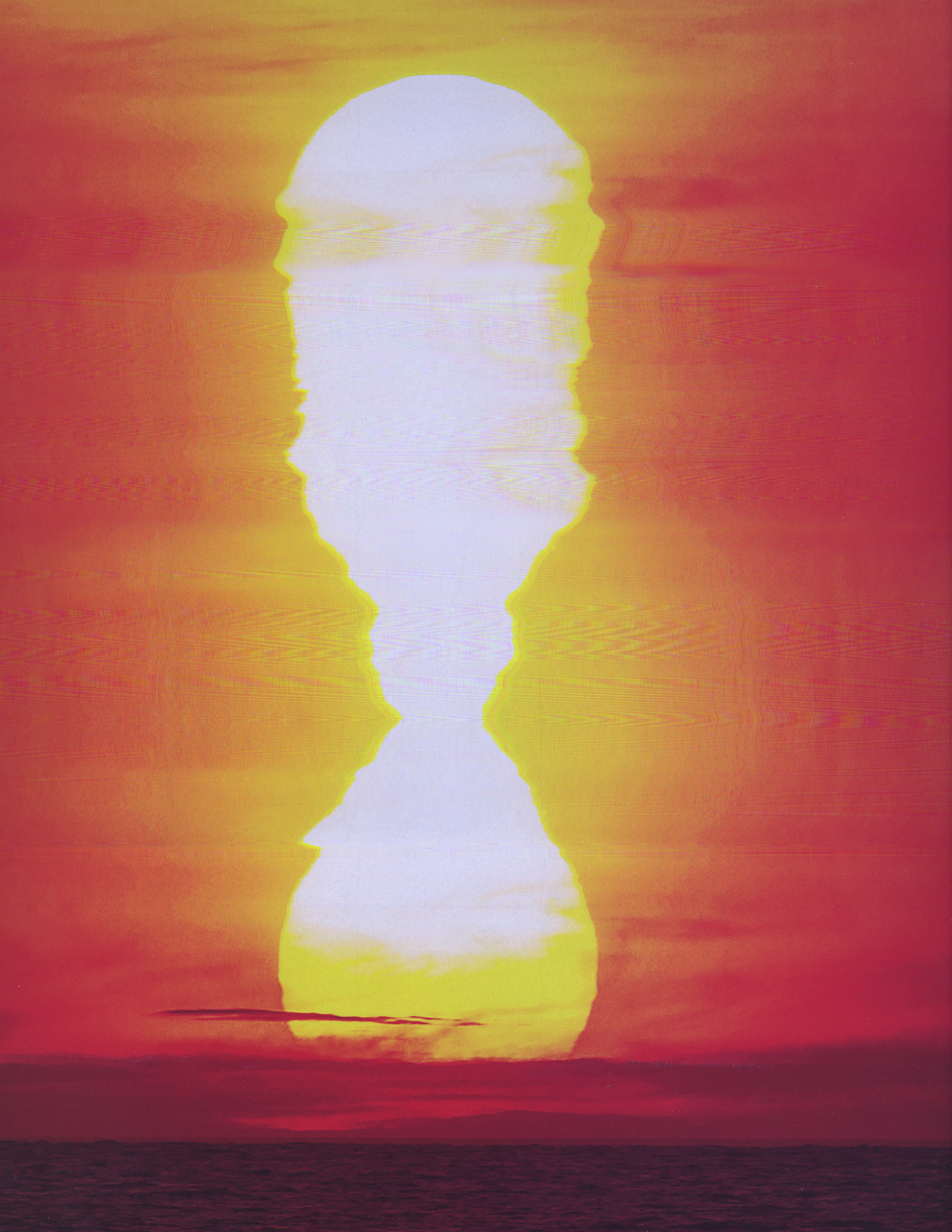
McLean Fahnestock, Breathing in the Insubstantiation, December 2021, archival pigment print, 17" x 22”, 2024
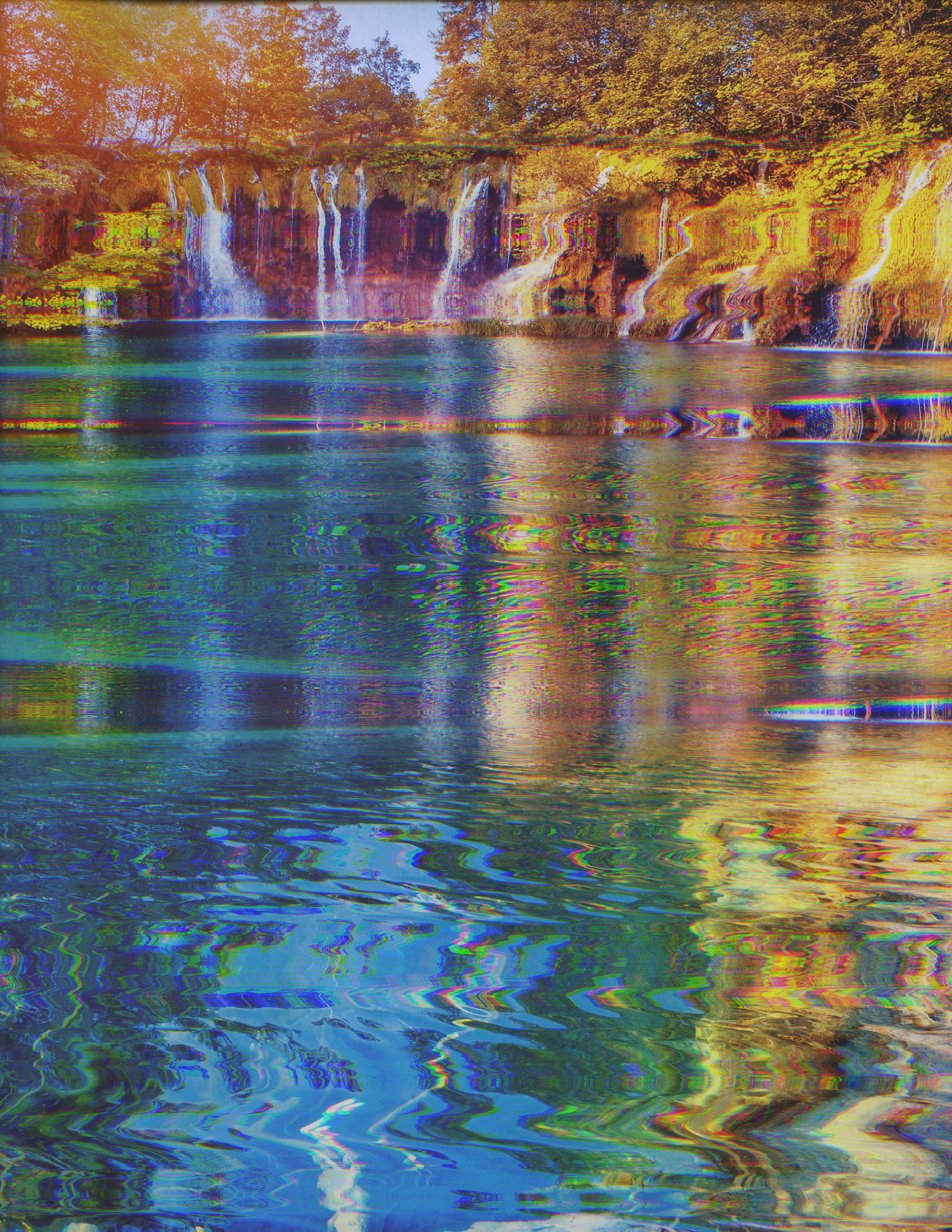
McLean Fahnestock, Breathing in the Insubstantiation, July 2020, archival pigment print, 17" x 22”, 2024
RB: You incorporate YouTube relaxation videos in some of your work. Do you find the process of making this work calming, or does it produce a different kind of experience for you?
MF: Working with YouTube relaxation videos is oddly not very relaxing. I spend a lot of time hunting for media if I am setting up parameters and restrictions for my source material, so I do some deep searching in YouTube to try to get beyond the algorithm. I really enjoy setting up rules for myself for the gathering of images or video or objects and following them all the way to their ends. It is a Sol Lewitt kind of enterprise.
I came to video from sculpture instead of from film or photography, so while I do sometimes capture my own footage, I do a lot of seeking out of the right material and I make work by shaping that material. I end up with libraries of source material like other artists have different collections of paintbrushes, paint, wood, photopaper, film, or glazes.
So to come back to the question, is it calming? It's fun and exciting, but also frustrating when you have an image in your head of what you want and you can’t find it. It’s like thrift shopping for slivers of time.
RB: You’ve worked with VR and other immersive media. Did anything surprise you about working in that medium, or are there any unexpected considerations that don’t exist in other formats?
MF: The biggest consideration in the creation of VR work is when making videos where you can see all around you, a 360 degree view, is that you, the filmmaker, you have to move out of the way. You can’t be “behind the camera” because there is no “behind the camera’ in VR and that is a really interesting compositional problem. How do you move the gaze of the viewer in the direction that you want and how do you stay out of the picture?
I am really excited for immersive media to continue to develop, and I enjoy the new ways it offers for artists to create an actual digital space, but there are so many barriers to access inherent in VR, AR, and XR that still need to be addressed. I think that we assumed that immersive media would open up worlds, but the headsets can go from uncomfortable and heavy to unusable, even for those who simply wear glasses, and further on to panic inducing for those who have claustrophobia, not to even mention accessibility for those with sensory disabilities or sensory processing disorders. The equipment is expensive and hard to use. Even AR is not well integrated yet. You must download apps, have wi-fi access, a smartphone. It’s closer, because it is your device, and has accessibility settings already dialed in for you. So, I’m optimistic, but there are still obstacles to overcome.
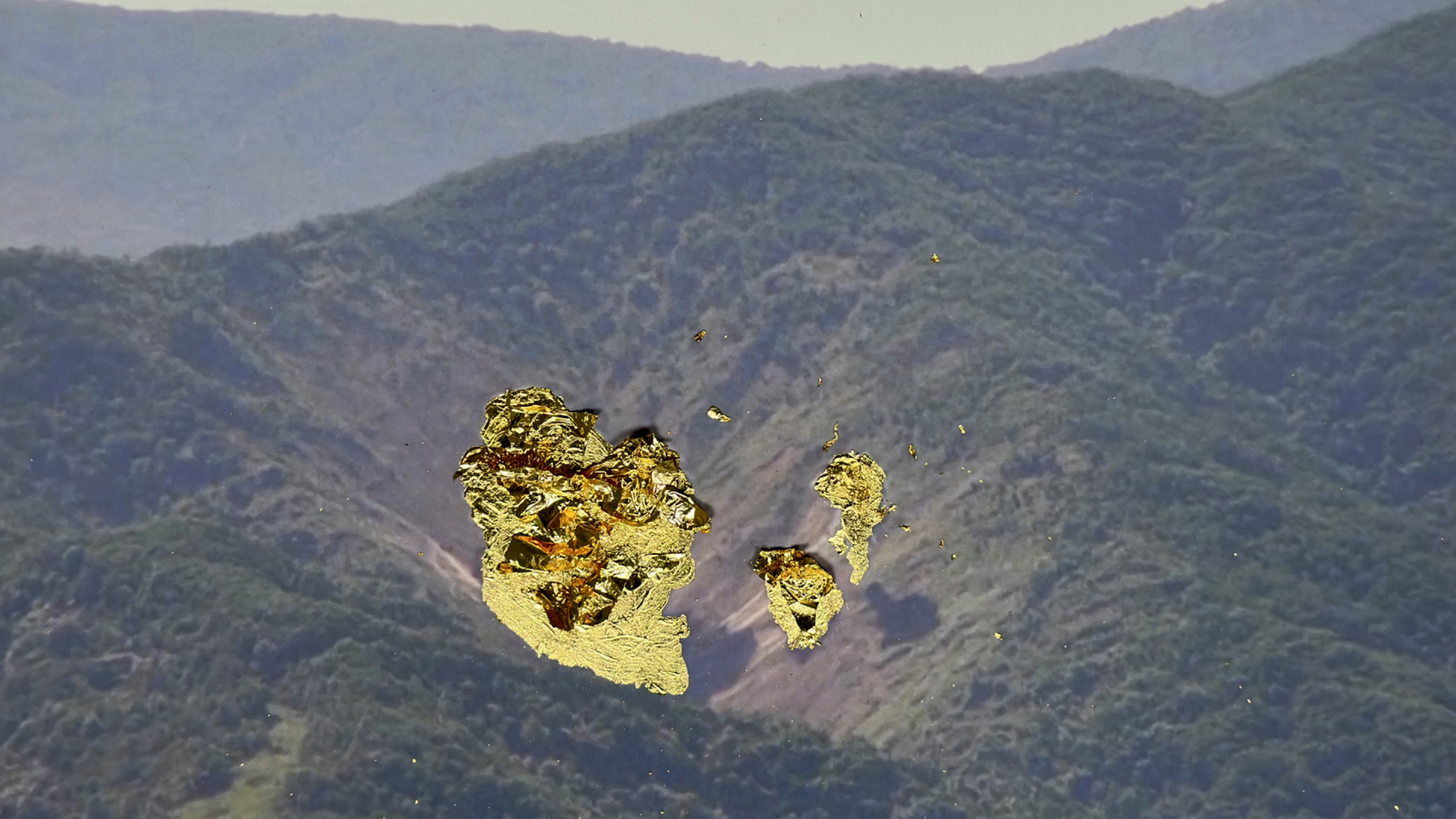
McLean Fahnestock, Dominion, digital video with stop-motion, 2:05 minutes, stereo sound, 2024
RB: In your conversation with Joe Nolan in Number Inc., you discuss the idea of work being “tethered” - particularly in relation to the South, regionalism, and where digital work belongs after it’s experienced. Much of your work exists untethered to a single form, appearing as sculpture, projection, or augmented reality. How do you think about context when a work doesn’t have a fixed objecthood?
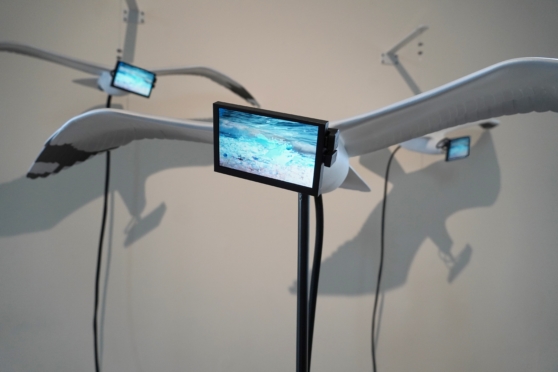
MF: There are works where I really highly consider the objecthood, the way that the media is expressed, and how that builds content. When the media lives and how that shapes the experience that the viewer has. It is piece by piece. Some are absolutely attached to a container, like the seagull works that are up at Radar right now, Decoy Flock Egregore. They have a video component and a sculptural component, but do not exist without each other. Other works, like Dominion, have multiple forms. This piece can be experienced as a single channel video that can be projected and looped in a gallery, or with a title and credits screened in a film screening, or as a dual channel installation on two screens next to each other. Some are more flexible than others. The other work in the Radar show, Drum Solo: Hyperbole for the Undiscovered Country, is a work that is configurable, it changes every time I install it because of the size of the space, the screens that are available, the way that I arrange the different video channels (there are 12 that I have to choose from).
Working with new media does allow me to have flexibility in the way that context is generated. And that can be a challenge as the work doesn’t always come with the standard rules of engagement for the audience. The context then is built through other means, generally in my work through the employment of collage strategies. Images and material that carry that context as well as content into the work, such as the YouTube waterfalls, other mass-market landscapes, and characters like the seagull.
RB: Drum Solo: Hyperbole for the Undiscovered Country is an installation that is reconfigurable for different spaces and screens and has been shown in different locations. Have you ever noticed work taking on different meanings or effects as it moves between sites?
MF: The work is difficult in a group show context because the sound component can overwhelm the other works. The snare drum rolls work best to create that overwhelming waterfall sound, an aggressive white noise, when they are at a solid volume and that generates a scale to the work that really drives the content home. So, the effect it has is magnified by the ability for the piece to take up that sonic space as well.
When I showed the work in Michigan, it was snowing outside so there was also this great shift in the created environment inside versus outside. It was a smaller space, shorter ceilings and dark in the room, and there are three created video waterfalls in the room as part of that installation. It felt different. The work created a dialog between the physical location and the imagined, and in the darkened space it felt warmer and more like a theme park creation of the topics.
Here, showing it in Wedgewood-Houston, in the center of ongoing development in Nashville, the work takes on the conversation about the construction of desire. Building the impossible waterfall, selling it to the highest paying, pricing out the people who have been living in the neighborhood, and then making it inaccessible. It feels colder and more aggressive.
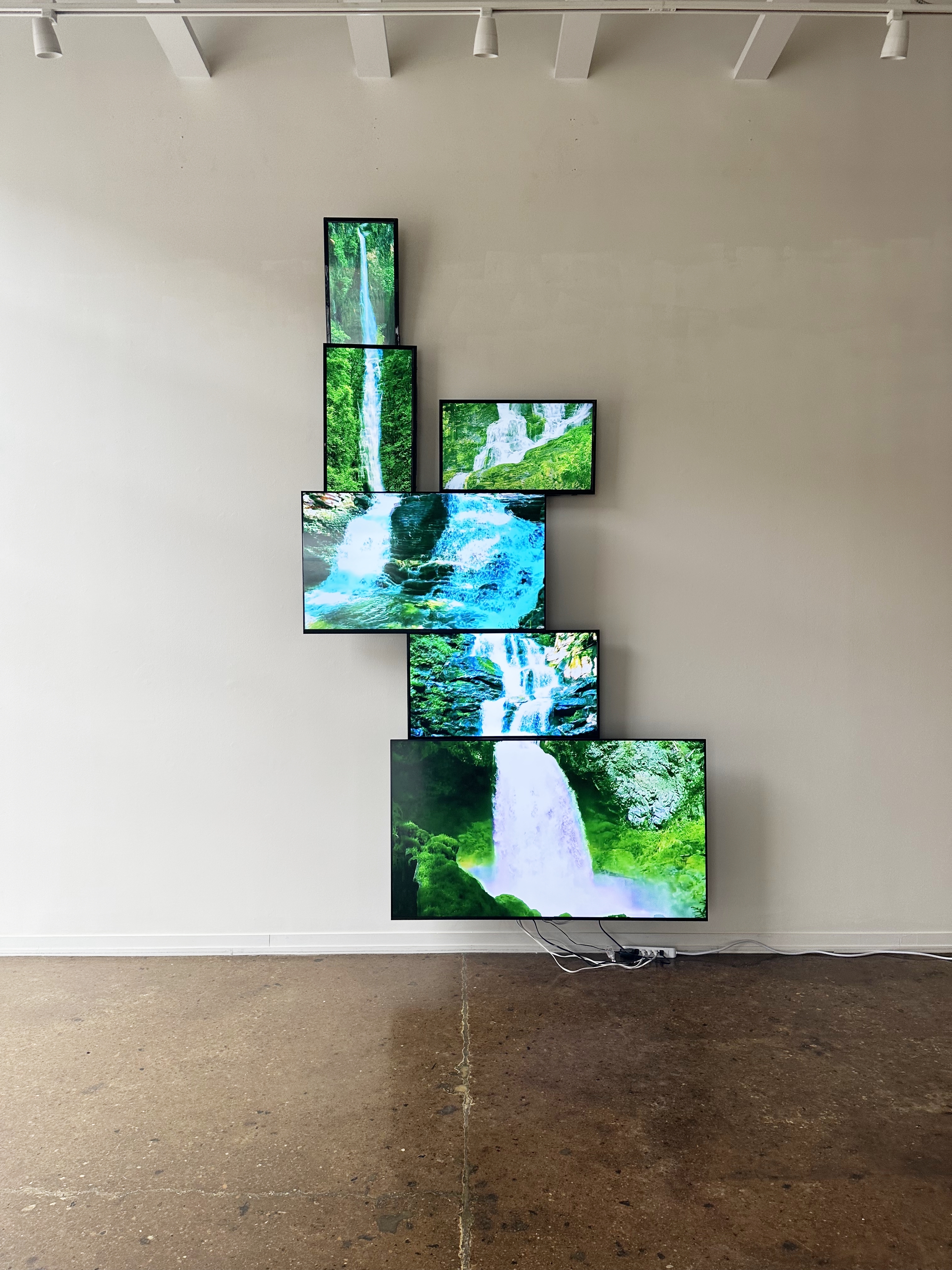
McLean Fahnestock, Drum Solo: Hyperbole for the Undiscovered Country, video installation, as installed at Radar 615, Nashville, TN, 2018
RB: You collect and work with older technologies such as VHS and DVD recorders. These tools often have quirks, limitations, and settings that contemporary technology no longer includes. What are some of your favorite effects or sensibilities that these older technologies allow you to access?
MF: Using older technologies gives me more access to aesthetic and formal choices, but also expands the meaning through the reach of time imbued in the work. The swift moving developments in tech create a visual timeline. Changes in resolution, texture through noise, grain, or pixelization, and aspect ratio, are held in our minds as markers for media. These are sometimes tied to nostalgia, like home videos or the early internet, or Vine, or media presentation forms like television news, classic movies, or streaming.
My favorites for just plain aesthetics and fun? I like the mess and glitch that comes from the decay of digital media as it starts to corrupt through overuse or copying. In the past I have used a lot of footage from television news, and I like how formulaic it is. That makes it something easy to start to manipulate.
I think it also comes from my training in sculpture. You must have the right tools. That led me to collecting the DVD players, VHS players, recorders, all the cables, different connectors, adapters, chargers, modulators, monitors, so much stuff! But you need to have it when you need it. Just like the correct wrench.
RB: Sound design plays an important role in your work, particularly in how you disrupt expectations through Foley and electronically generated sound. Can you share a specific example of a Foley sound you’ve used, and talk about how and where you sourced or created it?
MF: For my work Gold Rush, a stop-motion work where a palm tree is engulfed in gold glitter flames, I wanted the fire sound that was not exactly roaring and crackling fire. I was seeking something to reinforce the meaning of the glitter and ground the palm tree in a place. I wanted the sound of coins falling into the tray of a slot machine. The rhythm is similar and I wanted to bring another reference to money, especially that kind of money, Vegas winnings, fast easy come easy go money.
I went to a thrift store and bought a really cheap decorative metal tray and recorded myself pouring a quart container of coins on it over and over. Then I recorded running my hands through the coins, Scrooge McDuck style. I layered the sounds and looped them to make the soundtrack.
For other works I have recorded more Foley like this, rummaging for materials and using a microphone set up, but I have also used free sound libraries, a keyboard, and clips of choirs and orchestras that I have remixed into loops and drones using Adobe Audition.
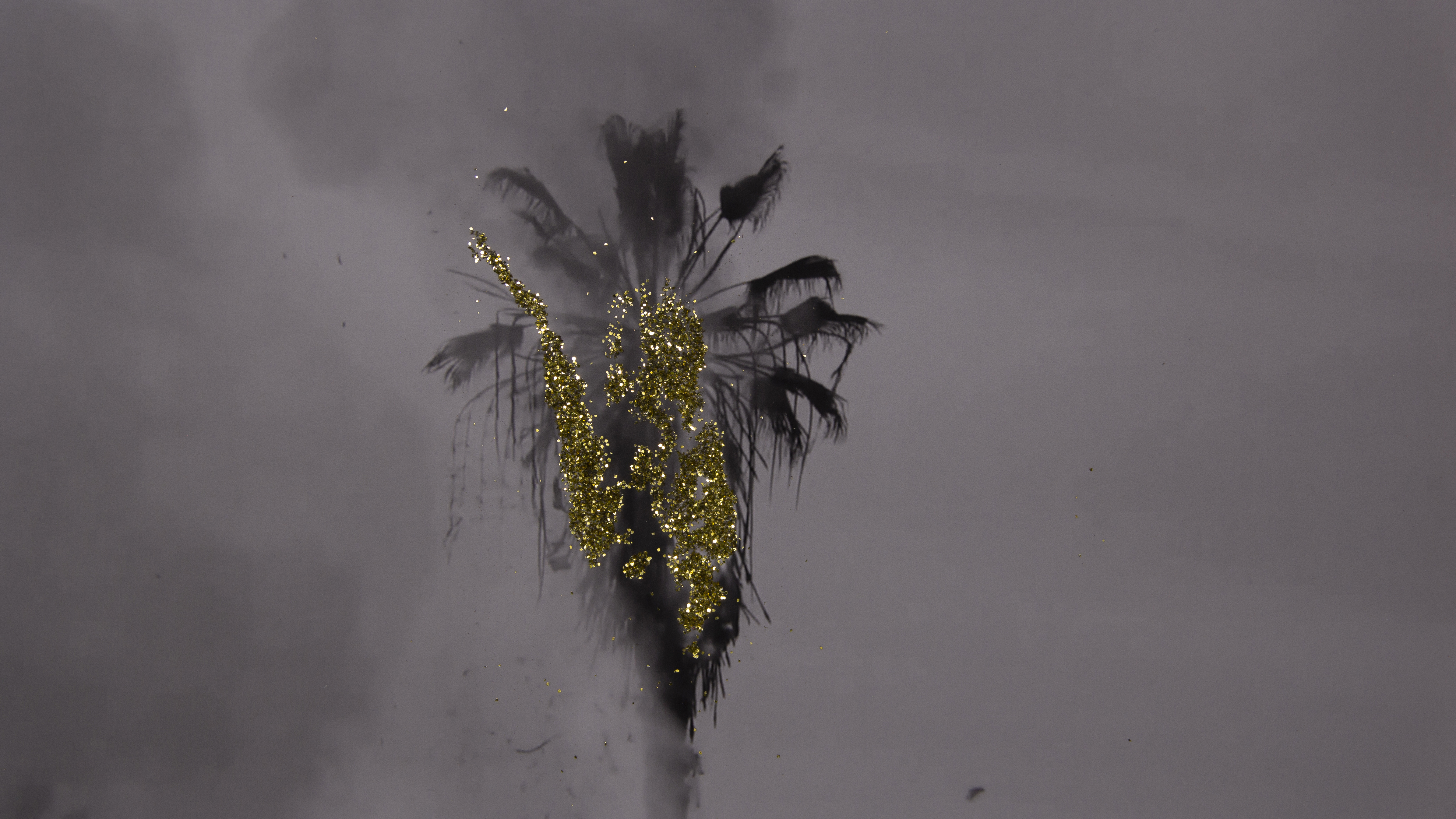
McLean Fahnestock, Gold Rush, digital video and stop-motion animation with biodegradable glitter, continuously looping video, stereo sound, 2021
RB: You’ve spoken about working with anonymous, mass-produced landscape imagery - like a waterfall image purchased at a dollar store - and then tracing those images back to their original locations online. Have you ever uncovered something unexpected while researching the origins of these images?
MF: One thing was my misconception about the real location of the landscapes. For example, I really did expect the waterfalls to be from tropical locations, and there are many from Southeast Asia, but I was surprised to find astounding ones from Croatia. There is a National Park there called Plitvice Lake that is really stunning and many of the stock images come from there.
I think that another unexpected thing I have found is the reuse of the same images in multiple applications. The same waterfall picture will show up as a tapestry online and in a calendar a few years later. I found a company that is the wholesaler for the products. It’s strange to think of them coming from some company who is manufacturing our images for casual escapism. Like, ok guys, which 12 beaches are we going to package for the public this year.
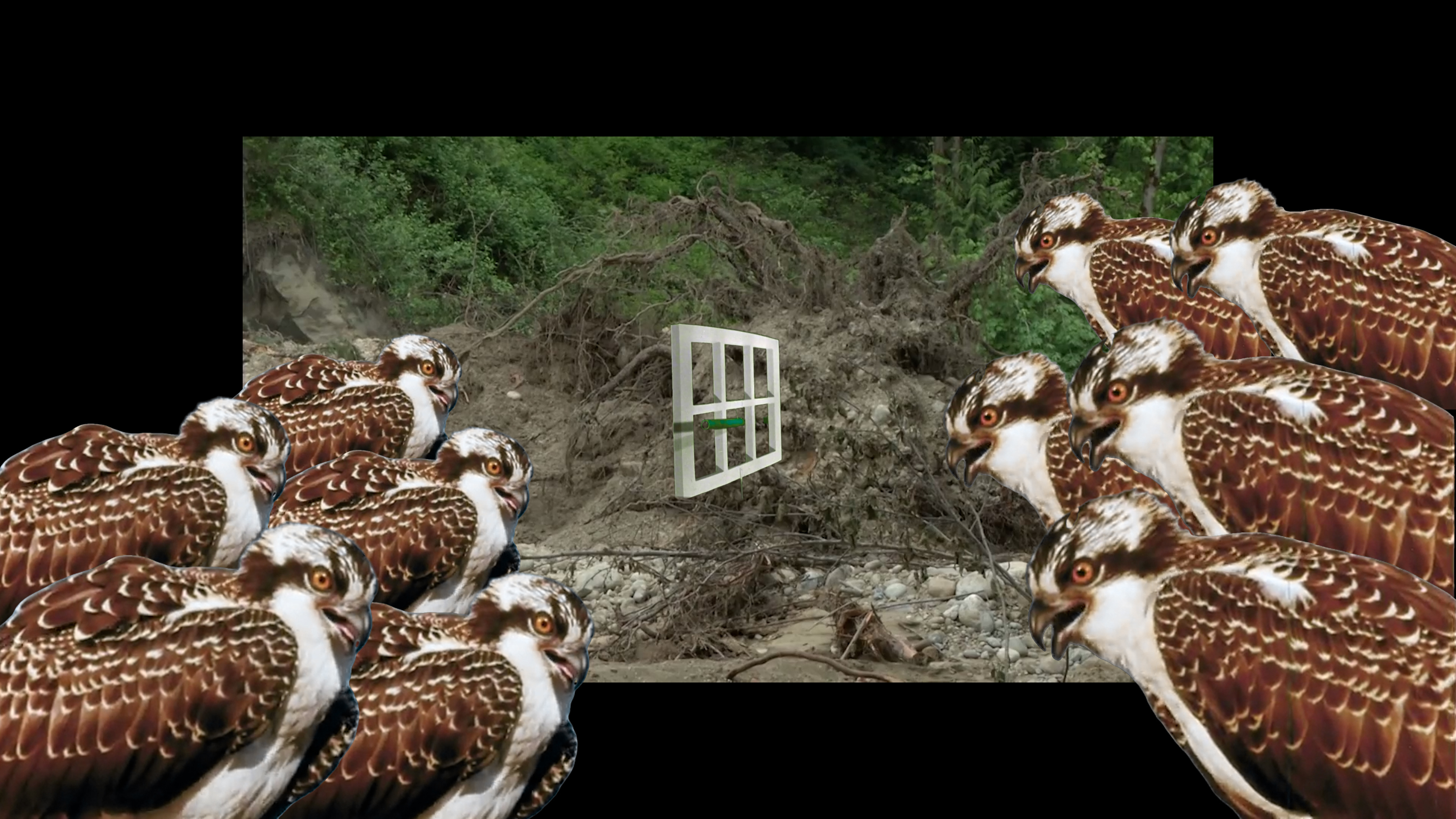
McLean Fahnestock, The Desire for Birds Provokes the Desire for Stones, 4K digital video, stereo sound, 2024
RB: You’ve said that it is "the full circle completion that I feel from presenting an artwork to an audience that is the most rewarding part of making art for me. There are things that I am communicating with my work that I want people to consider and enjoy." Have you ever been moved or surprised by someone’s response to your work?
MF: Yes. I do really love being in the studio and just making, but getting the work out into the world is the most rewarding. There are times when people have absolutely had a response to a work that is not what I intended or even considered. My most emotionally charged work, Grand Finale, showing all 135 space shuttle launches at once in one big, tiled video, has produced the most moving responses because of the inclusion of the Challenger footage. I have been contacted by people who worked on the space shuttle program who talked about the pride they felt working on specific launches. That piece is different than my current works because of the use of the video history of exploration that touched so many of us.
RB: What are you working on now and what’s next?
MF: Right now in the studio I am finishing up a piece called My Side of The Mountain. It is an interactive work named for the young adult survivalist fiction book from the 1980s. It is comprised of the bust of a falcon with a camera in its eye that captures and tracks movement. The movement tracking is superimposed on to a video of a forest on an accompanying screen. The work combines sculpture, video, and some programming using an open source platform called p5.js. I have used p5.js for components in other pieces, to make wire frame birds, and to animate arrays, but this is the first time I am using it to make a piece interactive. It is really interrogating surveillance and the projection of ownership. It overlaps with another longer-term project I am working on that is about boundaries.
Next up is a screening of a work in the UK, and starting on yet another project scanning a taxidermy coyote for a new video sculpture with a camera component for some interactivity. I found one to scan at a restaurant by my studio, and I am trying to convince them that I just need an hour before service to scan it. They are wary but I think I just need some time to convince them. But, if anyone has a taxidermy coyote and is willing to let me scan it for a sculpture, please email me!
Note: McLean's work is currently on view at Radar 615 in Nashville: https://locatearts.org/exhibitions/nashville/mclean-fahnestock
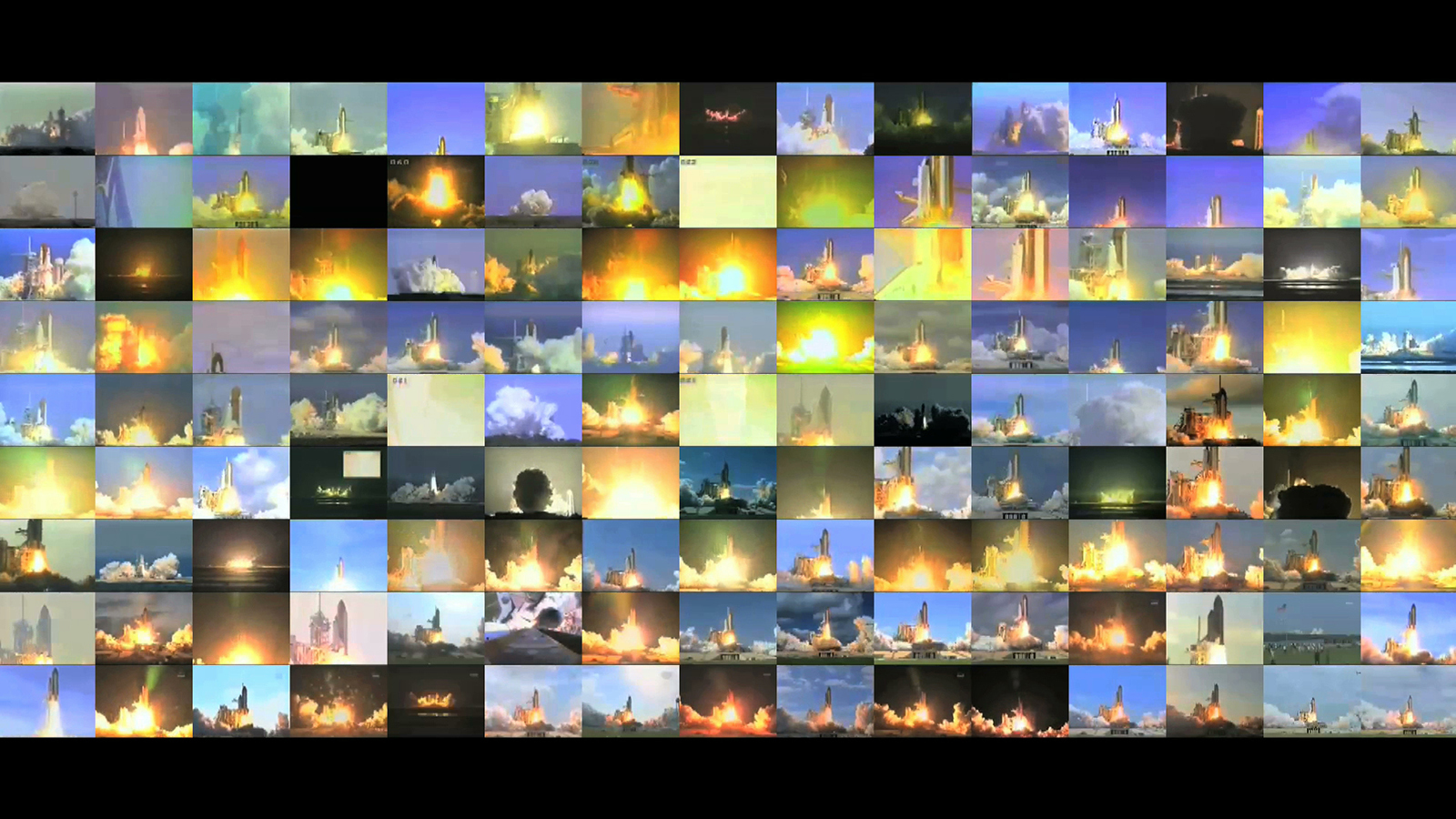
McLean Fahnestock, Grand Finale, digital video, stereo sound, 2011
McLean Fahnestock seeks out footage, images, and items that expand our understanding of place and carry the character of exploration. McLean received a BFA from Middle Tennessee State University and MFA from California State University Long Beach. Her work has been exhibited and screened across the United States and Internationally at institutions such as the Aurora Picture Show and Menil Collection, Houston, Frist Art Museum, Nashville, Black Mountain College Re{Happening}, North Carolina, Technisches Museum Wien, Vienna, Austria, The California Science Museum, Los Angeles, The British Library, London, and MOCA Hiroshima, Japan. Her work was selected for Off the Screen at the 57th Ann Arbor Film Festival. McLean is an Associate Professor at Austin Peay University in Clarksville, TN and keeps her studio in Nashville, TN.
Rachel Bubis is a Nashville-based independent arts writer, regular contributor to The Focus blog, and LocateArts.org Web Manager for Tri-Star Arts.