INTERVIEW: LAIN YORK
DEC. 13, 2025

INTERVIEW: LAIN YORK
DEC. 13, 2025
Rachel Bubis: After developing your drawing skills for many years, you decided to shift away from realism which you’ve described as an “escape velocity.” What led to that moment, and how did it transform the direction of your work? Was it over time or suddenly?
Lain York: It happened fairly quickly coming out of university. I was looking for a particular immediacy for what I was doing. Ideas were coming quickly and I found myself moving away from what I thought I was supposed to be doing. I was looking at painters like Francesco Clemente, Maria Lassnig, and Basquiat.
I was also getting involved in the independent artist-run groups at the time in Nashville which moved quickly in terms of identifying venues and making work specifically for themed shows. That gave way to the early 90’s and a very free and fun period. I felt I was shedding a lot of frustration left over from university and found a community in which we responded to each other in peer groups. We were all influencing each other’s work.
RB: You’ve spoken about the connection between poetry and painting — that “super-powered language is needed to convey a non-verbal medium in swiftly moving times.” What role does language or writing play in your art practice now?
LY: Old Art Forums and non-American art/cultural periodicals were rife with poetry. Painting on one page, a poem on the other. Which leads us to this super-transitional moment. Again. I feel the need for sharper, more incisive tools and/or a new way of implementing the ones we have. As painting increasingly loses the impact it has had collectively, and poetry has become marginalized in an undereducated society; we need more articulate languages than the ones we are falling back on. I feel our languages are failing in articulating what is happening to us now.
My thoughts have been to look at these viable alternatives in a new way. I see painter colleagues publishing amazing books of poetry and poets, amazing painting and drawing. I am limiting the convo here to just these two hoary disciplines.
I had a very formal background with a lot of art history that required using language in a very particular way to discuss things like formal and thematic considerations. It was rigorous and we were expected to break down painting in this manner to discuss it critically. I felt this was extremely helpful in my own work but it was also missing something vital. Then I discovered artists like Joseph Beuys and Jose Bedia trafficking in alchemy and magic. I feel their work mediated physical experience with a spirit world. This could not be nailed down with language as I was using it. This is where poetry and incantation comes in.
I used text initially as a cataloguing device, strictly objective. Later it became automatic writing layered and embedded to activate it. I only feel comfortable using letters, improvised words and phrases these days. This is still revealing itself to me in new ways.
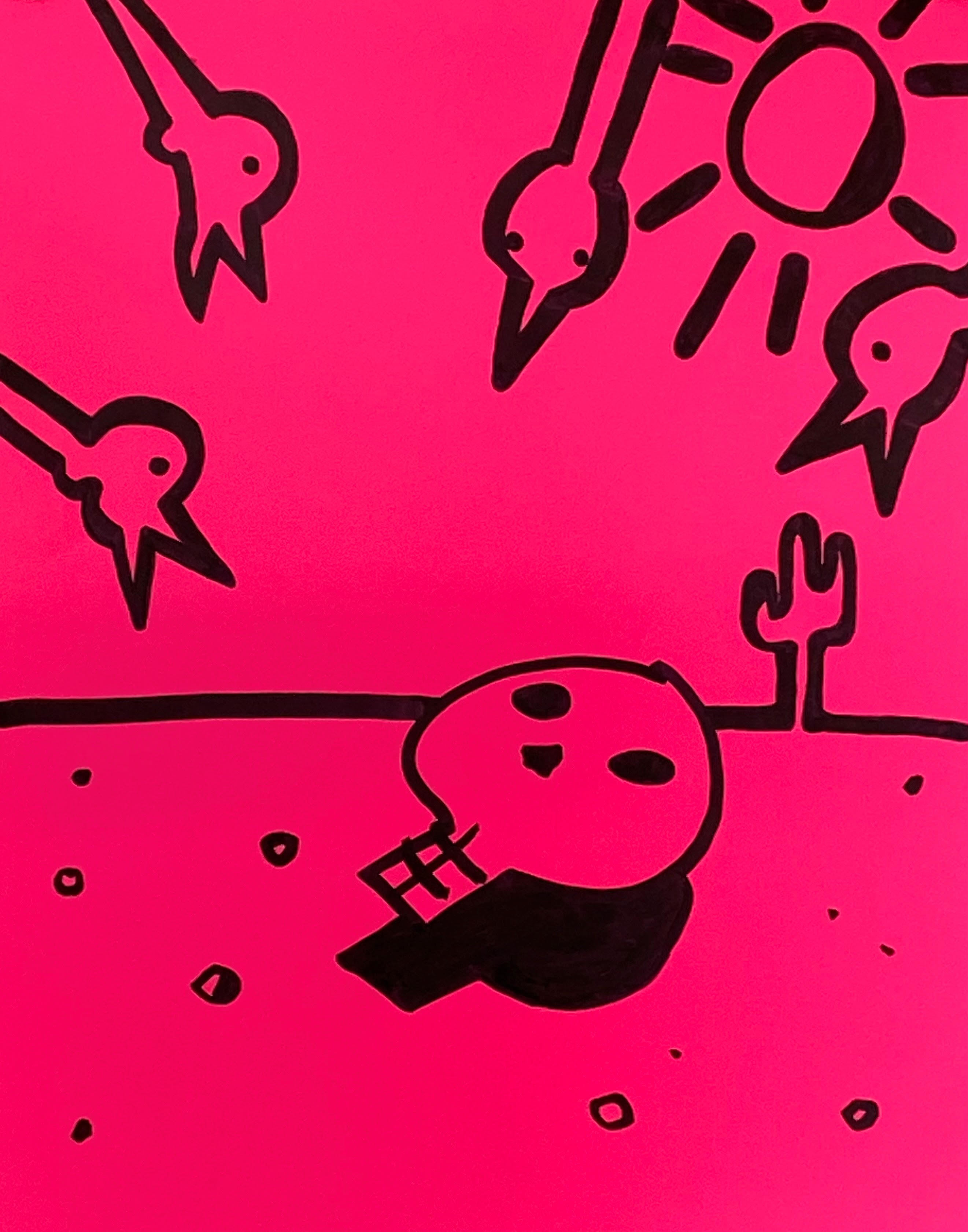
Lain York, Squawk, 2025, ink on acid-free paper, 30 x 22 inches
RB: You came up in a time when the art community was more critical, with rich dialogue in studios, shows, and writing. How do we bring that kind of critical conversation back?
LY: There’s no doubt that everyone wants this. I feel I have the same conversation repeatedly with individuals IRL, but this more meaningful engagement is not happening with the collective. The problem seems to me to be that many of us are all pulled in too many directions. Digital culture has empowered us to spread our awareness to more areas simultaneously, but it could be that we have done so too thinly. The community I came up in demanded the accountability of presence. You had to show up.
I get the efficacy and necessity of digital networking, but I also realize the value of standing in each other’s presence. It’s a different operation having a direct influence on the nature of that engagement. Small, localized groups meeting regularly in person make a huge difference and when these smaller units are allowed to develop, a more nuanced engagement occurs.
My experience has been that independent, peer-based group shows in which artists take chances making work for each other are absolutely critical to the development of individual studio practice. This greatly enriches the larger dialogue and it is here that mediated critical, responsible, and informed writing can make more of a difference.
RB: I think many people in the community would describe you as someone who’s consistently shown up for decades — making work, organizing artists, and helping shape a more sustainable art community in Nashville. What keeps you motivated to continue showing up?
LY: I very much appreciate hearing that as I feel I’ve been rather absent. The world and Nashville in particular have moved very quickly since the pandemic. There is so much more for creatives to respond to, but venues have become a serious problem and networks are fragmented and transitioning.
It's still mystifying how little interest the city and business community have in what the creative networks are doing in Nashville, considering how much they put on the table for just about every other established and nascent industry here. This has become apparent to me in a new way over the past 6 years. I feel it would take so little on their part to support what we have been doing and it could make such a huge difference.
That said, folks continue to show up seeking engagement and, because there is pretty much no culture industry infrastructure here, we may have an interesting opportunity. We need an articulate plan and an agenda, but everything is very messy right now and we have fewer resources available to us.
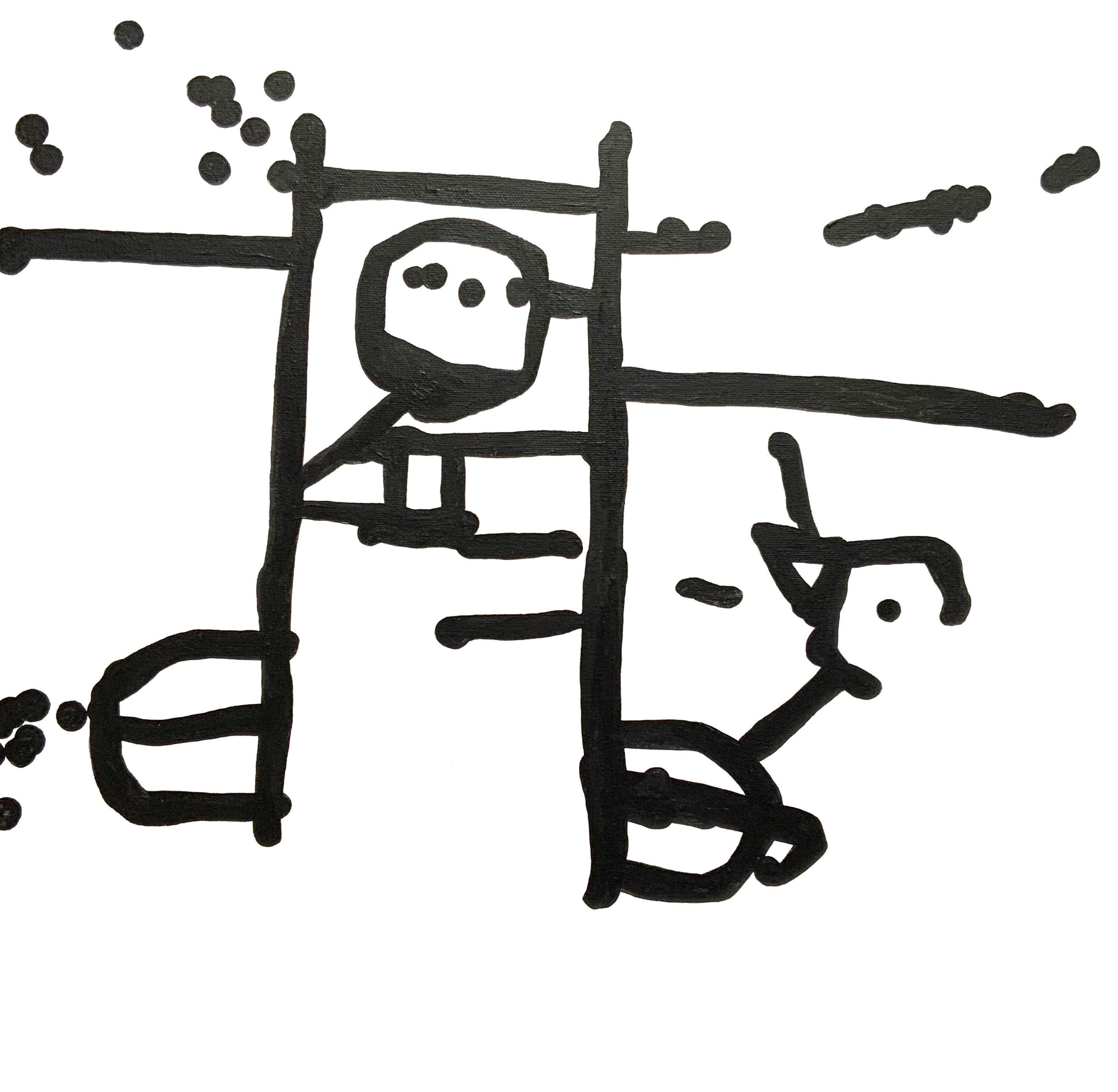
Lain York, pick you up, 2024, acrylic on canvas, 24 x 24 inches
RB: You joined Zeitgeist Gallery in 1997. Do you remember that first show or what it meant to you at the time?
LY: Janice responded to an artist in an untitled show that year, tracked me down to make contact, and I connected the two. Peter Baldaia at the Huntsville Museum of Art had recommended my work to her and she offered us both a show. I installed the show, and she offered me a job. I have been with her and the gallery for 28 years. It was a transitional moment for the independent community as so many independent groups began to break apart, establishing blocks of studios in area warehouses, and some were opening their own galleries. This was a heyday for artist-run spaces all over the world which immediately jacked us into an international network of studio artists and Zeitgeist had already many connections outside Nashville, as did Terri Smith who was curating the Temporary/Contemporary at Cheekwood and this eventually attracted a Whitney Biennial search committee. There was a lot happening.
Janice was very interested in this transition as it related to the more established artists she was working with locally and in larger markets. It was an opportunity to break more challenging work in the independent spaces, Cheekwood, and then immediately begin trafficking it into the commercial galleries. It was a lot of fun.
RB: You recently posed a question on social media about how Nashville’s business community perceives its art scene. Did you get any enlightening responses, or has your opinion changed on this?
LY: Lots of responses from artists, not so much from the city or business community :D
This continues to be a hanging question.
RB: You said in a recent interview, “Nashville has consistently been wary of anything that makes it look smart." You mentioned you think this has changed though and new opportunities for growth and development are available. What are the best examples of this that you’ve seen?
LY: I may have spoken too soon. 9-1-1: Nashville, anyone? Bueller??
My opinion continues to be that regardless of what we artists or natives to Nashville think about its cultural scene, its development, or its infrastructure — what drives the city and business community’s interest is whether it fits their definition of an economy and branding. If that is what visitors and new residents want and will spend money on; they will support it. If not, we’ll keep doing what we do without their support.
At this moment, I will continue to believe more investment on the cultural front, even if it’s off the hip of entertainment (or higher education, or fashion, or boutique shopping, or healthcare, or pro-sports, or…) and proper media/branding will pay huge dividends for all interests. However, the current development paradigm is proving very unsympathetic to what we are doing and have established here.
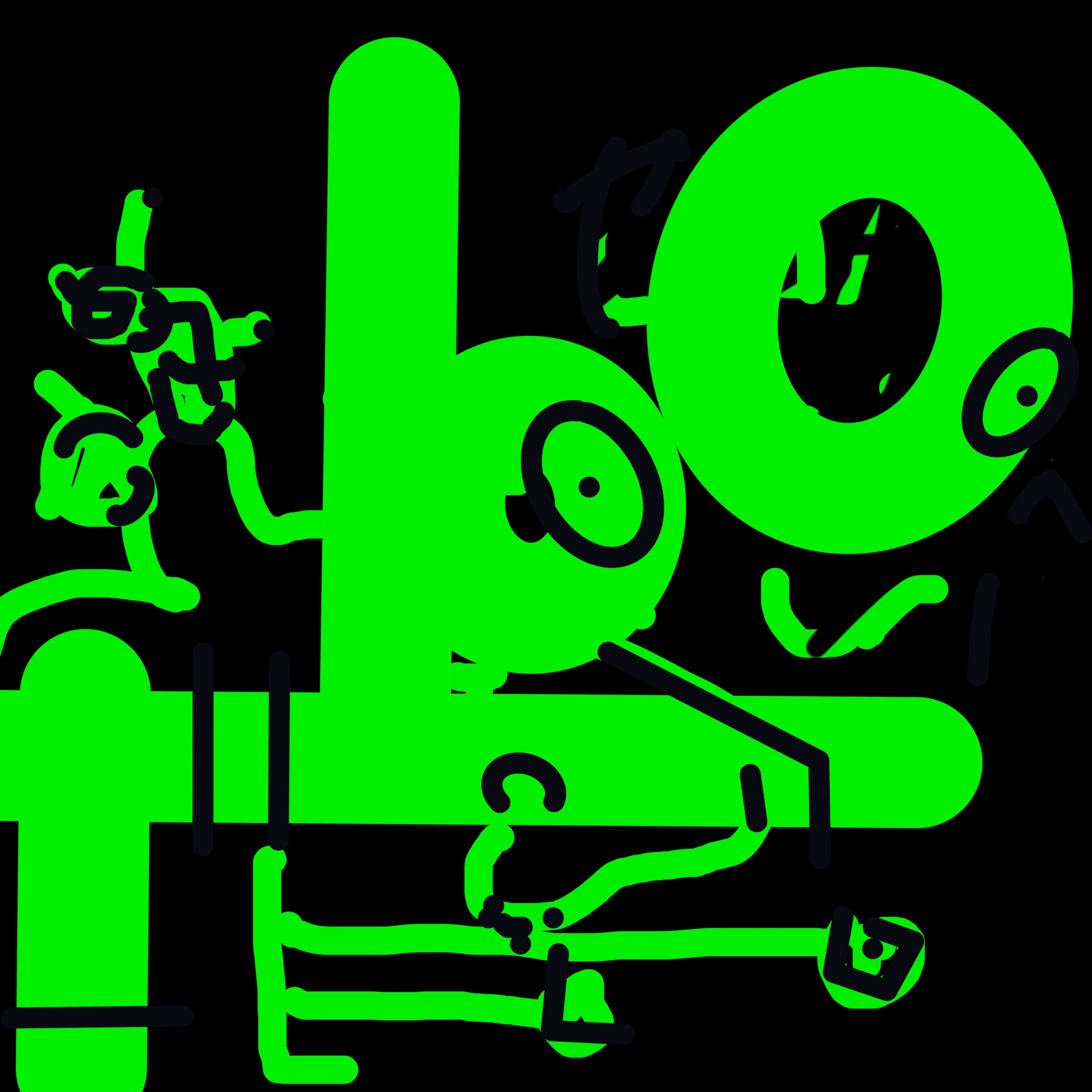
Lain York, and you don’t think so…, 2025, digital
RB: How do you feel about the development of Wedgewood-Houston?
LY: It’s hard not to look at it as anything but heartbreaking. If what continues to land here has any interest in the creative networks preceding them, as early development interests have acknowledged, I am not seeing it. We still feel we could be good partners. Those of us still left. My hope is that it is not too late for this district and all the residents and businesses that moved in feeling they were moving into a creative neighborhood.
RB: You recently collaborated in a live program with a composer, dancer, chef, and poets, responding to their performances in real time. What was that experience like? Was there anything surprising?
LY: It was very familiar as this was the type of community engagement I came up with. When working with others who bring wonderful energy and this instance, heavy formal training and performance credentials — it all flows and feels effortless and exhilarating.
Audience reactions are always fun and surprising and one never knows what’s really happening in a collaborative performance until someone who saw the whole thing tells you.
RB: Are there any dream collaborators or disciplines you’d like to explore next?
LY: I have to say that I have been very fortunate to have hit enough highs. My interests most recently have been working with others to help develop their vision and partnerships. Of course, any of these operations that actually generated appropriate income for venues and collaborators alike would be lovely. That said, I am currently working with a group of professional creatives loosely associated through a Curb Center project to explore developing formats for creative ensembles to bring collaborative, multi-media pop-ups into neighborhoods to address what these types of operations mean for neighborhood and community building.
RB: Your quote about your work existing in a “continuum of ideas others before me had” beautifully captures how artists build on collective histories. Who do you feel you’re in dialogue with today?
LY: I feel other disciplines outside painting and drawing are currently telling me more about what I am doing in my particular lane.
RB: You’ve described reaching “a particular openness” with material and images where “something unexpected can happen.” Can you give an example of this happening in the studio?
LY: I pared my practice to Post-it notes and sharpies during the pandemic shut-down. The plan was to find a base I could work outward from. I started by putting down as few lines as I could to suggest a “believable” space moving for one note to the next. I then pasted them up in series on the wall to see what was happening. It was like the collaborative experience mentioned earlier in which these moving parts were working together and the notes facilitated seeing comprehensively what the bigger picture was.
This has led to more fluid line making and automatic, generative forms that began to give way to imagery. I then let some of these characters develop like the alarmed bird or dog observer. It’s more flow and less evaluation on the micro-level and letting the process show me what they’re doing. I feel I am still developing this and looking forward to seeing more of this on canvas or panel in larger formats.
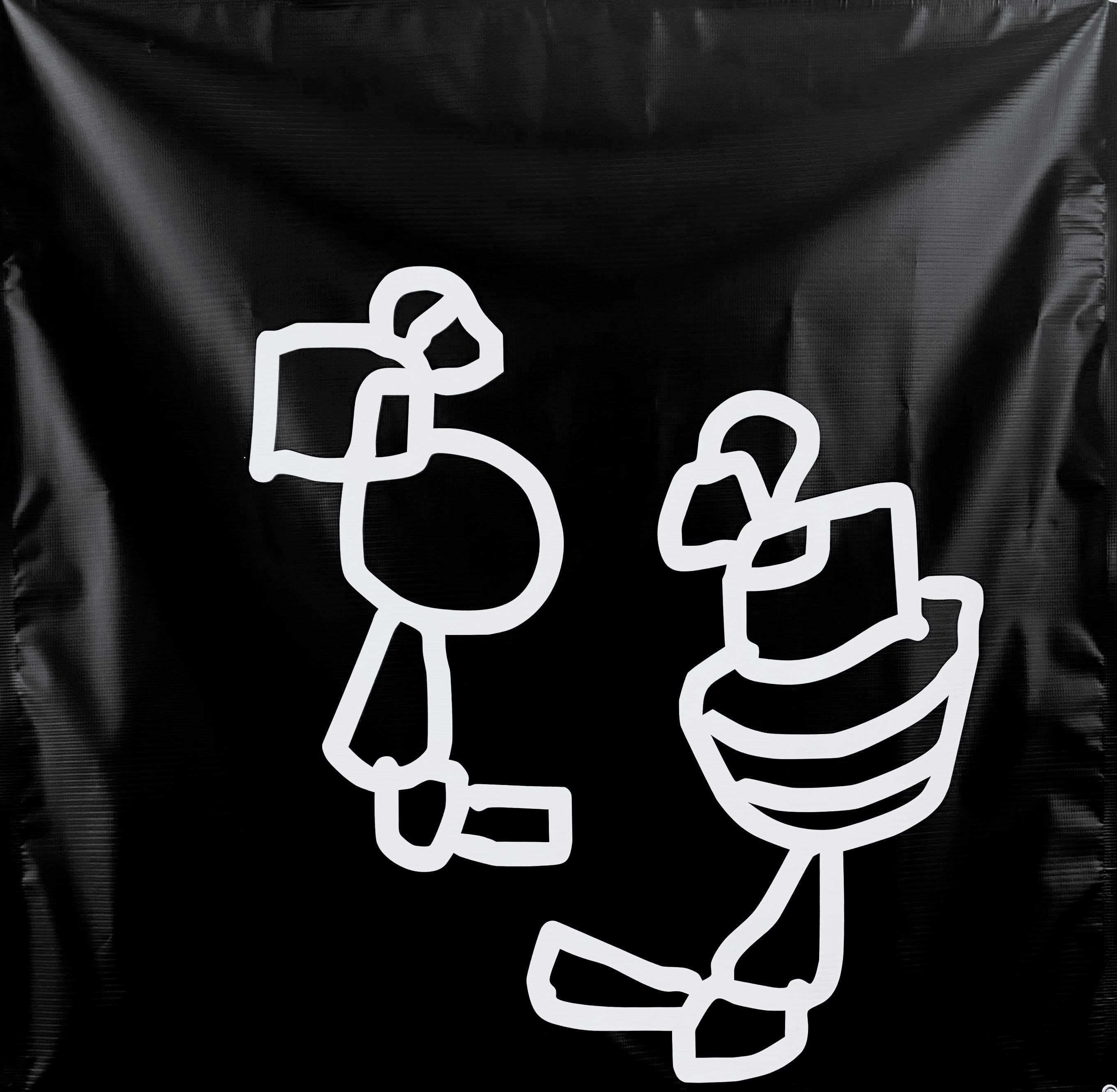
Lain York, pink art, 2024, ink on vinyl, 48 x 48 inches
RB: Do you believe art exists independently of its maker, or is it inseparable from the consciousness that created it?
LY: I feel it exists independently. If Jung is to be believed, the use of/understanding of symbols is hardwired in all of us. I believe works of art come from a consciousness that operates the pen but one that is bobbing on an unfathomable ocean of personal unconscious that is shared by a collective unity.
RB: You’ve described a sense of “connection to something much larger” when working. Do you see that as a spiritual experience, a psychological state, or something else?
LY: Absolutely. At this point in my young career, I feel the magic happens when these two elements work together. The body is next to fall in line as the practice also becomes somatic and that “something else” is ignited. I feel this experience has always been foundational and consistent in my work and practice and I am becoming more aware of the mechanics.
RB: You’ve written about wanting art to “move the general well-being of all flora and fauna forward.” How do you see your current work contributing to that vision?
LY: That is an expression of connectivity and continuum. It would have been better stated as hoping to observe and be a part of natural flow. Here is where I feel ritual comes in — Stravinsky’s Rite of Spring. I absolutely believe everything is connected and it is through these practices that I engage a universal whole and the collective I am only a tiny part of.
RB: What are you working on now and what’s next?
LY: I feel I have so much mapped out already and that the strategies I have been using in different media are all in play in a new way. So much internal work I have been doing over the past 5 years is bringing the older work into a different focus and it may be that working with particular characters that have been popping up in the drawings becomes the focus.
Lain York is a native of Nashville whose work continues to reference images from our collective sense of history.
Rachel Bubis is a Nashville-based independent arts writer, regular contributor to The Focus blog, and LocateArts.org Web Manager for Tri-Star Arts.