INTERVIEW: TONY SOBOTA
OCT. 19, 2026
INTERVIEW: TONY SOBOTA
OCT. 19, 2026
Anna Mages: In a previous statement, you talked about the importance of color relationships. You said that a rich visual experience is so necessary that, if it is not there, the artwork is dead. How did you begin to develop this view about color? How did it develop as you moved from caricature work into formal painting? Do you ever arrive at a point where you are satisfied with the color relationship? And if not, what do you do with that?
Tony Sobota: One thing I really struggle with as an artist is the idea that everything matters. Composition, value, theme, the content, color, the way that you handle edges... there are so many aspects. I believe they all matter. However, to slow things down and not get overwhelmed, I focus on one aspect. And for me, color naturally became that one aspect.
When I first set out to learn how to paint, I thought I could go naturally from drawing. In reality, it was not that simple. As I was doing very basic, rudimentary things, I became interested in color. I participated in workshops - even driving across the country - to learn about color.
One time, a teacher pulled up a slide from an animation project. It looked like a rainbow of colors - very vibrant. Then, he pulled up a color wheel with samples of all those colors, showing us how they were actually close together. He explained how you have to have a little green in the red or yellow in the blue to help the colors relate to one another.
When I'm looking at a painting, I tend to be a needy viewer. I carry this into making a painting as well. I like to create a lot of differences, but I'm always asking: What is too much? When does it become cluttered? Or, what is too simple? Ellsworth Kelly could create an interesting painting that's just a blue square with a curve on one end. What's more, he could make you care about it. That is not too little in terms of the way he laid that paint down and gave you the experience of that color. But there are so many different ways to approach color, and I think part of the fascination is that I will never master it. I will never figure it out. It is endlessly interesting. So, I think in my pieces, I tend to stop working on a painting when there is nothing else distracting me... when it has enough to hold my interest without something too loud or obnoxious calling my attention.
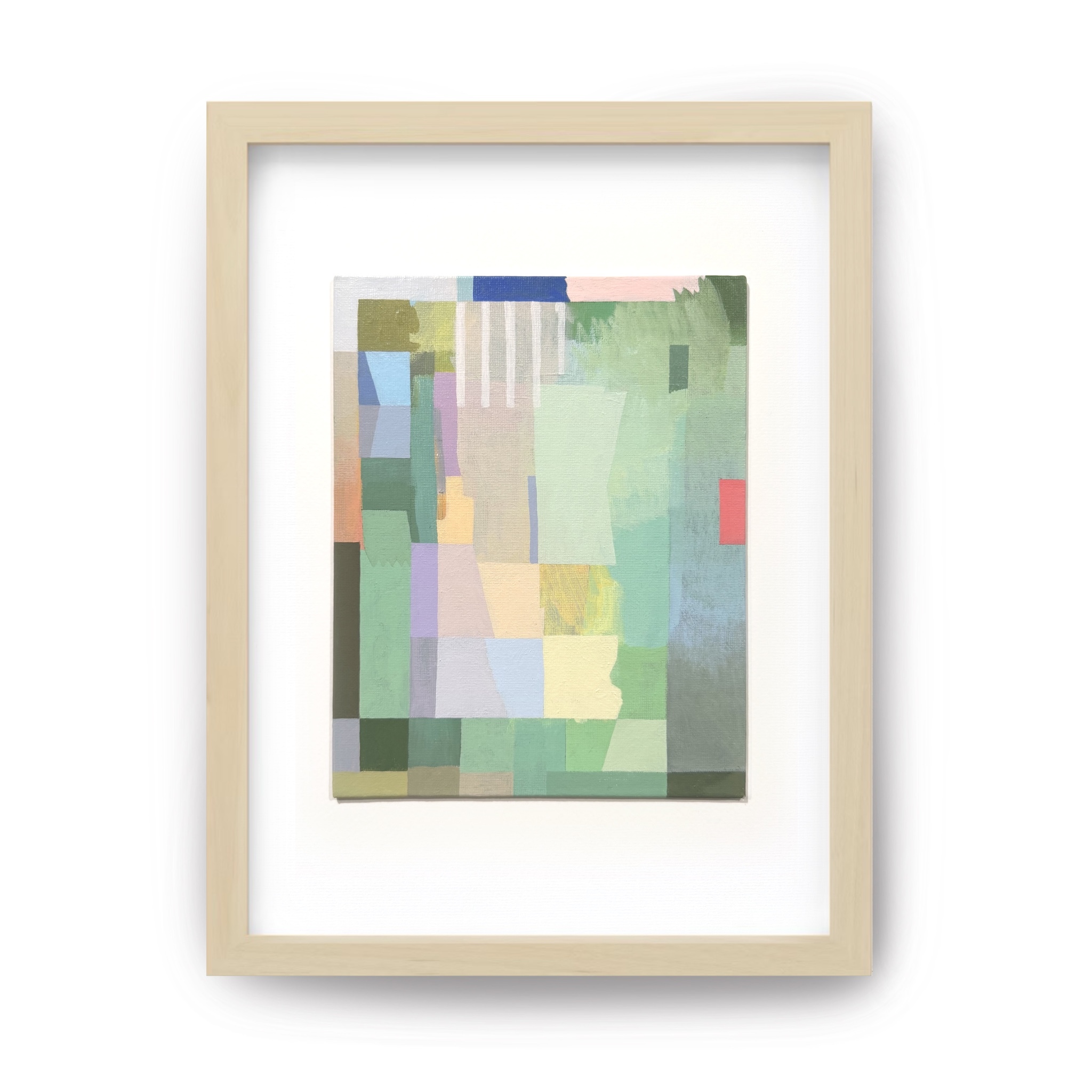
Tony Sobota, Broken Grid (Homecoming), acrylic & flashe on canvas panel, 8" x10"
AM: There is something there about intuition. I appreciate what you said about everything having importance. You have to have some sense of value to work well with color. But, we also talk about certain painters because of their use of certain formal elements. We discuss Caravaggio’s use of value, but with another artist, we might talk about composition or color. It is almost like if we focus on everything at once, everything else feels very flat. If everything were held as equally significant, nothing would be important.
TS: I think that's why I did some grid work for a while. These grids allow me to simplify the composition so that I can focus on mixing and color relationships. I honed in on this practice for a few years... I feel like I could do that forever. Eventually, the grid started to dissolve; yet, everything is still based on the grid. Anything that I title Broken Grid, Dissolved Grid, or Obliterated Grid is based on this formula.
Moving forward, I want to introduce more compositional elements and work on edges more. Perhaps I might even return to some realism, bringing my understanding of color to the way that I approach landscape.
AM: Do you primarily work in acrylic, or other mediums too?
TS: Yes, most of my paintings are acrylic. I lost my studio space earlier this year, so my home has once again become my studio. I do not want to paint with oils in my home to keep it non-toxic.
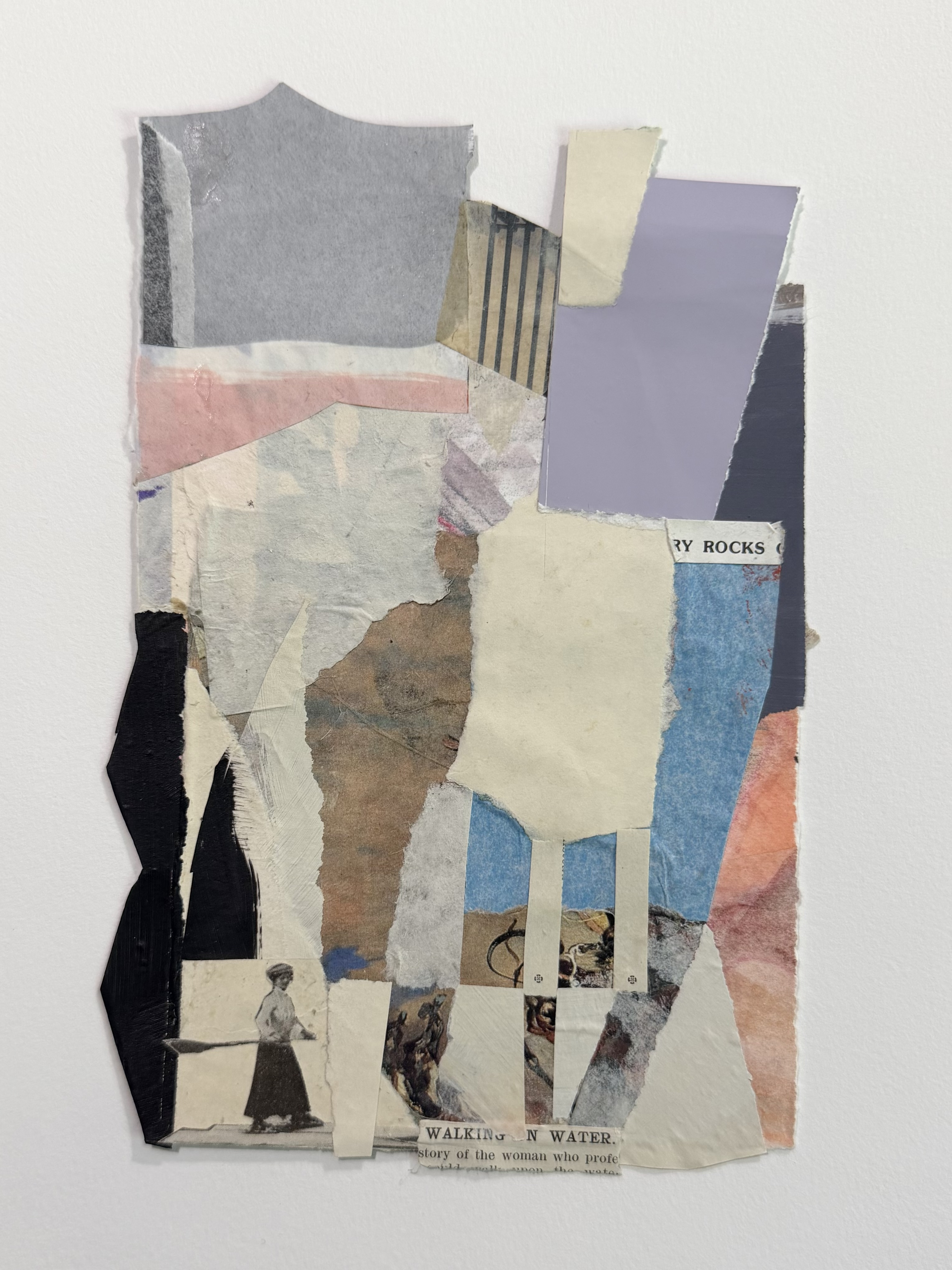
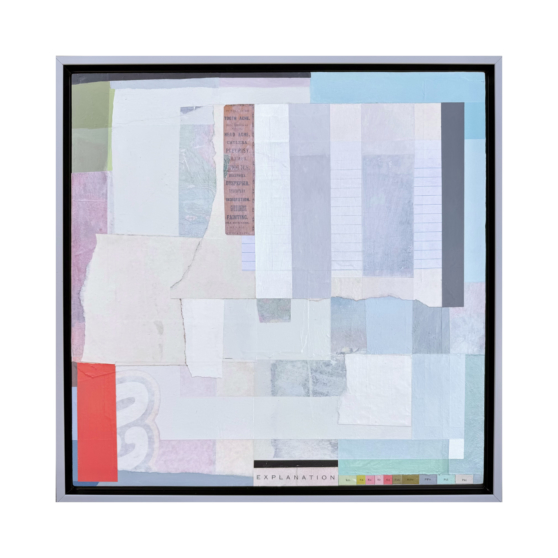
Tony Sobota, sketchbook page, mixed media collage, 6" x 8"
AM: How would you describe your sketchbook pieces? Are these mixed media? Is this a new process for you?
TS: These are mixed media collages. I tend to collect things - paper, dried parts of my palate, maps, or scraps of text. All of these pieces hold visual interest to me.
Color is still the way that I organize them. When I'm making the collage, I'm working very immediately. I move around the different pieces over and over again. Many artists take a break from their typical practice to work on collage because it becomes a highly technical and intellectual process. As I'm focusing on color, a theme will break through the collage. Suddenly, all the pieces will relate to one another. But I'm not necessarily making a collage with the intention of creating a thematic piece. It's just an exercise.
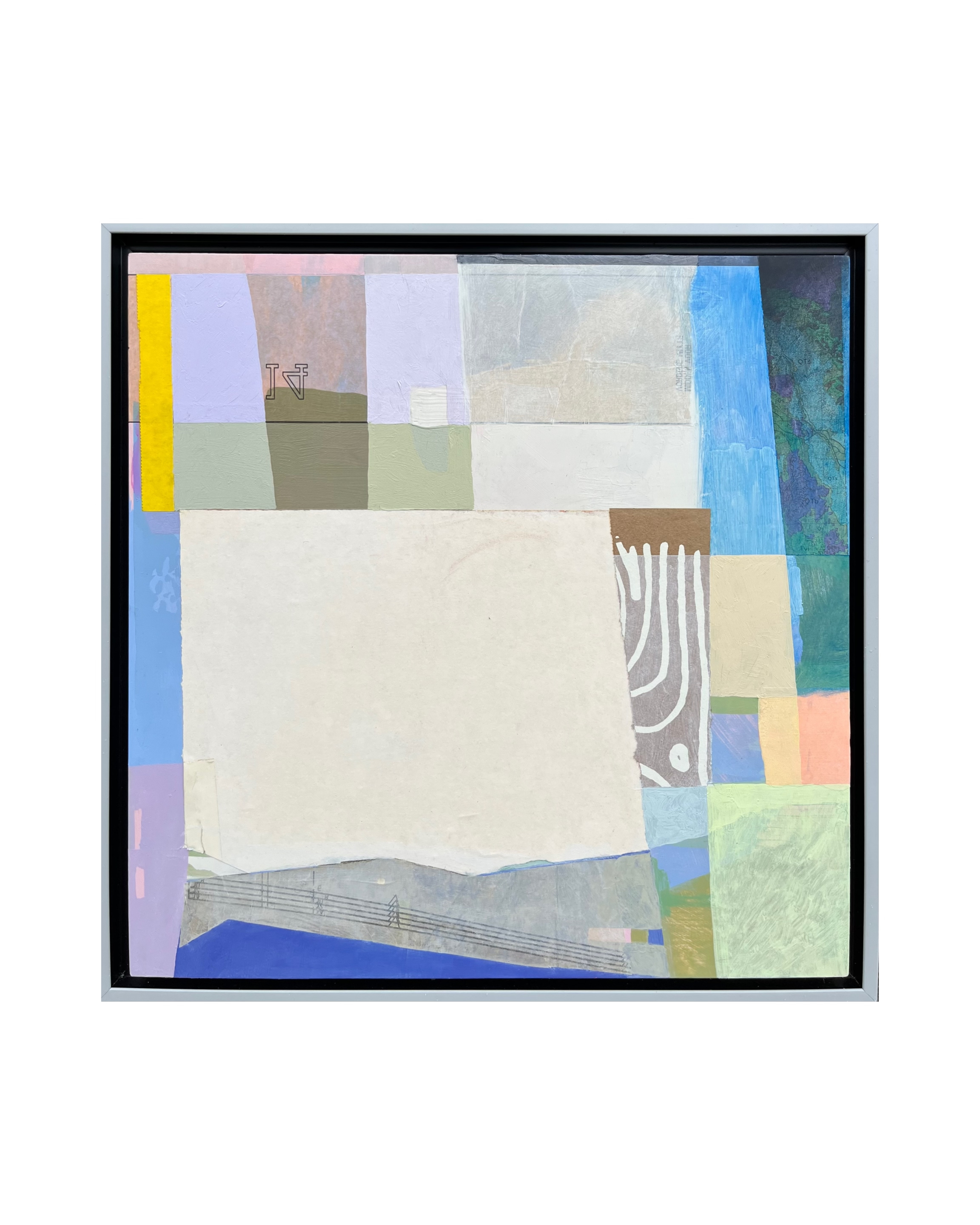
Tony Sobota, What About Collage (1), mixed media collage on panel, 16" x 16"
AM: You described collage as being an immediate form of working. Do you find this to be playful? Less commitment and more exploration?
TS: Absolutely. When I return to painting later, I realize that I can do similar things with the paint. If you have an idea, just go for it. You can always paint over it, and it will be richer...
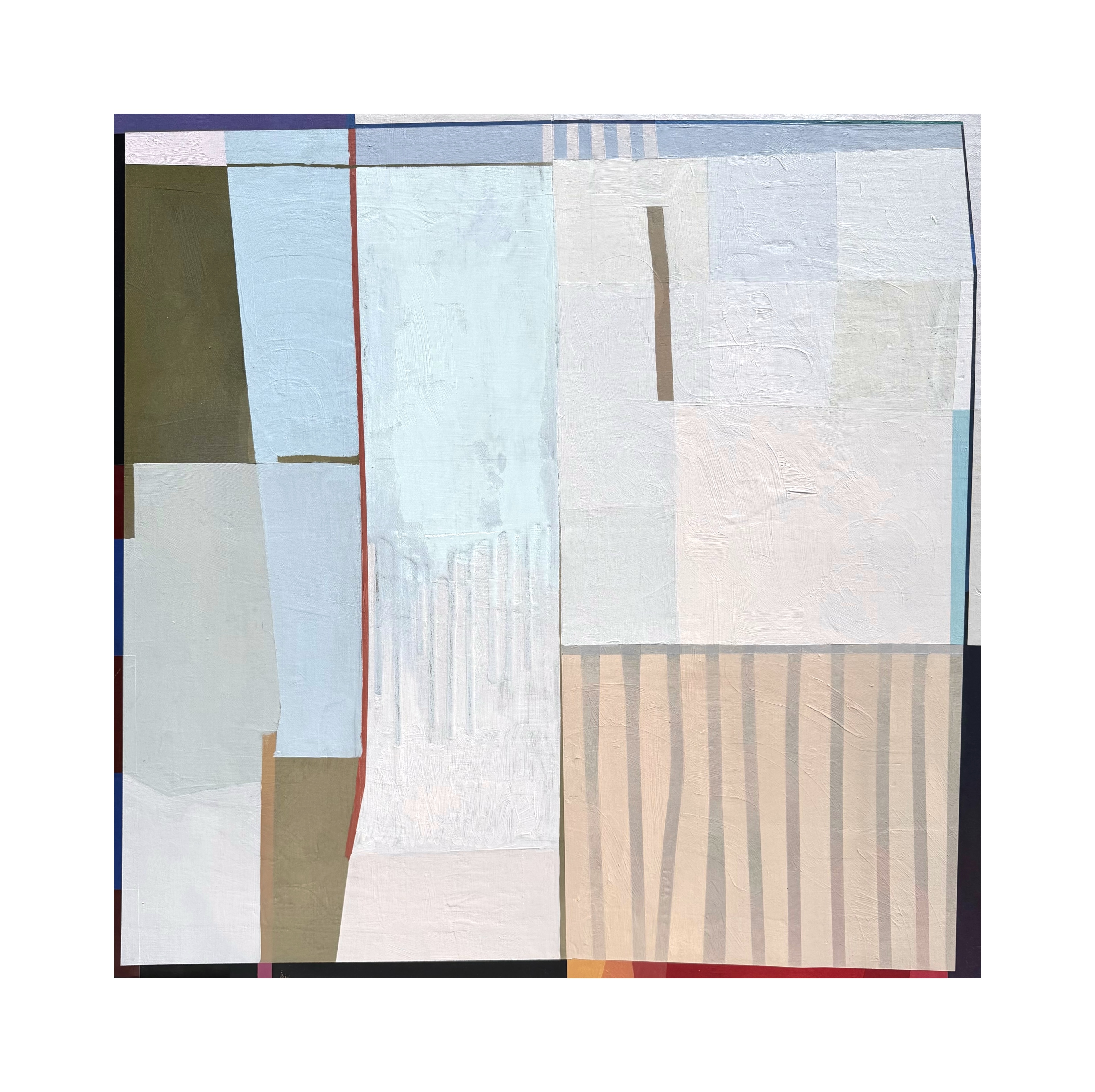
Tony Sobota, City Park, acrylics on panel mounted canvas, 30" x 30"
AM: What role do titles play in your pieces? In a work like City Park, does the title pinpoint a subject for your audience? Or is there something else going on?
TS: That title specifically references Richard Diebenkorn’s Ocean Park series. Here, I'm looking at a way of abstracting a landscape to focus on the feeling of the subject. Pushing to abstraction helps more people experience the feeling of the place than you would just get from a picture of a park. I am not always referencing other artists in the title, but with titles, I like to give a tongue-in-cheek clue as to where I was going with the piece. I did a series of collages that I ended up framing on panels. I ended up calling them “What about collage,” which is a reference to the comedian Gary Gulman. They are just another way of allowing my viewers to experience the painting. After all, that is how I experience work when I'm going to a museum or gallery. I take in the piece, then look at the title and object label, which adds more texture to the piece itself.
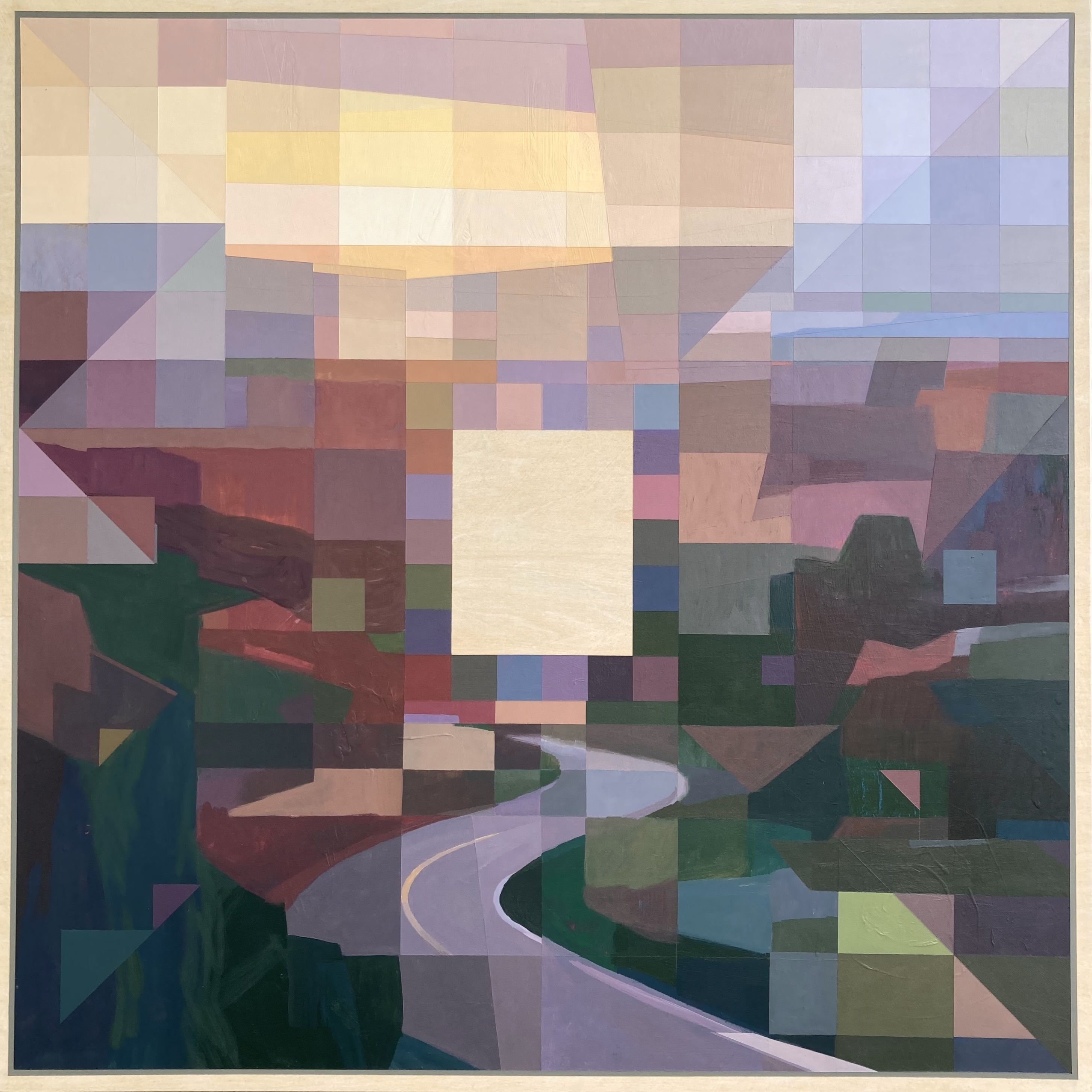
Tony Sobota, Canyon, acrylic on birch panel, 24" x 24"
AM: When you're approaching a painting, what is your relationship with your subject matter? Do you start with a clear subject and allow it to gradually become absorbed into the painting?
TS: I tend to have different bodies of work that each relate differently to subject matter. Sometimes I am direct in my references, such as the various series I have done on the city of Nashville. I have also done some series where my subject is completely abstracted. I am interested in that “in-between” place, looking for an odd mixture of both.
I tend to prioritize the feeling or the emotional experience of a place. My piece Canyon is just a series of shapes and colors–very grid-based. At the same time, it looks like what it is. I think our brains complete the sentences to understand the image.
I also appreciate work that just poses questions. That's where I think artists can really excel - when they stay interested in a question for a long time. I have been really inspired by Zaha Hadid's architectural landscapes. Her architectural practice is known for its cursive, but her paintings are about bending the grid and distorting reality in a certain way. I find this interesting - taking something recognizable and making it very personal.
One of my favorite painters who works with a stretched grid is Jeremy Gilbert-Rolfe, especially his collaborations with Rebecca Norton. Their work challenges and pushes me to explore new ways of working with the landscape.
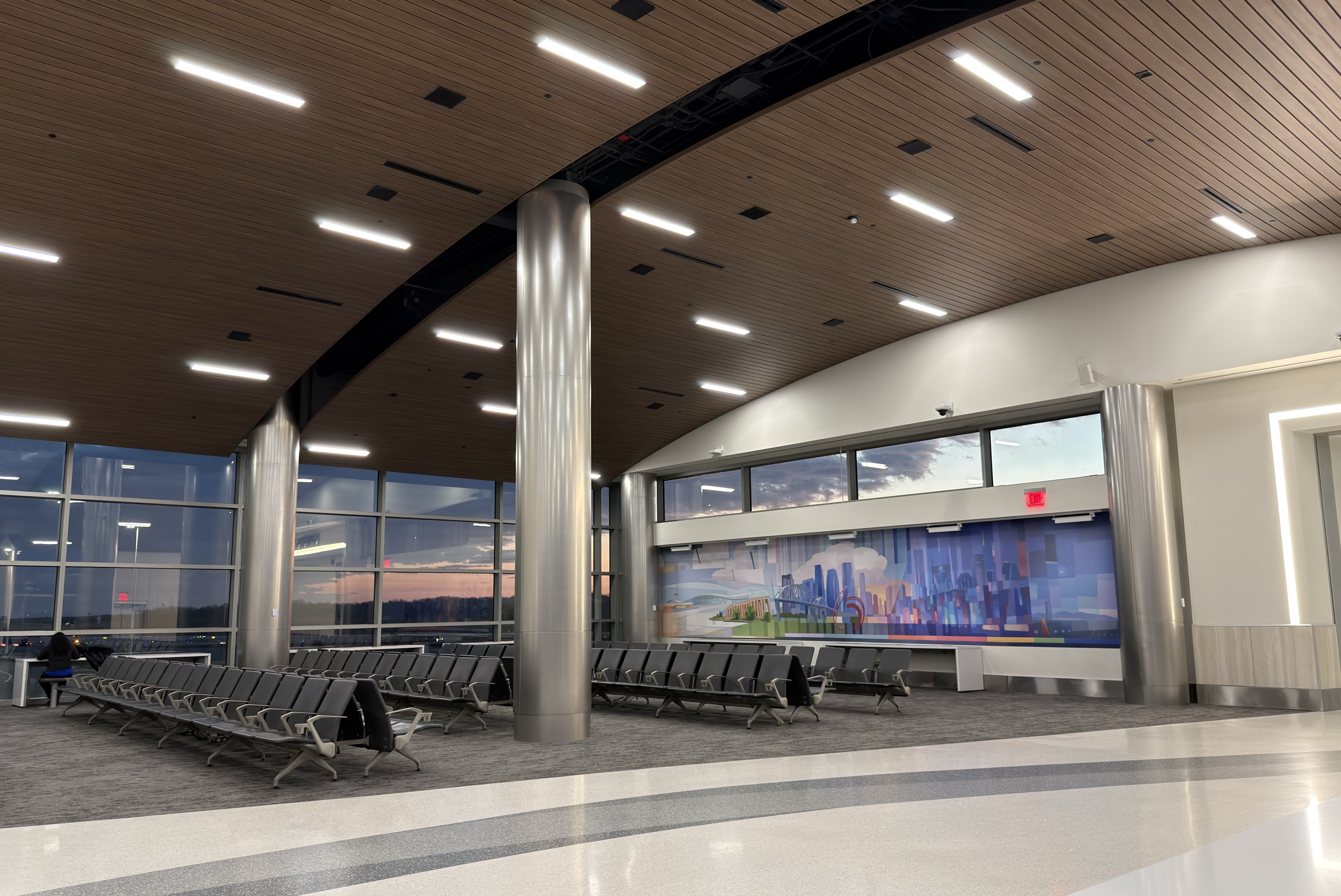
Tony Sobota, Nashville in a Day, acrylic wall mural, 7' x 40' (Nashville Airport Gate D5)
AM: Your work reminds me a lot of Aaron Douglas’s Harlem Renaissance murals. Your airport mural especially reminded me of his work.
TS: Not worthy! That is a huge compliment, considering Douglas’s gigantic contributions to art history and to Nashville. Although I have loved his work for years, he is only more of a recent influence on the murals. I have a deep admiration for what he was able to accomplish both thematically and in having all the formal aspects working at the highest level. Content and craft can either complement or battle each other...
AM: How does your interest in the grid and color play out in your murals? And how does your client’s specific art direction influence that, for example, in your recent airport mural?
TS: The last couple of years I have focused on corporate commissions, really out of necessity. But, I also want to produce things that I love. I tell my clients I will not make anything for them that I do not also love. I have been very fortunate that my clients have appreciated this, wanting something that is consistent with my practice.
Leading up to the airport mural, I had been studying Nashville’s landscape for a decade through my paintings. And so I took a lot of those personal observations and paintings, modified them, and essentially smashed them together to create this transition from day to night. By doing this, I created a piece that I feel represents Nashville, but also my own point of view.
I did not necessarily set out to be a mural artist, but I do enjoy painting large. I love how murals provide people with a way to experience a big painting. I receive a lot of selfies from people, friends and family passing through, or people on Instagram letting me know that they saw my mural before flying out.
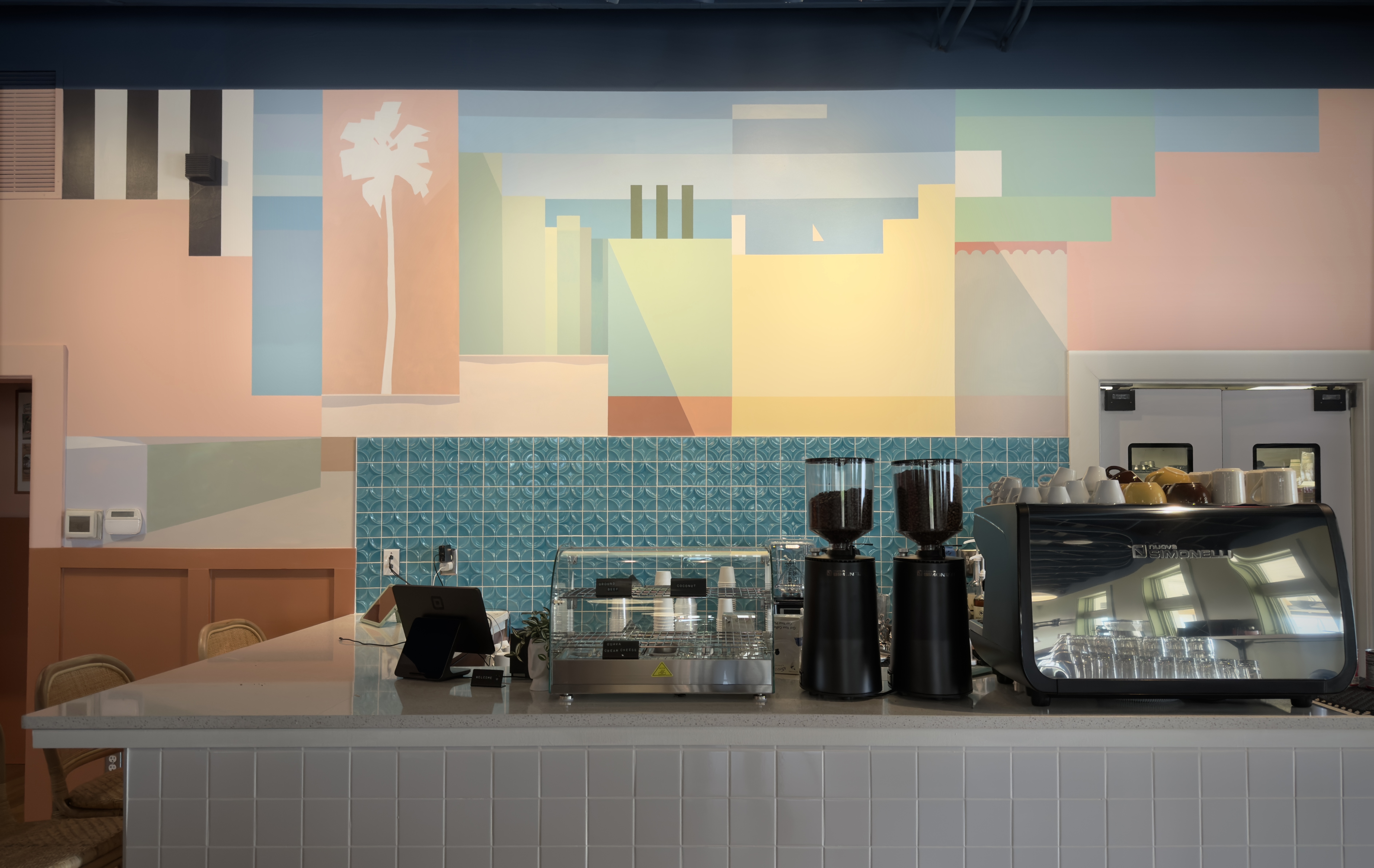
Tony Sobota, Cuban Coastal, 2026, acrylic wall mural, 7' x 12'
AM: I want to hear a bit more about what your practice has been looking like recently. What obstacles have you encountered recently? What has surprised you in this season?
TS: This year has been both amazing and a year of incredible disruption. I finished the airport mural just before the end of last year. Moving into this year, I lost the studio in February.
I had to pull everything back here, get rid of some things, and consolidate. And on top of that, I was dealing with a lot of back pain, which disrupted the whole summer program - family, trips, work, etc.
If anything surprised me, I guess it would be how quickly things can fall apart. I was on bed rest for a couple of weeks, so my wife was working so hard to keep the house together, run the summer schedule, and take care of me. I was not really thinking about the uncertainty of what I will be physically up to in the coming months.
Over the course of my career, a lot of people have asked: How can I make a living from my art? Ironically, I had to deal with the opposite this summer: What do I do when I cannot make a living from my art? I found that when the art is taken away, all you're left with is the people you care about. I do not do well when I have nothing to offer, so it was humbling to just “receive” care, primarily from my wife. But this experience was a great reminder to me of the need to cultivate being a better husband, dad, son, brother, and friend, alongside the work of being a better artist.
AM: There are so many tropes about artists that we've glorified. One of the most common is the “starving artist,” which supports the idea that we have to be all or nothing to be a success. But I think in the end, a lot of people help us get to where we end up.
TS: Absolutely. I think one of the most paradigm-shifting things I have heard and come to believe in the past couple of years is that there are really only two worldviews: connection and separation. We are always moving in one of those directions. I really do want to be about connection. It was hard to do that this summer, physically, as I was not able to make it to people's openings or other events. I am emerging from that, and I hope to be able to get out there more.
Tony Sobota has spent much of the last decade observing Nashville’s rapidly changing urban landscape, forming his interests into an ongoing series of observational drawings and architecturally abstracted paintings. Early on, this Art of Construction series won him first place as a part of the Nashville Arts and Business Council’s Periscope program for rising artists. Among his several grant awards include his Little Kurdistan Community Mural, completed in 2019 and featured on NPR. Most recently he was awarded a large scale commission to celebrate The First Ten Years of the Music CIty Center’s success. His corporate collections also include Verizon, Meta, Metro Nashville, Graduate Hotels, and the Nashville Soccer Club.
Anna Mages is a Senior Intern for Tri-Star Arts.
* images courtesy of the artist