INTERVIEW: SHARON HAVELKA
AUG. 25, 2026
INTERVIEW: SHARON HAVELKA
AUG. 25, 2026
Rachel Bubis: Your work is deeply rooted in your experiences growing up in Memphis as a third-generation Chinese American. How has the cultural landscape of Memphis shaped your practice?
Sharon Havelka: I was born in Memphis and grew up in the 80’s from the generation of Delta Chinese that owned and operated corner grocery stores in neighborhoods throughout the south. My sister and I played in the aisles stocking shelves and breaking down boxes. She would ring up customers on the cash register while I sacked their groceries. My grandparents later had a restaurant where we spent one wonderful summer chopping cabbages, and stuffing wontons and egg rolls. There were also the many Chinese American weddings we attended at the Cook (now Renasant) Convention Center - lavish banquets with ten‑course meals, a thousand guests, and dancing til late into the night.
As I got older, the prejudice directed at Chinese Americans began to settle in, and I found myself pulling away from this heritage. There is a particular kind of identity struggle that many third‑generation kids grow up with - feeling more American than Chinese, yet always seen as foreign. My reaction was a toggle between being the rebellious “young American” or trying to fit that authentic “Chinese” role society wants. Learning to make art, going to Memphis College of Art, was my way of trying to figure out my feelings of what I am versus what is expected.
Then, I started quilting with used materials that my mother gave me. At first, I was focused on the fact they were recycled. It wasn’t until I was offered a show in spring 2026 that I looked at what I had made and found that a common thread ran through the materials: they contained materials from either the grocery store or the restaurant. This concept became my exhibition, Familial Objects, at Shape Shifters in March 2026. It was exciting to approach the past as a creative outlet with nostalgia that is now free to be enjoyed, explored, and celebrated.
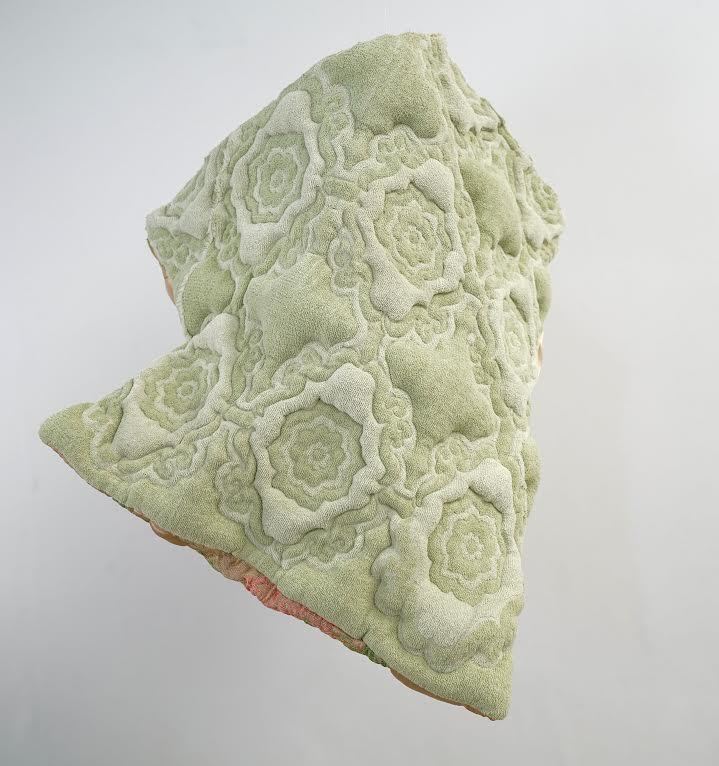
Sharon Havelka, Ohh, 2023, green towel, 18” x 19” x 24”
RB: Many of your sculptures seem to shift between the microscopic and the monumental. At one moment they evoke cells or anatomy, and at another they feel like entire landscapes or ecosystems. What draws you to moving between those different scales?
SH: It’s how I move through space - like walking up Sacre Coeur in France or hiking the Black Forest in Germany to take in the vista, spiraling down to the slivers of grass shooting through a crack in the sidewalk or the tiny sporing of moss growing from a canal drain, then back up to take in the immense sky and universe. I like to imagine myself as the middle point of these two opposing scales, to feel the connection between being an enormous giant or a teeny tiny speck.
I always liked the concept of an enclosed landscape - a vast expanse trapped in a tiny box. I remember as a child being completely entranced by my grandmother’s globe terrarium. I would stare at this little world of greenery with small ceramic animals hiding behind the mosses and bits of wood - trapped in the glass globe. I think it's that feeling as a small child I try to replicate.
RB: You worked as an ICU nurse before becoming a full-time artist. Do your experiences studying anatomy and caring for the human body influence the way you think about form, structure, or mortality in your work?
SH: I loved learning about the human body when I went back to school for nursing. Because of the life drawing classes I had taken at Memphis College of Art, I immediately connected to the bones of the vertebral column - quite a few of my early wall hanging quilts have this skull, vertebra, and rib composition. A few years after becoming a nurse, with my husband and our three children, we moved to Germany where I worked in the ICU at Landstuhl Regional Medical Center. Gaining a deeper understanding of the organic qualities of the human body while moving through unfamiliar European landscapes really invigorated my artistic direction. I experimented more with what defines a quilt. Starting with a little stuffing and cinching, the wall quilts began crawling, then stepping, trying to fly, until finally coming “off the wall.”
There is a relationship between my sculpture work and various aspects of the human body - from the largest organ, the skin, to the millions of microorganisms of the gut biome. As I am constructing a piece, I see the underlying skeletal structure of shape and form, the musculature of overstuffed trapunto, and how color and pattern convey various circulatory systems and perfusions.
Life is not a noun state of being, but a verb of continual action and process. I use the suspension of hanging sculptures by a single monofilament to create shifting perspectives from gentle movements, the tension of balance, and gravity itself, to address the impermanence of life.
RB: Food, cooking, fermentation, and the food chain appear throughout your practice. What interests you about those cycles of nourishment, decay, and transformation?
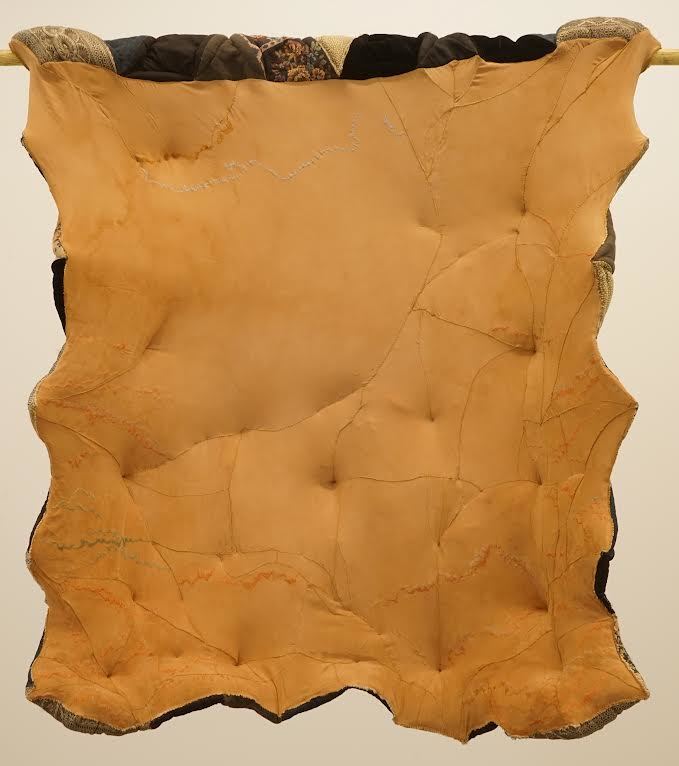
Sharon Havelka, Salmon Skin Fried, 2021, worn out shirts, black velvet pants, upholstery material, other scraps, 39” x 39” x 8”
SH: I love how the salmon skin bubbles when seared on a hot pan, the edges slightly curl, the shiny silver turns golden brown and crispy, how this nutritious part of the fish can become delightfully crunchy and very tasty. Salmon Skin Fried, through stitching and stuffing of various textiles, transforms this notion of the discarded into a beautiful and intricate tribute to the delicious.
There is also a condiment called “Fermented Beancurd” you can buy at the store. It’s made from cubes of tofu that are inoculated and left out to grow a covering of white fuzzy mold. The tofu is then soaked to ferment in rice wine. I've only seen photos, but I think it’s beautiful. It’s got B vitamins, great on Chinese spinach or long beans, and a little goes a long way. Hairy Tofu is about highlighting this microbial world through texture and color with tufts of wispy hairs, translucent layers of fabric, and fine detailed embroidery.
I am intrigued by not just the process of fermentation, but also the variable social perception (from delight to disgust) of fermentation - what we think of as decay is really an effervescence of nourishment and health. The human body is engineered from a world of microbes - vcboth inside and out, from cellular to skin. We are not but the microbes we house!
RB: You often incorporate secondhand textiles from friends and family into your work, including materials from your grandparents' restaurant and grocery stores. How does knowing the history of those materials shape the work?
SH: I like the unique one-of-a-kind aspect of gifted textiles; knowing who and where materials come from gives lineage to each piece. I also invite people to find photographs of themselves from around the time they used their given textiles. These photos are then displayed to personalize and give context within time to the materials.
I look at and listen to the materials as they often tell me how they can be transformed – how they can be stuffed, how they can move, if they can be dyed or stained, and what new story can be told.
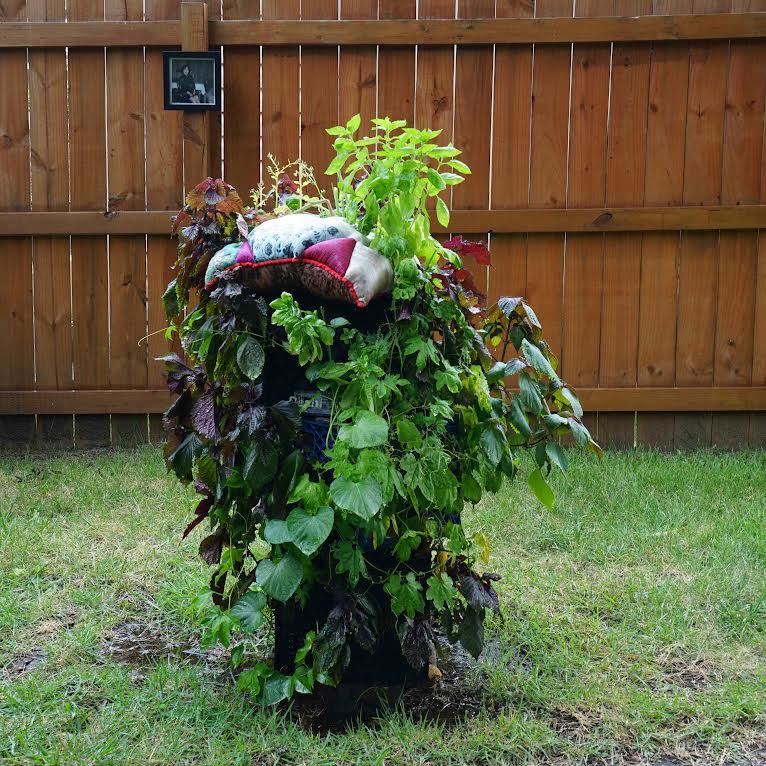
Sharon Havelka, Wait Still, 2026, milk crates, garden plants, photo, 44” x 20” x 20”
RB: Do you give people prompts about the kinds of materials you're interested in - certain colors, fabrics, or textures - or is it always a surprise what they bring you? How do you decide what belongs in a piece?
SH: I am open to people giving me whatever they want. Often that unexpected color or pattern of a fabric sparks an idea I never would have pursued on my own. That surprise element is incredibly freeing.
Using old shirts and dresses has opened the door for my parents to offer even more objects such as ice tongs and milk crates. My dad will curiously ask, “What can you make with this?” Sometimes I use things instantly, and sometimes it takes years to get over the preciousness to cut something up. Some projects begin, but never finish. Sometimes the object must decide if it becomes an art piece or not.
I recently ordered a fabric shredder so I can turn all my leftover scrap materials into stuffing. Until now, I’ve been hand‑cutting old clothes into small squares along with reused pillow batting. I really want to use every bit of material nose-to-tail, so to speak.
RB: Have you ever been surprised by someone's response to your work?
I am most surprised and excited by my parents’ response. To first and second generation Chinese Americans, being an artist is counterintuitive to their immigrational work ethic. But even if they didn't quite understand “art” or what it means to be an “artist”, they have always been supportive.
I remember asking my father for an old garage rag - which was actually one of our childhood towels. It was threadbare and mossy green with a floral pattern. My parents were very surprised to see the towel turned into a voluminous, surreal sculpture. They then proceeded to search for the rest of the set to give me.
After this new understanding my father told me, “Art is about seeing something differently, seeing in a different way.” I really like how, for them, these objects of the past that were known only as work related items can now be appreciated for their beauty in this transformed state.
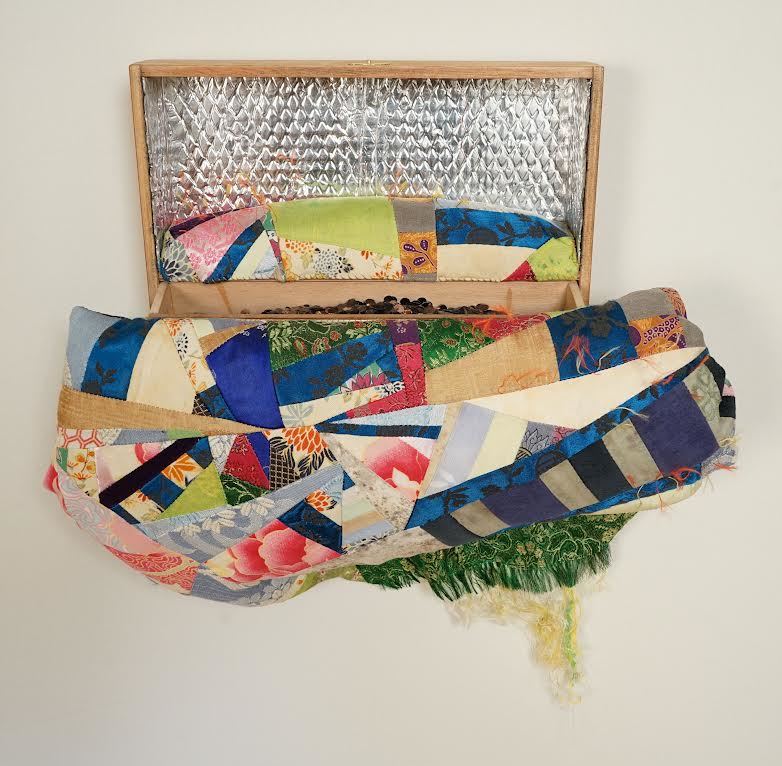
Sharon Havelka, Soundproof Forest, 2019, soundproof material, cigar box, 20” x 18” x 6”
RB: In Soundproof Forest, you reference George Berkeley's famous question, "If a tree falls in a forest and no one hears it, does it make a sound?" and transform it into another: "If a person could do something that no one would ever know about, what would that person do?" Have you spent much time answering that question for yourself? Has your answer changed over the years?
SH: Yes! “Who am I?” is a continual question that I ask myself. The answers have evolved over the years. To question is to try and understand one’s own nature. I ask myself, how would I really act without any pretense or expectations? Can I be my true self with others? What is primordial nature vs. ego? Does altruism truly exist?
Making art and showing art is a great example of dealing with these questions. I can create art all day long alone in my studio, making what I want, how I want, etc., but to stand up and reveal to other people what it is about, is something I have had to gain the confidence and learn the verbal skills to do so. Also, am I continuing to make what I really want to be making or what others want to see? And what is a healthy balance of influence?
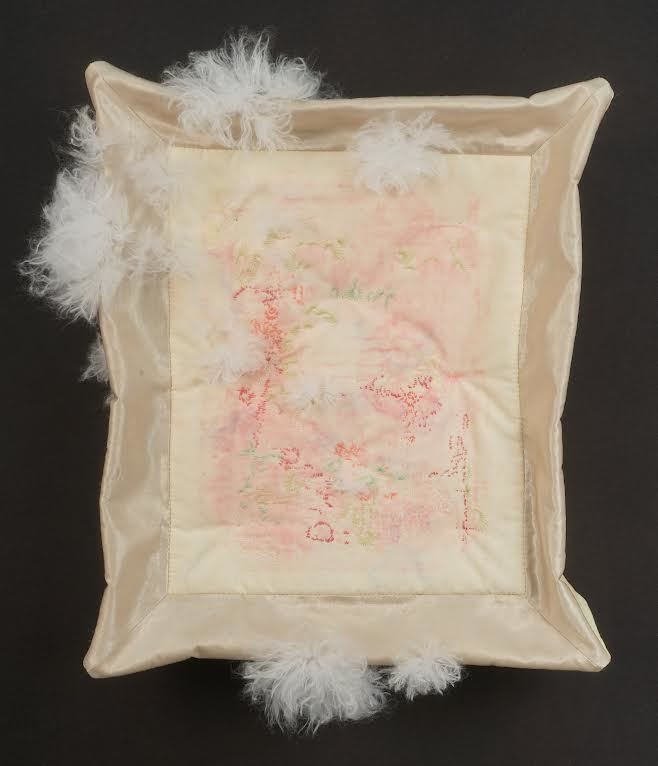
Sharon Havelka, Hairy Tofu, 2020, the tofu is made from my grandmother’s curtains and other linens, a pink print is pulled from a family anniversary party gift book setting the backdrop for a hand embroidered microbiological landscape, 17” x 14” x 5”
RB: Some of your pieces feel like living organisms, as though they're growing or evolving on their own. Does it ever feel like they develop a personality or begin directing you toward their final form?
SH: I never know how my sculptures will end up. I begin with an idea of where I want it to go, but the distortion of overstuffing takes its own direction. I can control it to a point with quilting and cinching, but I also like to see what the materials can do, how it stretches when stuffed, how shape changes color and pattern, etc. Because some pieces are hung from the ceiling, gravity, and balance come into play when creating shape and form. The materials tell you what they will become.
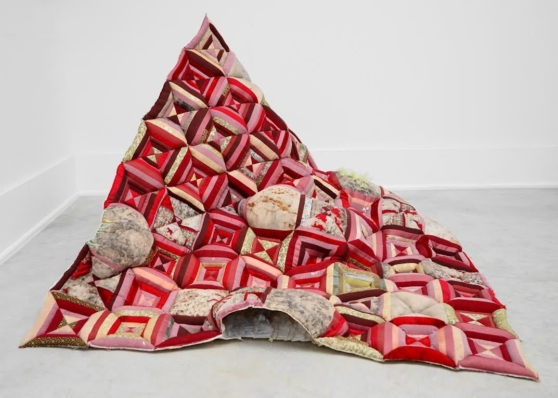
For The Eclosion and Circadian Rhythm, I knew I wanted to work with these two red towels edged with wide borders, though I couldn't predict how the geometric shapes would stretch once quilted and stuffed. As the red towels puffed up and the quilted borders began to ripple and warp, the shape and underlying idea started to emerge. Cinching is then used to either accentuate or stabilize that form.
RB: Several of your works are simultaneously inviting and a little unsettling. They're soft and tactile, yet they can evoke insects, organs, fungi, or other things that make viewers uneasy. (I think I have a little bit of trypophobia, and this occurred to me while looking at your work). Are you interested in creating that tension?
SH: Then I guess I have the opposite - trypophilia?! I do find wispy molds and empty wasp nests beautiful (but draw the line at spiders). These oddly grotesque things often go unnoticed and overlooked by society, but I want to present them as exquisitely beautiful - I want them to be seen.
My work balances contrasting ideas: positives and negatives, micro and macro, pattern and chaos, beauty and the grotesque. I am definitely drawn to this interesting relationship or tension of opposites.
RB: What are you working on now, and what's next?
SH: I am preparing for my exhibition, Familiar Remnants, at the University of Memphis Fogelman Galleries, in January 2027 as well as Six for Ten, November 14 through December 12 at Studiohouse on Malvern which is a 10th anniversary show for my art group Six Points.
In addition, I recently made my first living sculpture, Wait Still, which is literally growing at Studiohouse on Malvern. I stacked three grocery store milk crates, filled them with soil and topped them with a stuffed sculpture made from a corner of embroidered tablecloth. This tablecloth came from my parents’ friend’s mother, Ms. Bing, and a photograph of her from the 1970's hangs nearby. Inside the sculpture I planted a small ecosystem of kitchen-scrap scallions, pink radishes, and sweet potatoes. I also planted bitter melons from my mother, purple shiso from my neighbor, passion fruit vine from another neighbor, and basil seeds from my husband. These were all sown in the grid of diamond shaped holes on the sides of the crates and have grown to cover the milk crates that house them.
I’ve been watching this sculpture take shape over the last couple months - bitter melon spiraling tendrils grappling upward, little pink radish leaves towering with little pink flowers, and purple shiso leaves growing out of the sides, leaves wide open… I will definitely be making more of these sculptures.
Sharon Havelka was born and currently lives in Memphis, TN. She experiments with the traditional craft of quilting by using clothes, linens, and other found materials given to her by family and friends. The history and experience of the three generations of her family who once immigrated from southern China to the Mississippi Delta are worn in these unique, threadbare fabrics. As also an ICU RN she is inspired by the physiology of the body and brain, permeating her art as shape, form, and function. She received her BFA from Memphis College of Art. Her work has been shown in local, national, and international shows such as Delta Arts, Quilt National, and Fiberart International. She received the Arts Accelerator grant, was a Crosstown Arts resident, and had a solo show at Christian Brothers University.
Rachel Bubis is a Nashville-based independent arts writer, regular contributor to The Focus blog, and LocateArts.org Web Manager for Tri-Star Arts.