INTERVIEW: LAURA CLEARY WILLIAMS
FEB. 11, 2026
INTERVIEW: LAURA CLEARY WILLIAMS
FEB. 11, 2026
Daniel Holdridge: Your practice is anchored in drawing. Through multiple technical and material processes, you’ve demonstrated a sincere interest in what the formal elements of drawing can accomplish. What are some qualities of drawing (historically, technically or otherwise) that invite this kind of focus, for your work?
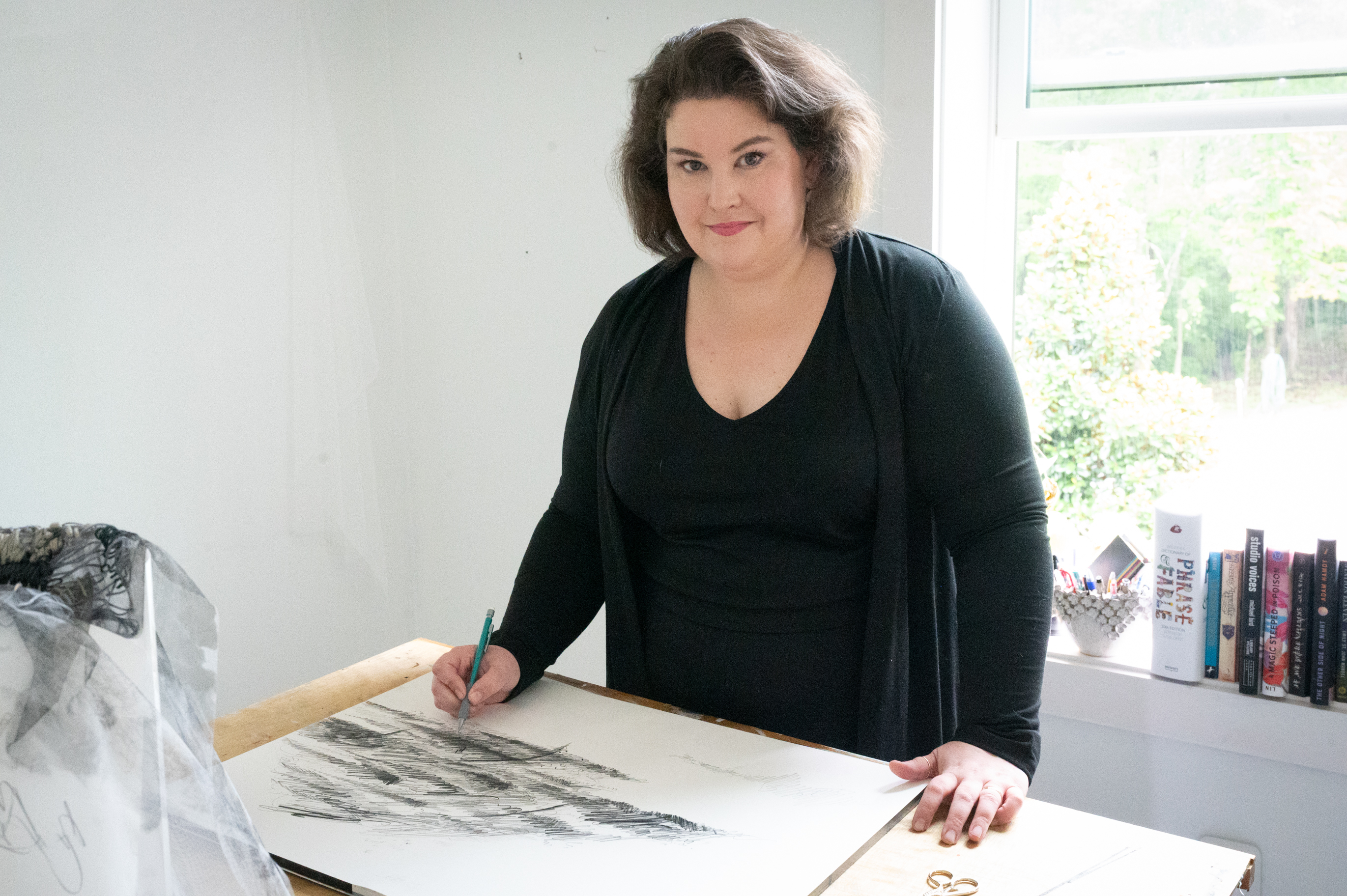
Laura Cleary Williams: I think I want to say drawing was the first thing I was doing, but that’s not true. What happened was I fell in love with printmaking. Through learning about printmaking, I discovered that it was based in drawing. What I can do with a print is repeat the same thing over and over again. But what I can do with a drawing is change it a little bit every time.
Drawing has always been the anchor of my practice because it is both immediate and cumulative. Historically, drawing functions as a record of thinking rather than a finished declaration. It holds hesitation, repetition, and revision in a way few other media do.
Technically, drawing allows for an intimate feedback loop between the body and the surface. A mark is made, and the next decision is shaped by that mark’s presence. For my work, this immediacy aligns with an interest in memory, duration, and accumulation. Drawing lets me stay close to time as it unfolds, rather than stepping back into a purely conceptual or illustrative space.
Those formal, technical concepts are what I’m interested in. But it’s also like I really don’t think my work is complete until it’s viewed. That conversation between myself, the piece, and the viewer - I think sometimes paintings get in the way. Sometimes the experience of a sculpture gets in the way. Sometimes we’re seeing the technique before we’re actually experiencing the piece.
DH: You hold a Master’s degree in Printmaking from SCAD Atlanta, and have collaborated with noteworthy printmakers such as Kiki Smith and Valerie Hammond. Your current oeuvre is composed mostly of drawing or otherwise drawing-related objects. How has your education as a printmaker and your experience with artists like Smith and Hammond shaped your drawing practice, if at all?
LCW: My background in printmaking reinforced this orientation. Printmaking trained me to think in layers, sequences, reversals, and systems. Even when working singularly, I approach drawing with a printmaker’s sensibility: thinking about pressure, transfer, residue, and repetition. Working with artists like Kiki Smith and Valerie Hammond clarified for me that rigor and vulnerability are not opposites. Smith’s work demonstrated how drawing could be bodily, symbolic, and materially experimental without losing intimacy. Hammond’s teaching emphasized discipline, structure, and generosity toward process. Together, those experiences encouraged me to trust slow accumulation and to let material intelligence guide conceptual clarity. My drawings are not preparatory; they are sites of sustained inquiry.
Laura Cleary Williams
DH: How did working with someone like Kiki Smith shape your practice?
LCW: One of the reasons that I was drawn to SCAD’s graduate program was its publishing wing. Lots of wonderful artists worked with the program. While I was there, there was a sort of secret conversation that someone big was being brought in. It turned out that Kiki really wanted to go to France, to Lacoste, to see the lavender fields. SCAD has a location in Lacoste. She wanted to go to SCAD and do a project so that she could see the lavender fields. One of my close friends in the art world was chosen to be the printmaker working with Kiki on the project. And I said, “That’s great. Do you guys need coffee? Do you need somebody to tear paper, do you need somebody just to be there?” My presence, along with other colleagues who were roped in, allowed the project to go from one print to eight.
So I went from getting coffee to a being printmaker on all eight editions, as well as master printing on two editions with Valerie Hammond (Hammond is a close friend and co-teacher of Smith), and ultimately becoming assistant project manager over the whole edition.
I was shipping things back and forth from New York. I was developing photolitho plates. I was helping take pictures of Kiki Smith’s back. I was talking to her about insecurity regarding her practice. She would work a twelve hour day, to exhaustion, advocating her practice as well as her father’s work (Modernist sculptor Tony Smith). She was so present for her practice through her pain, through her endurance, through her every day.
It was incredible to watch someone who wasn’t just passionate but professional, and that professionalism is something that I’ve held very near and dear to my heart, through my practice. Being around somebody who I was that inspired with did more for my practice than going through school.
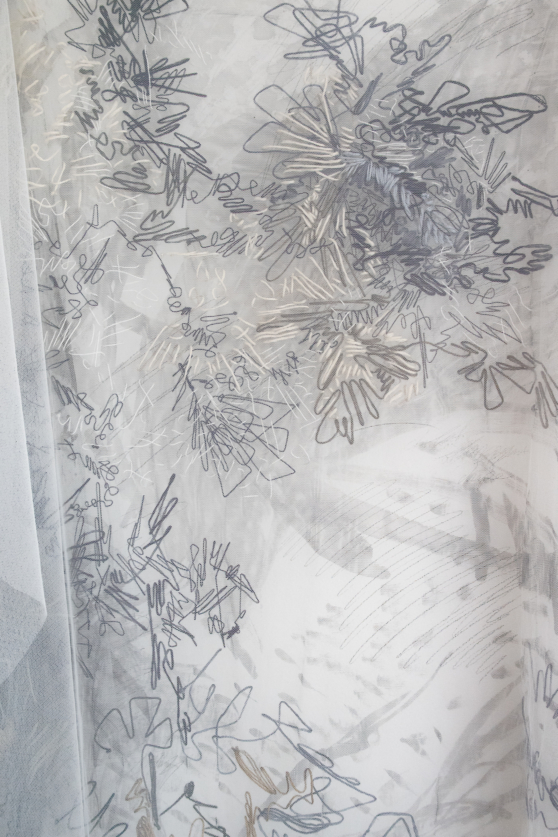
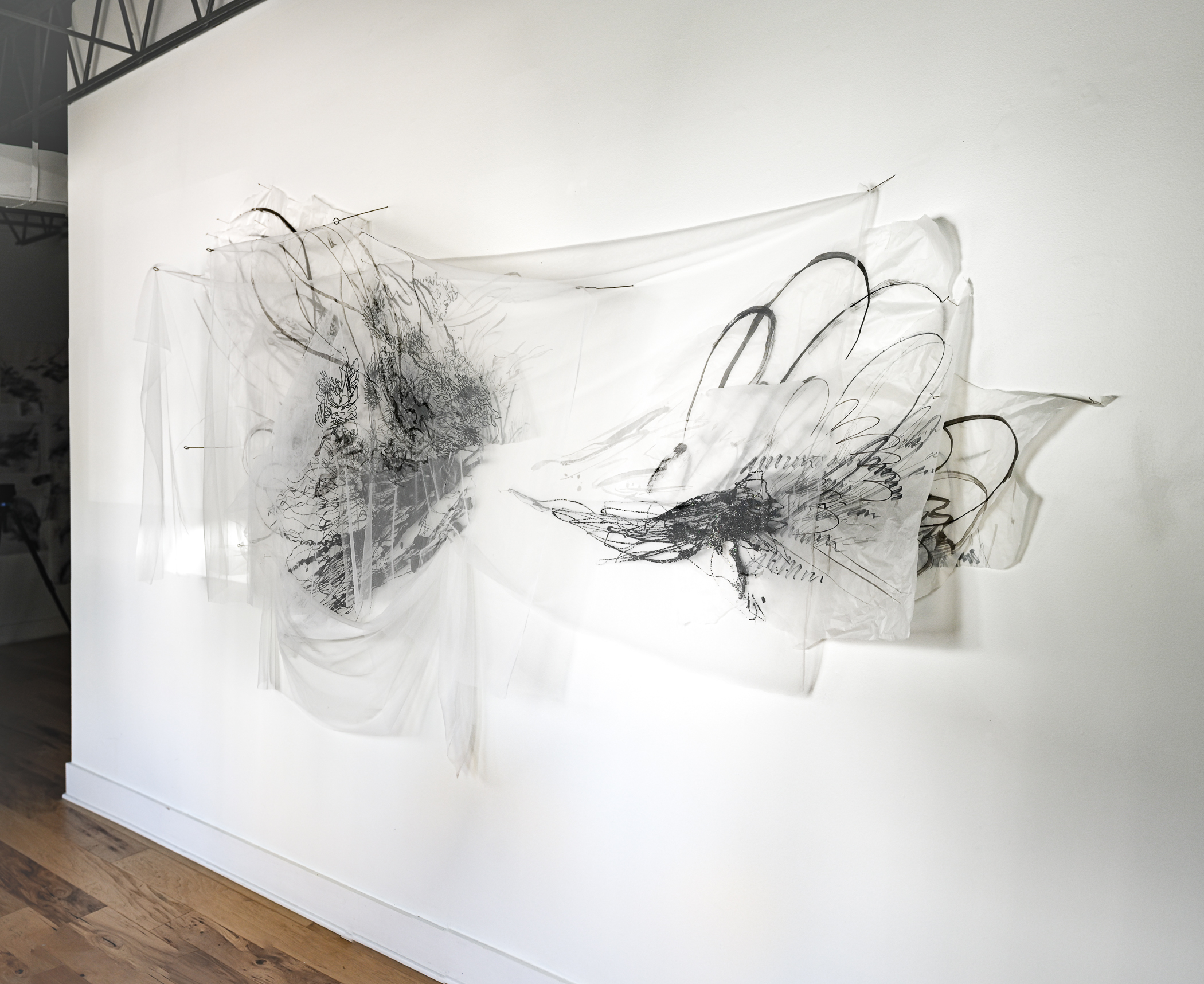
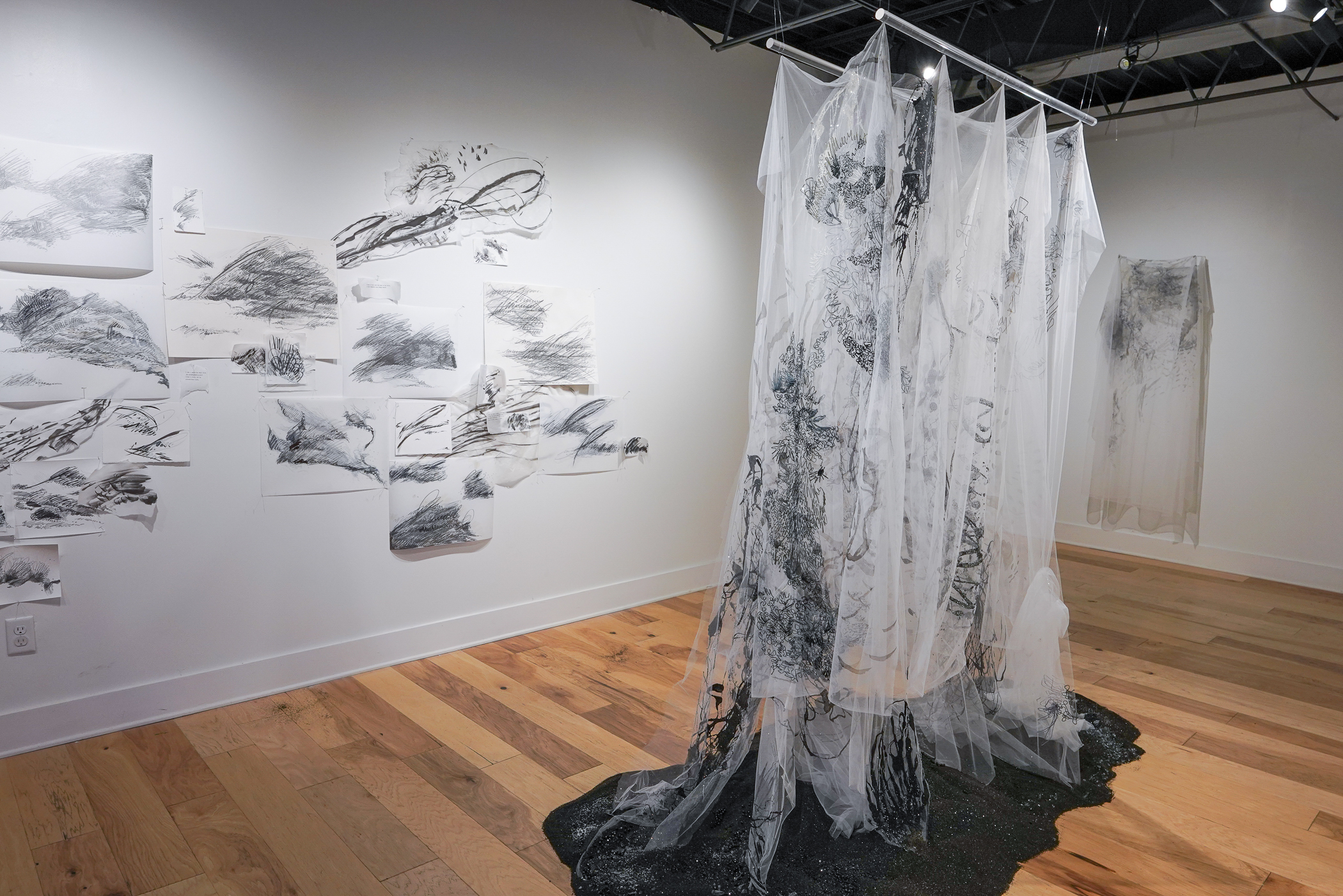
DH: Lately, your practice has expanded to include three-dimensional fabric artifacts, retaining your characteristic mark-making, but suspended in layers of silk tulle netting fabric, rather than being arrayed on paper. You’ve described these works, many of whose installation layout is variable, as ‘puzzles’ or ‘quiet games’. Can you describe the experimentation or research process that contributed to the recent Beyond the Veil series?
LCW: The recent shift into three dimensional fabric works emerged organically from questions drawing could no longer fully hold on paper. The Beyond the Veil series developed through extended experimentation rather than a fixed plan. I began working with silk tulle because of its translucency and resistance. It does not behave like paper. Marks sink, hover, or disappear depending on tension and layering. The process became one of testing how a drawn line could exist in space, how memory could be suspended rather than fixed. I describe these installations as puzzles or quiet games because they are modular and relational. Each panel responds to the others, and the installation is completed through movement and navigation. The research was slow and physical: stitching, drawing, unpinning, reconfiguring. Meaning emerged through repetition rather than assertion.
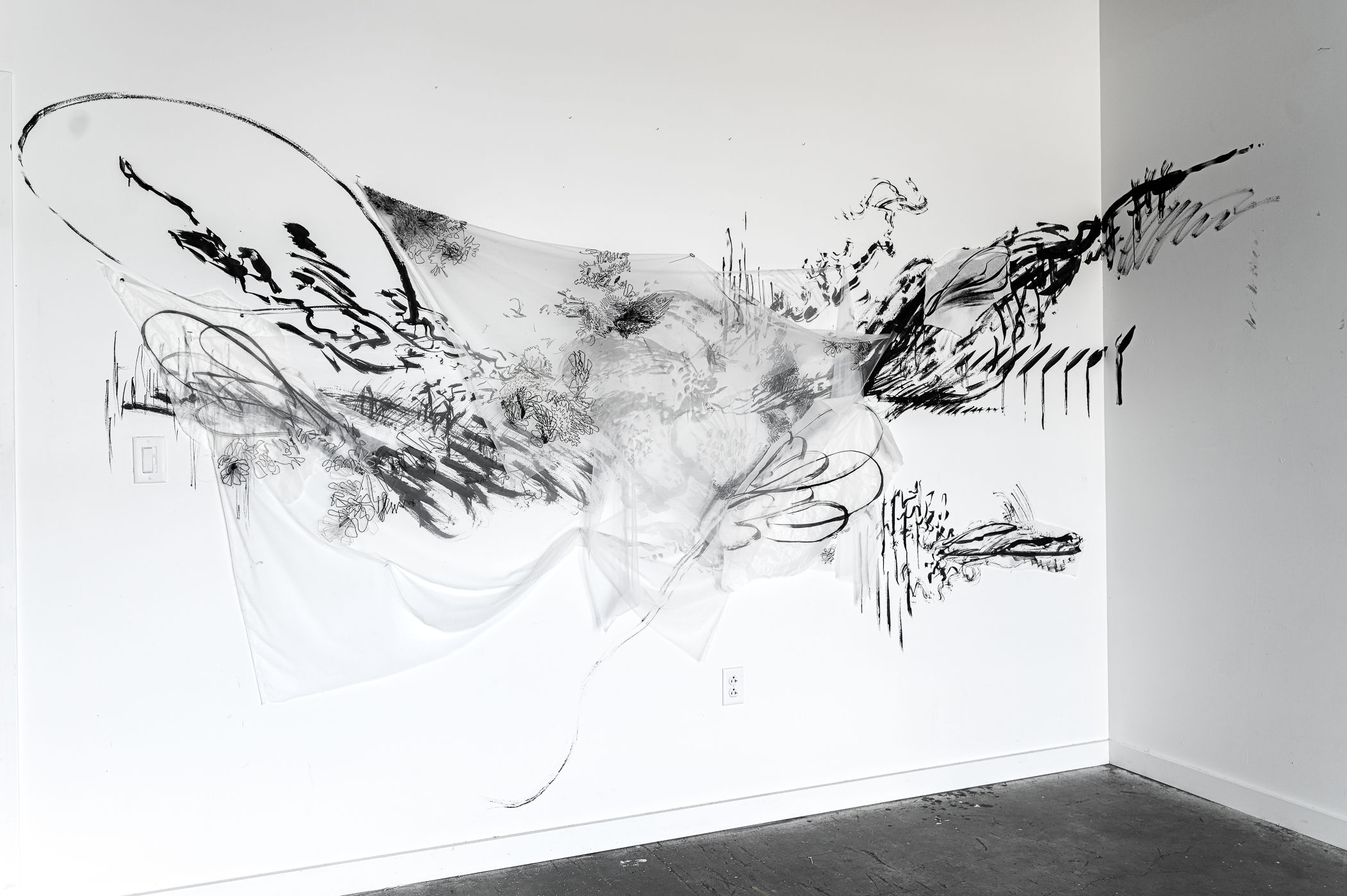
I want to be doing twenty, thirty foot panels in an industrial space. That same conversation, but scaled up. What’s interesting is that body size is translating better. For Stove Works, I was able to paint a mural in the staircase that goes up to the studios. It felt like being able to take a full breath.
Laura Cleary Williams
DH: Currently, you are the education director at AVA (Association For Visual Arts) in Chattanooga, TN. In this role, you oversee multiple programs that help local artists to develop professional skills as well as foster their own creative goals. How would you describe the relationship between your role as an educator and your role as an artist?
LCW: My practice is my heart, my soul. I think some people come to faith the way I come to art. It is so important to me. My practice will always come first. That being said, I found that working in isolation lacks reward.
My role as an educator is inseparable from my role as an artist. Teaching keeps me accountable to clarity, while my studio practice keeps my teaching grounded in lived experience. Working artists do not need abstract encouragement; they need practical tools that respect the realities of time, money, and emotional labor.
I have made big mistakes. As an educator, I hope to help steer other artists away from them. I want them to stay true to their practice, and it’s easy to teach because I’m passionate about it. I want to get people as excited about their practice as I am about mine.
Art education for working artists strengthens an arts community by reducing isolation and demystifying professional pathways. In Chattanooga, this is especially important. There is extraordinary talent here, but artists often lack access to consistent mentorship and sustainable systems. Education becomes a form of advocacy. It helps artists stay in the city, build longevity, and contribute meaningfully to the cultural ecosystem.
DH: A more specific component of your role as an educator is its geographical location. The art ecosystem of the South, particularly Chattanooga, is noticeably dissimilar to places like New York, Philadelphia, or even Atlanta. Does this difference in culture impact what you emphasize in education programs?
LCW: Most people don’t know who Kiki [Smith] is when I’m having a conversation. They’re like ‘Oh, an artist’, and I’m like no, you don’t understand. It’s eye-opening for me, for people not to get it. It’s a reminder that being classically trained is a part of it. But what I can impart is how important research is. Understanding your place in the conversation. I understand who my heroes are because I’ve met them, I’ve studied them.
I think one of the things that I’m struggling with, as an educator, is the research. The commercial artist comes to me and they want to know how to sell their work. I tell them that they should make work that is authentic and speaks to them, so that it speaks to others. You can’t do that without understanding the greater conversation that your work is a part of.
Laura Cleary Williams
DH: How can artists with more academic or traditional backgrounds interact with emerging or commercial artists?
LCW: Mentorship. I think the trick is having somebody who’s giving you permission and community. These artists need to be talking to each other, because they have so much to bring to bear. The emerging artists have so much to teach established artists, to remind them why they started. This is where we should be desegregated, we need to be talking to one another. That’s what makes an ecosystem.
DH: Your Instagram account provides a robust and relational survey of your work, offering context for current projects and reflection on earlier work. At a time when artists’ relationship to social media is fraught with debates over LLMs, image-generating software, and other issues of digital identity and ethics, how do you navigate social media platforms?
LCW: You need to make sure that what you’re practicing is accessible, so that there’s an archive of it, a record of the passion that you’re bringing to enrich the conversation. Are there many, many faults to social media? Of course. I choose to approach social media as a tool rather than a metric. My Instagram functions as a visual archive and a relational space, not a performance of productivity. I am thoughtful about what I share and why. In a moment when digital identity is complicated by AI and image generation, I prioritize transparency, context, and authorship. I post work in progress alongside finished pieces and reflect on process rather than polish. For me, ethical engagement means resisting speed and spectacle in favor of presence and care.
Laura Cleary Williams
DH: Many of your larger 2D works are reminiscent of the calligraphic abstraction of painters like Cy Twombly, as well as the contemporary illustrative work of other artists like Ethiopian-American printmaker/painter Julie Mehretu. Are there historical or contemporary artists that you understand yourself to be in dialogue with?
LCW: I do see my work in dialogue with artists like Cy Twombly and Julie Mehretu, particularly in their understanding of mark making as language and landscape. I am also deeply influenced by artists who navigate fragility and persistence through material, such as Eva Hesse and Ann Hamilton. Locally, I am continually inspired by artists who sustain thoughtful practices outside major markets. Seeing how peers build lives around work rather than around visibility has been grounding and motivating.
DH: If you could meet one artist, living or dead, who would it be?
LCW: If I could meet one artist, it would be Agnes Martin. Her commitment to restraint, discipline, and spiritual clarity continues to resonate with me. She understood repetition not as redundancy, but as devotion.
DH: You recently finished a residency at Stove Works as well as an exhibit at Wavelength Space. What’s next for you, and what do you hope to explore in 2026?
LCW: After completing my residency at Stove Works and my exhibition at Wavelength Space, I am entering a period of refinement and expansion. In 2026, I hope to deepen the spatial possibilities of the tulle installations, experiment further with scale, and integrate sound and moving image in subtle ways. I am also focusing on residencies that allow for sustained time and on building partnerships that support immersive exhibitions. More than anything, I want to continue asking how drawing can move beyond the page while remaining intimate, deliberate, and human.
* photos courtesy of the artist
Williams will exhibit her work at the Affordable Art Fair in New York, in March 2026.
Laura Cleary Williams lives and works in Chattanooga, Tennessee. She holds an MFA in Printmaking from SCAD (2012), and a BFA from the School of the Museum of Fine Arts at Tufts University (2009).
Daniel Holdridge is a Chattanooga-based independent arts writer, and new contributor to The Focus blog.