INTERVIEW: JOCELYN MATHEWES
JUL. 07, 2026
INTERVIEW: JOCELYN MATHEWES
JUL. 07, 2026
Faira Herod: You stated that what the body loses, an art practice can make visible and transmissible. Has this idea played a role in leading you to create art in response to your chronic illness? How has this act of creating art helped you overcome what you cannot control in your own body?
Jocelyn Mathewes: Generally, I make art out of fixation, whether that be from a desire to understand, a fascination, love, or frustrated preoccupation. I make in order to explore the mysteries of the world. Sickness is one of those mysteries that I explore in my artmaking. This body of work about illness came out of my fascination and frustration with the ongoing paradoxes of a body that “attacks” itself, and the parallel beauty, strangeness, and dysfunctions of the medical arts. It is the nature of chronic illness to be somewhat invisible, so making it visible is one way of exploring it.
“Overcoming” is a sensitive - often irritating - word for the disabled and chronically ill. It’s easy to feel pressure to succumb to the gravity of fitting into a narrative of triumph and success. I rejoice when sickness transforms into a state of restored function for anyone, and rightly so! But also - as my sculptures Never the Same Again explore - the state of “wellness” can be achieved through a broadened definition: adaptation, accommodation, environmental changes, or a new, perhaps expanded purpose.
So, the work is not about exerting a force over what I cannot control. It is more facing it directly, an encounter with the unknown and unpredictable. I think of attention as a form of love or an investment. I pay attention to and invest in the radical notion that bodies that are ill have enormous, unmeasurable value.
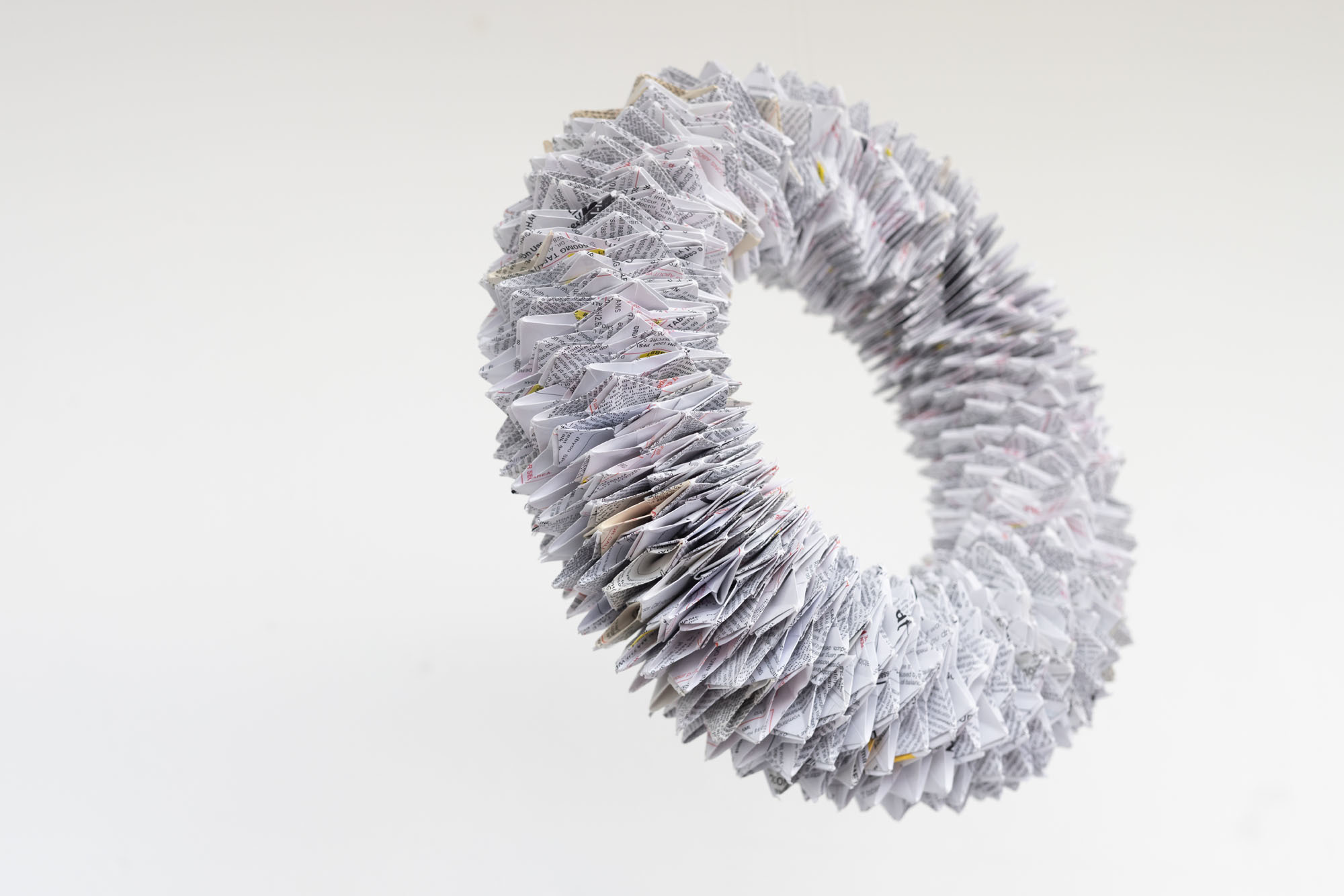
Jocelyn Mathewes, Symptoms/Side-Effects, 2020-2024, spiraling paper loop of individual origami elements made from prescription sheets, suspended 2020-2024, 14” x 14”
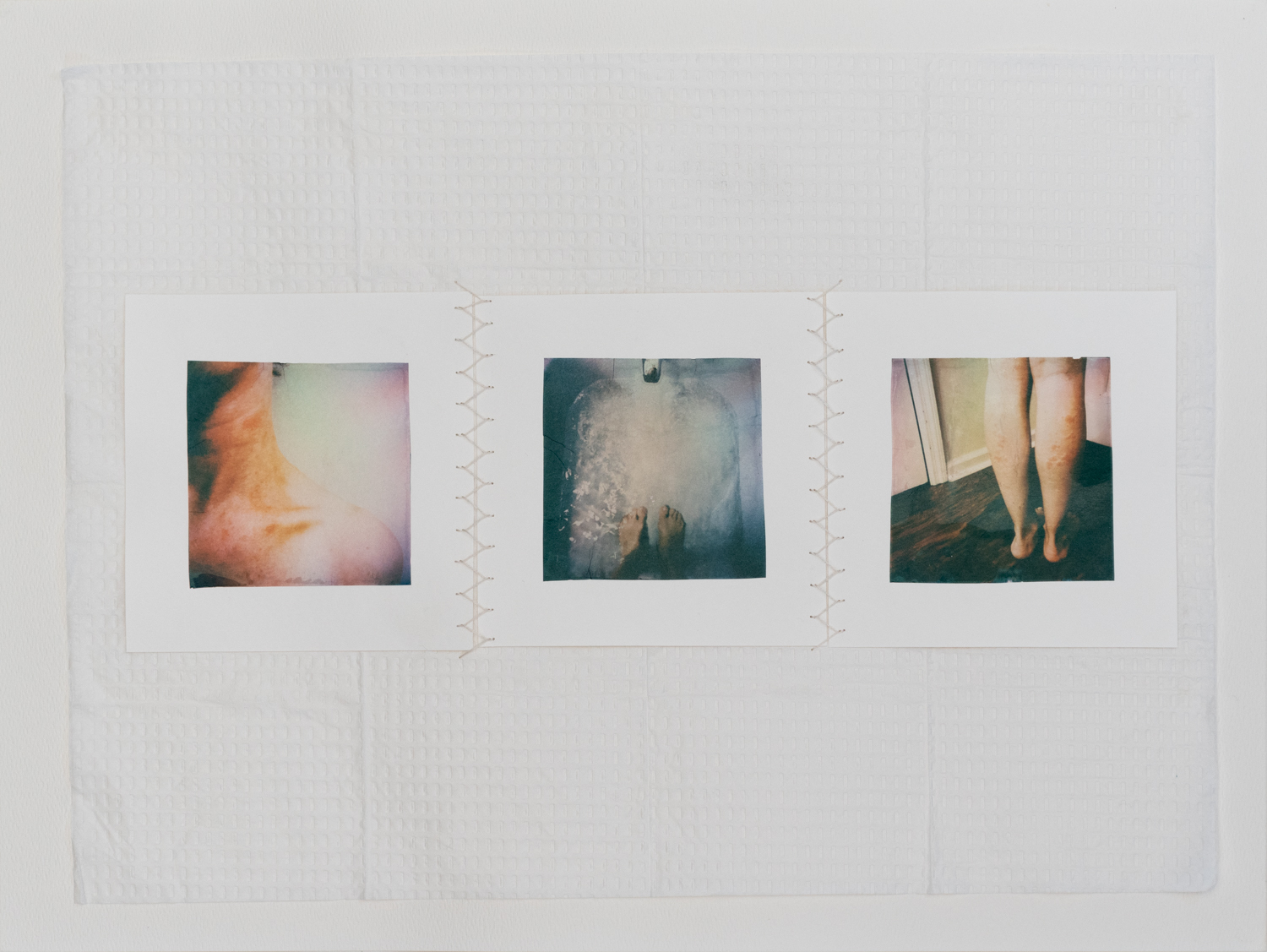
Jocelyn Mathewes, The Water Was Troubled (Wound Repair in a Sterile Environment), 2024, Polaroid emulsion lifts on paper, sewn onto gauze, 11” x 15”
FH: Your art is filled with bright colors and a lot of physical texture, incorporating cyanotype, maps, found objects, prescription papers and bottles, medical detritus, etc. What has drawn you to work with such a variety of mediums in your collage, sculpture, and works overall? How does working with these mediums help you convey your meanings to the viewer?
JM: There is first a filter of utility about selecting materials. I use what materials prove expedient and accessible. When my illness limits my energy, I work small and light, since pain makes it hard to wield heavy tools and objects. I worked out of my house using materials I had on hand, because it’s hard to leave the environment you shaped to better care for myself. These objects were readily available, sometimes even accumulating around me (like medical forms and other “trash”).
Overlaying this is an intuitive filter of what I find myself gravitating towards (materials or processes). There are seasons of obsessive collecting, reading, or making with particular tools or processes. Making work external to the body - rearranging texture, layers, mediums - all of that was a way of thinking outside the body.
I also think symbolically about the selected color, process or material: What is it good at saying? What does it make possible? So, I select my found objects with intention for their associations, and then let their forms and properties inform what is possible. I work in a process (cyanotype, collage) and think about what it can and can’t “say”. I add or subtract color (gold, red) drawing from my associations (sacredness, blood).
All the work is saying something.
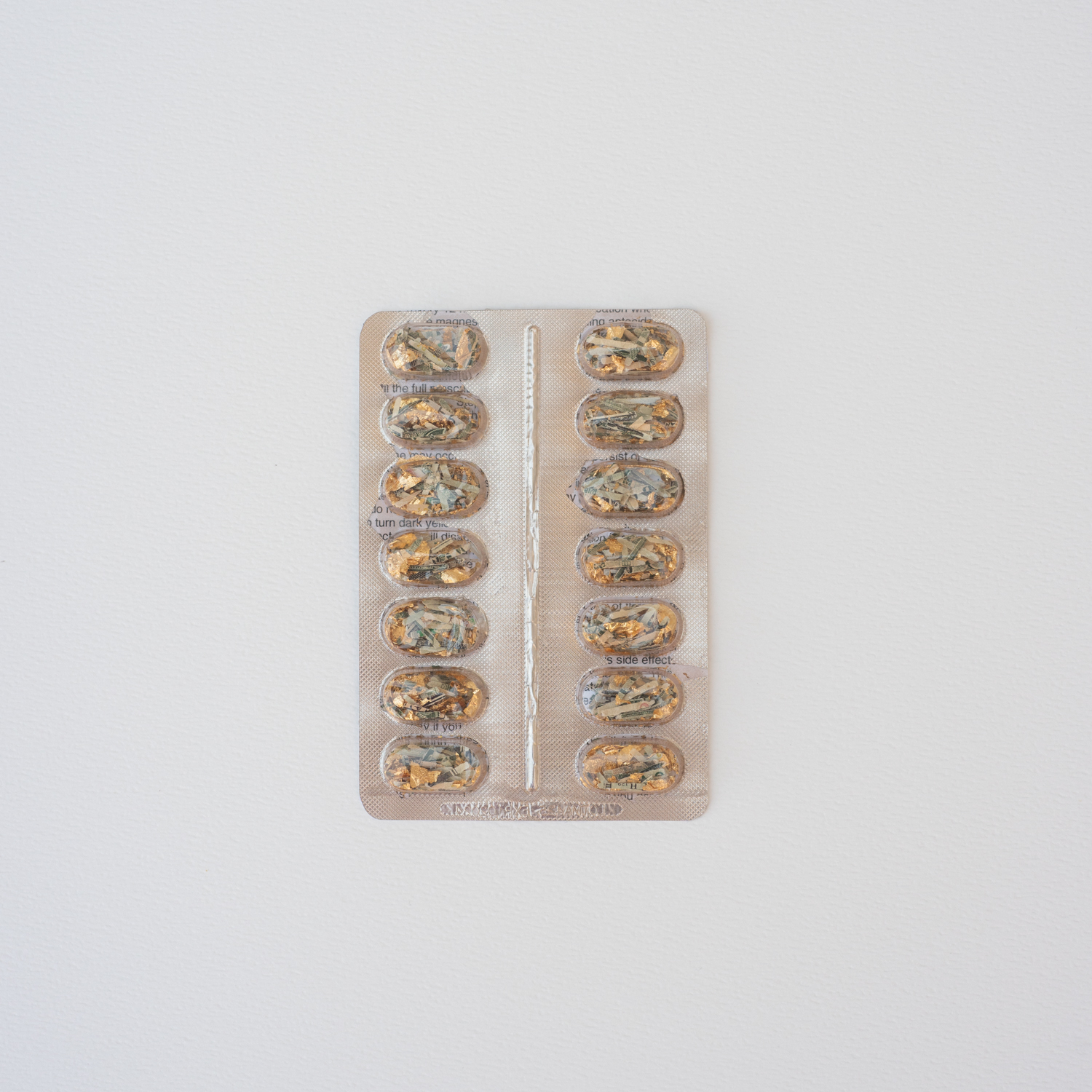
Jocelyn Mathewes, Spent (Mark 5:26), 2023, discarded pill pack, shredded money, gold leaf, prescription sheets, in 8” x 10” shadow box
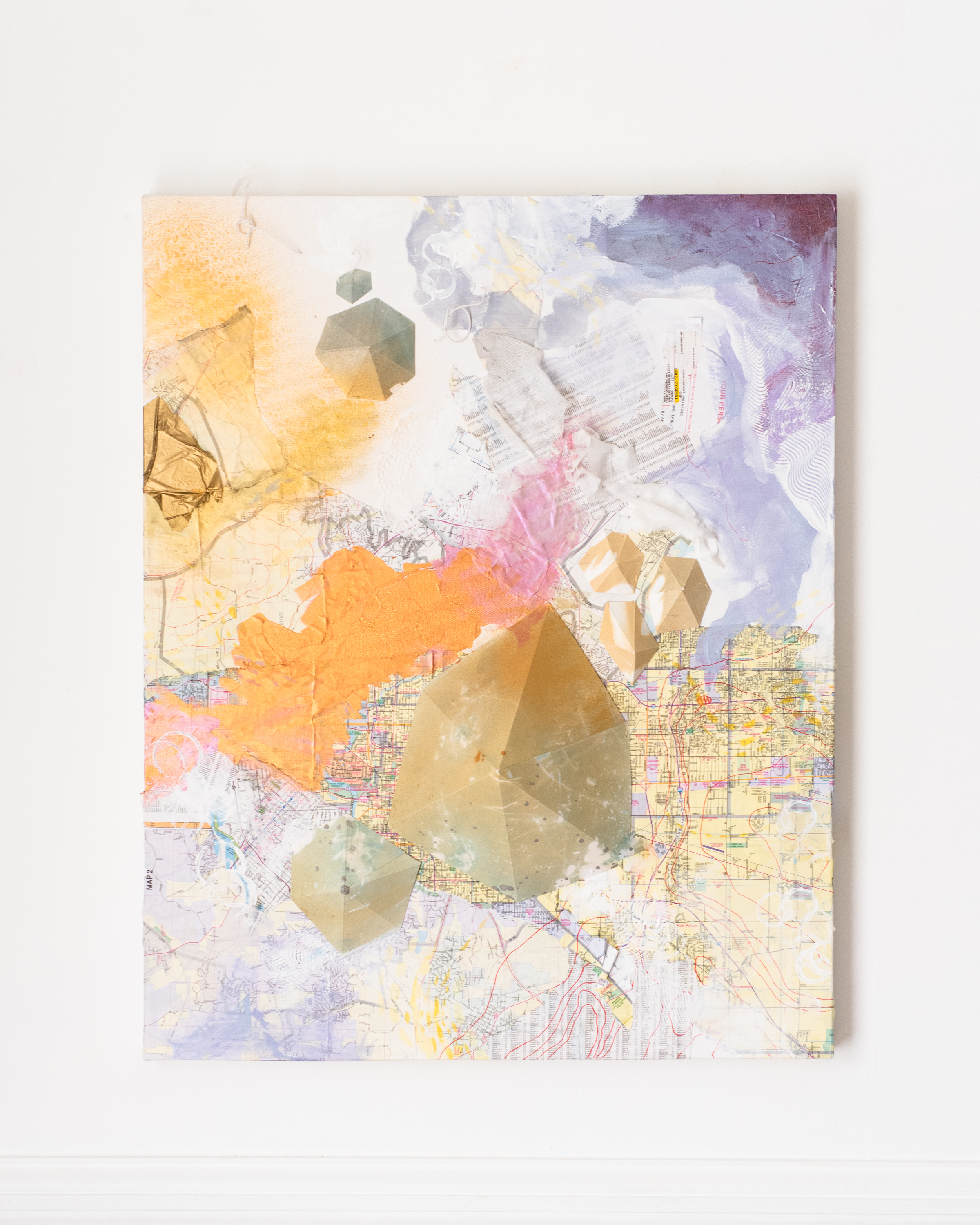
Jocelyn Mathewes, Do I want to be made well?, 2022, vintage road maps, cyanotype origami shapes, acrylic paint, glitter, spray paint, gel pens, cotton gauze, medical wrap, prescription sheets on canvas, 24” x 20”
FH: You have stated that you began your journey in graphic design, photography, and writing. What, after a decade of working in these fields, has stuck with you in your art and what have you left behind?
JM: So, when I think about it, nothing is left behind. No experience is wasted. I recently learned a useful term from a fellow artist named Adeola Davies-Aiyeloja (who I met through a lovely program called Pollinator) – “Sankofa,” from the Ghanaian Akan language. The term means to go back and retrieve what is useful from the past – that it is important to take lessons from what has come already. All the processes that I have interacted with have shaped me and I draw on them when and where relevant.
Photography was one of the earliest mediums I encountered in my life, besides drawing and painting. I experienced the technical transition from film to digital, so that has allowed me to bounce between digital and analogue mediums with ease. I studied literature in college, which focused on analyzing story structure and literary criticism. My work as a designer integrated text and image together nicely, so that put me squarely in the path of commercial creative work and communications.
My literature background helps me think about language, and historical echoes or lineage. My professional design experience combines language with visual communication, as well as attention to forms. Selecting a form and selecting a title are important to me. They can be a punchline, a poem, a puzzle, but not an afterthought. A work has to read as visually complete without it; it should “say” or “respond” to the title. Sometimes the title comes to me before the work. Sometimes the title comes long after it’s complete.
From a highly practical standpoint, my background in photography and design has helped in polishing the quality of images of my work, professional presentation, and supporting promotional materials. I leveraged these skills when pivoting to focus on my fine art practice after over a dozen or so years of commercial work.
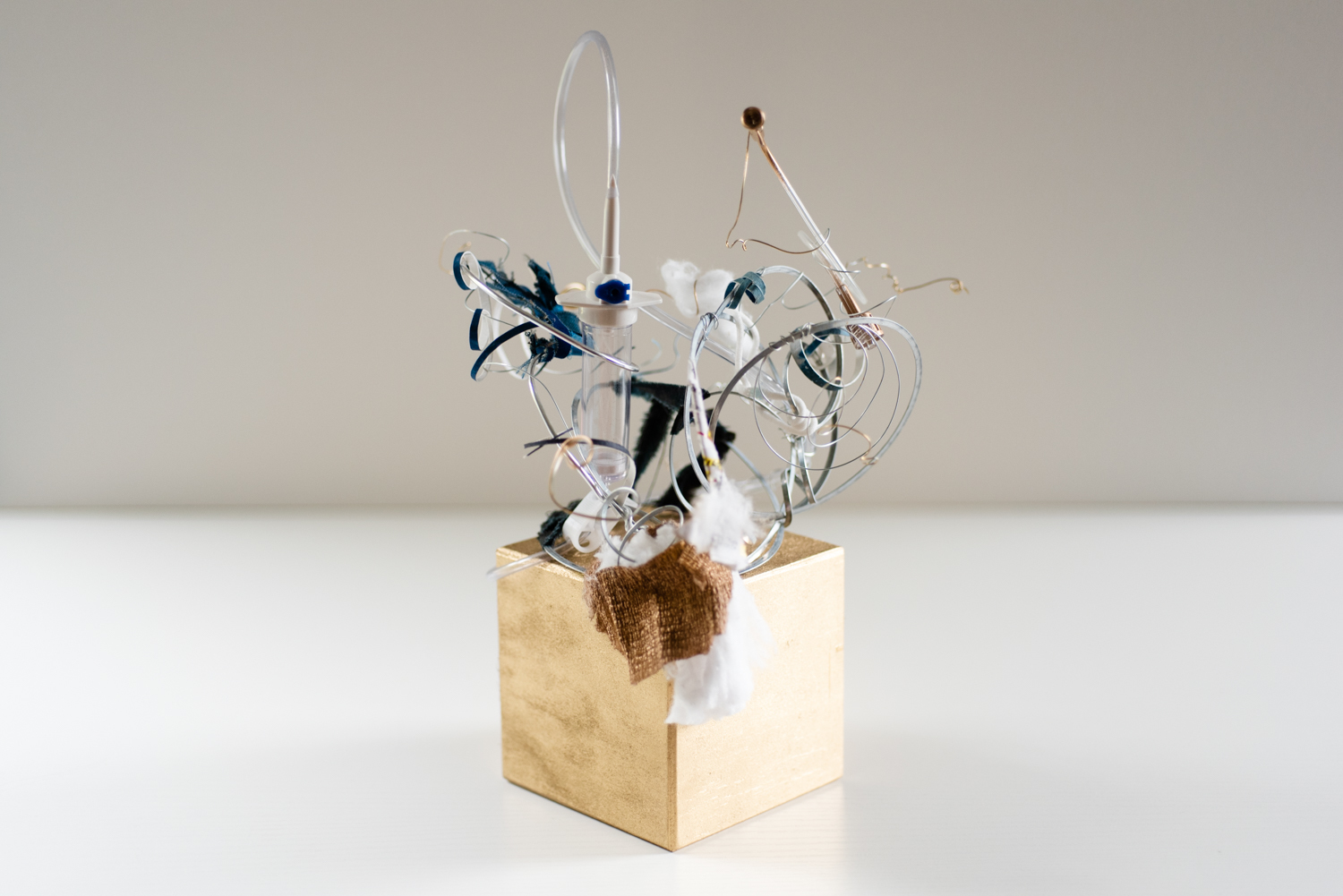
Jocelyn Mathewes, Never the Same Again, 2022, series of 7 sculptures, IV tubing, wire, fabric, cotton, medical wrap Slinky®
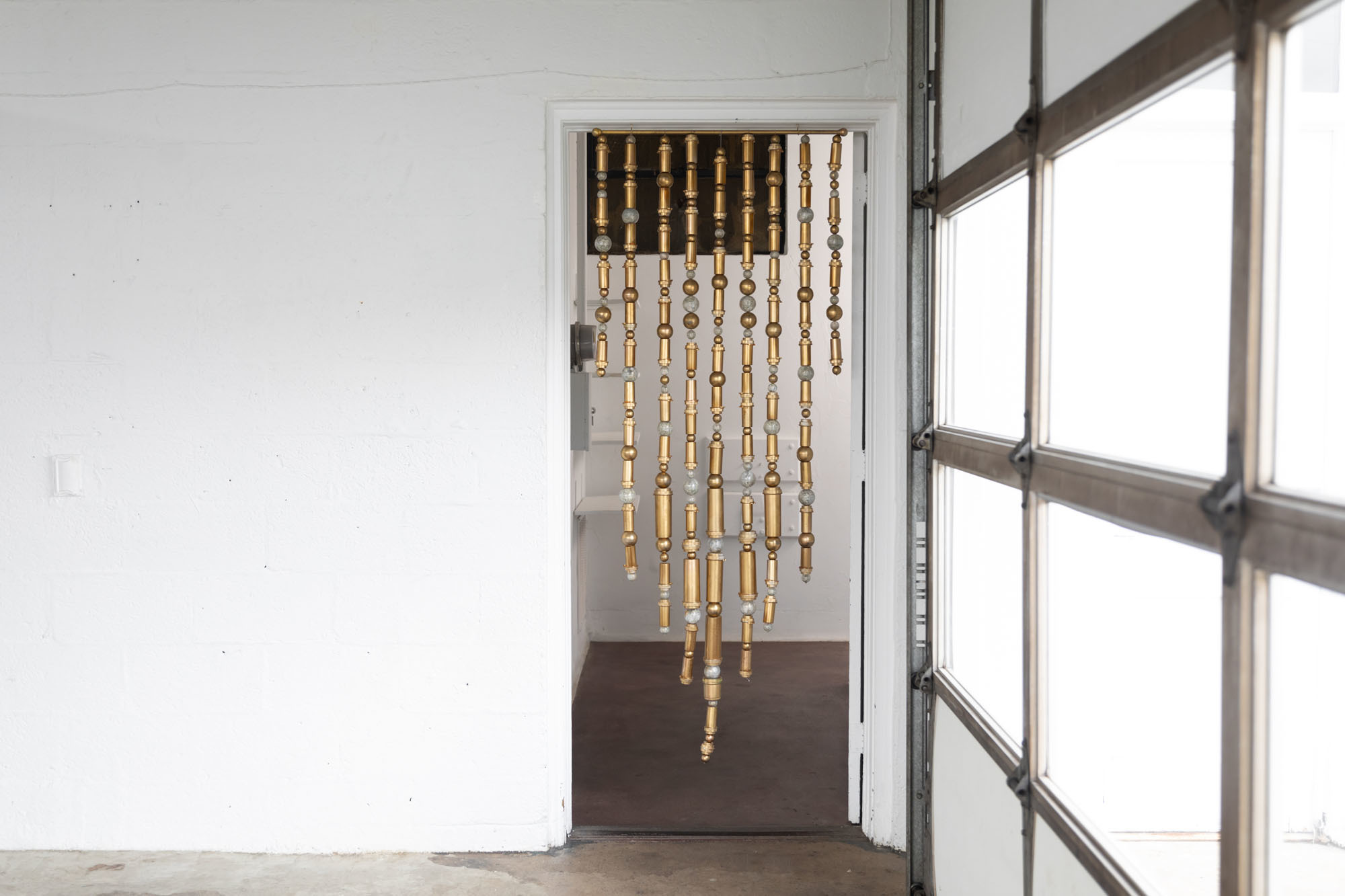
Jocelyn Mathewes, Medicine Threshold, 2020-2021, sculptural curtain made of prescription medicine bottles, shredded money, gold paint, metallic fibers, vending machine balls, 36” x 72”
FH: In your community you serve on the board for Create Appalachia, what has your coordinating of events and artist meetups helped you pursue in your art? Have there been any hindrances or improvements you've seen on your art from working in the community?
JM: A lot about creative work can be lonely, depending on the medium and practice. Illness can also be lonely. So much about these two things can be made better when knowledge and camaraderie are shared. Being involved in community gives me a more accurate sense of where my work is situated in the larger art world. It’s also inspiring to do things together - I heard it said that you likely already know or are connected to your next great collaborator, so just get started with them now.
I have several community outlets that I’ve been involved in for several years now. My first connective project is Local Artist Meetup, which has a newsletter of 400+ subscribers from around the Tri-Cities, TN area. We’ve had over 30 gatherings since 2019 of various kinds. The newsletter has grown into a community events and opportunities bulletin, published monthly. It’s supported and funded by members within the local community, and anyone from the community can contribute to it. It acts as a resource and news source for creatives and the arts community. I get excited and inspired by all of the energy and momentum in the community that I see through this project.
EAT/ART space is a curatorial and events-based project I started online during COVID in 2020. With over 60 artists featured over 25 different events and an estimated 450+ attendees over the course of the project, it’s put me in contact with artists who have become my collaborators and thinking partners. The dining room gallery let me test and see what kinds of work the regional public would respond to, the types of events that folks would find engaging. It’s given me clarity about the audience for my own work, and enthusiasm for incorporating more interactive elements in my exhibits and possibly in my future work itself.
Lastly, I serve as the Executive Chair of the Johnson City Public Art Committee. It’s a volunteer civic board that’s associated with the city I live in. By far, this involvement has helped me to broaden and deepen my understanding of systems and structures within the art world. Public art has a high level of complexity around it, both logistically and socially. You get a “behind the scenes” view on how decisions are made, what the processes are like, and what it takes to actually execute a large public project, what kind of art is suited to the public space. Much like the dining room gallery, it’s clarified how to position my own work and put me in a position where I can help other artists navigate complex project space.
Of course, all of this can be a challenge to juggle alongside a studio practice, a day job, and a family. If there are any hindrances, it comes from trying to make sure that time is spent effectively and that creative practice remains central.
FH: How has living in Appalachia with your family affected your work and how you make it? Does your family ever get involved in your pieces?
JM: I’m not native to this region. Having grown up further north, I sort of fell down the mountains into Tennessee. Understanding this new place as an outsider has helped me broaden my thinking; moving anywhere new and embracing a new home will do that to you if you let it. East Tennessee is much more rural than where I grew up and lived previously; those social dynamics required a period of adjustment and adaptation.
But more than that, the move to Tennessee generated the circumstances that made fresh explorations possible for me - a larger in-home space to work, and more sunlight to print cyanotype outdoors. A new place and new space creates new opportunities.
My rule of life is to grow where I am planted, which means nourishing the soil and tending to it wherever I am whatever that means for the season. This is one reason I’m heavily involved in my local and regional community. My family is here with me, nourishing alongside me; they inform my framework but don’t often collaborate explicitly with me as of now.
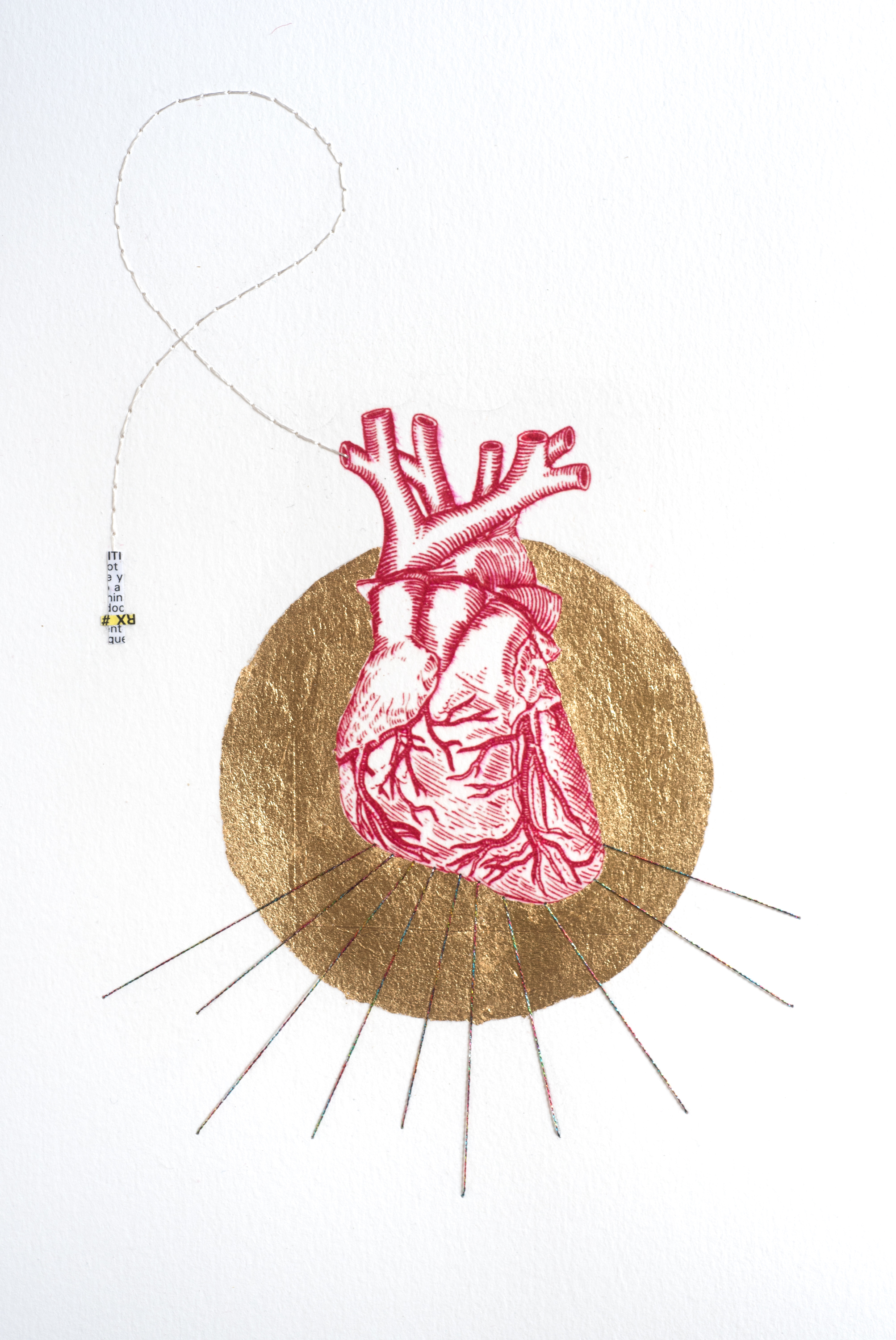
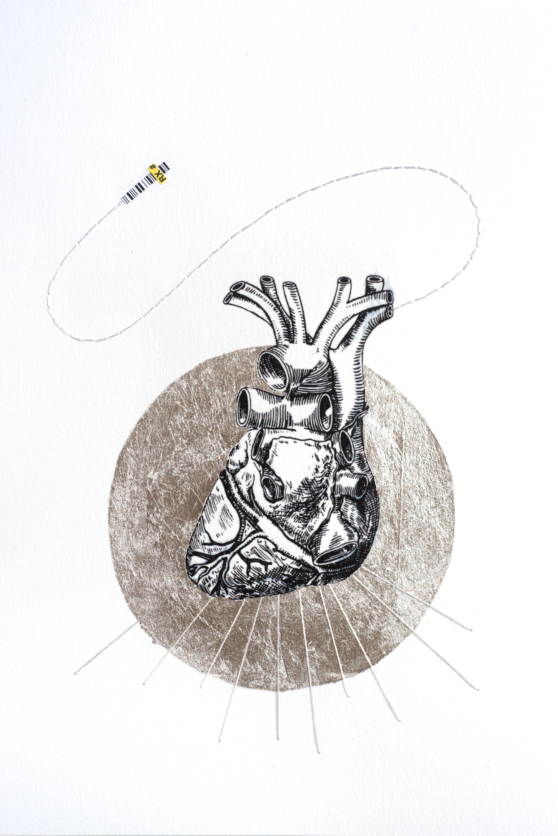
Jocelyn Mathewes, The Heart Size is Unremarkable 1, 2019, image transfer on watercolor paper, metal leaf, collage, embroidery, 9” x 12”
FH: Your work deals with heavy topics and addresses painful issues. Is your process ever meditative or emotional? How has the act of creating and making art helped or hindered you on your healing journey with chronic illness? How has it helped you to better understand it and how the world and medicine views those with chronic illness?
JM: I’d like to remove the term “heavy” - to me, this is simply a familiar reality. My husband’s pastoral work is similar - the struggles of a community are laid bare to him personally. My creative work is a personal struggle shared.
Helping or hindering is an artificial either/or here. All the work of engaging, exploring, difficulty, is invisible and embedded within the pieces. In that sense each piece functions as an artifact of my observation. The work yields and reflects understanding. And, there is much that I observe but still don’t understand.
Sometimes it hurts me physically to make, and sometimes it doesn’t. I make as much as I can with the time that I have because that’s why I’m here. Sometimes that making happens to meditate on illness. The goal is ultimately to keep being, and to describe that mode of being.
Describing this mode of being is important to me because my experience - as a chronically ill person, and especially as a woman - has yielded a familiar, sad sense that some (not all) medical arts have no fully humanized way of understanding the body in pain. Very generally, it is easy to be overlooked, misunderstood, misdiagnosed, dismissed. In my conversations with others in similar situations, it can be a kind of pain on top of pain.
Anyone who reads this ought to know that dark humor serves me well. I like to quote William Goldman’s famous line from The Princess Bride, “Life is pain, highness. Anyone who says differently is selling something.”
FH: You explained that your work, 30 Days, displayed how you must weave your own needs (dealing with chronic illness) and expectations of domestic life (being a mother and working in your community) into one. How did the work progress over the 30 days? When finished, did the process help you understand this weaving better?
JM: Specifically for 30 Days, the work uses recipe cards as the literal base of the collage, the substrate that receives the weaving. These particular cards were popular during my childhood, pointing to a food culture I grew up with and that was the norm at the time. Food practices are fraught with illnesses that require special diets.
There are many medical conditions for which special diets are a familiar thing, but with rare or autoimmune diseases it can be especially complex and individualized. The intrusion of artifacts from my illness into the vintage recipe cards reflects this tension – trying to merge things that are at odds; a disjointed experience that becomes oddly consistent through its repetition.
A standard domestic duty of the wife or caregiver is to provide food for the family. But this becomes alienating when you can’t eat the familiar or popular foods that your family wishes to enjoy or what others are in the habit of serving. The body at odds with social practice is what ultimately came on display. This became evident when the work was selected to be a part of the exhibition Women’s Work at the Indianapolis Arts Center in 2021. It was then that I saw how much it had to do with a larger social commentary.
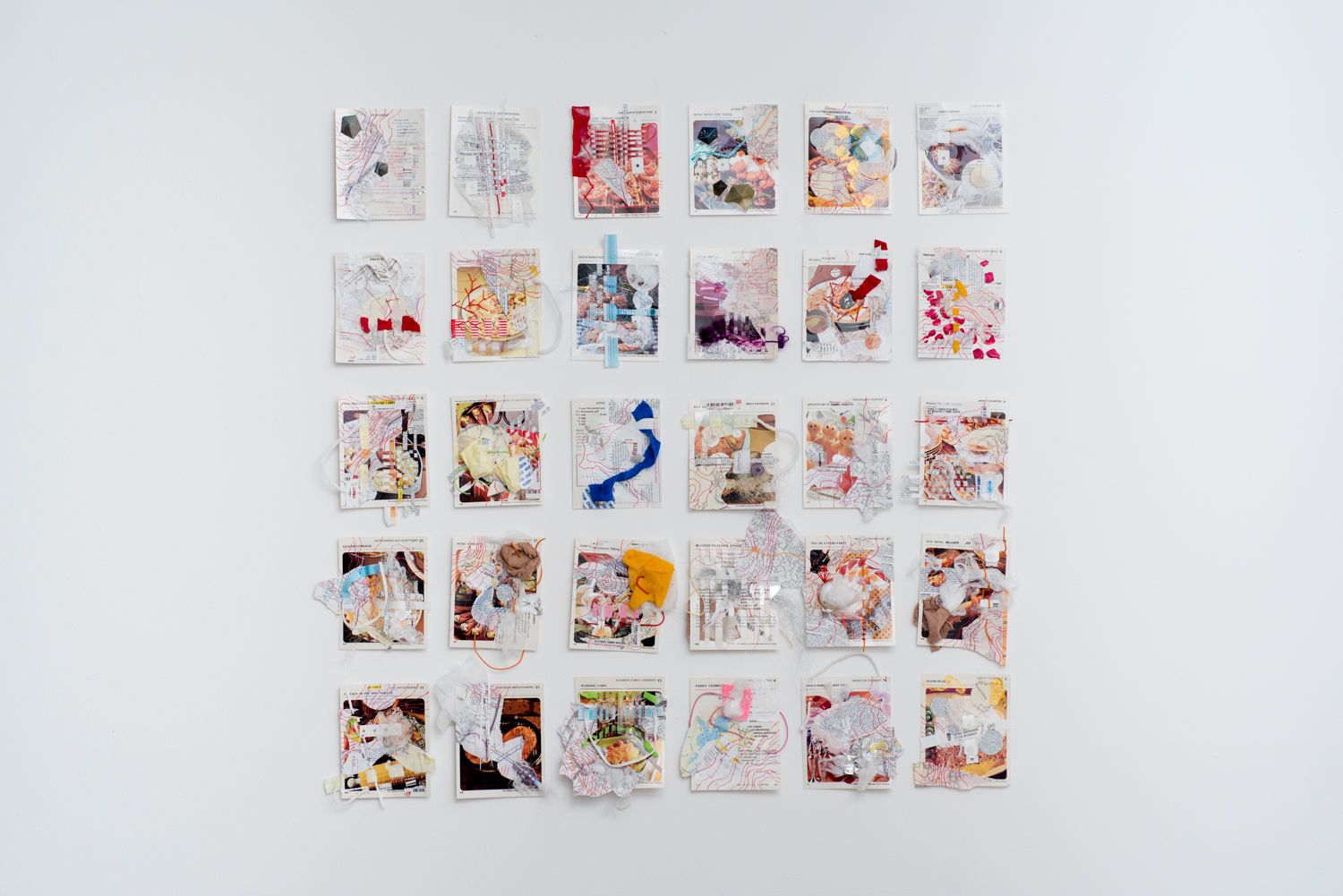
Jocelyn Mathewes, 30 Days, 2021, set of mixed-media collages constructed using vintage Betty Crocker recipe cards, road maps, vellum, embroidery, ink, paint, cyanotype, prescription information sheets, medical detritus gauze, hospital bracelets and wire, 36” x 36”
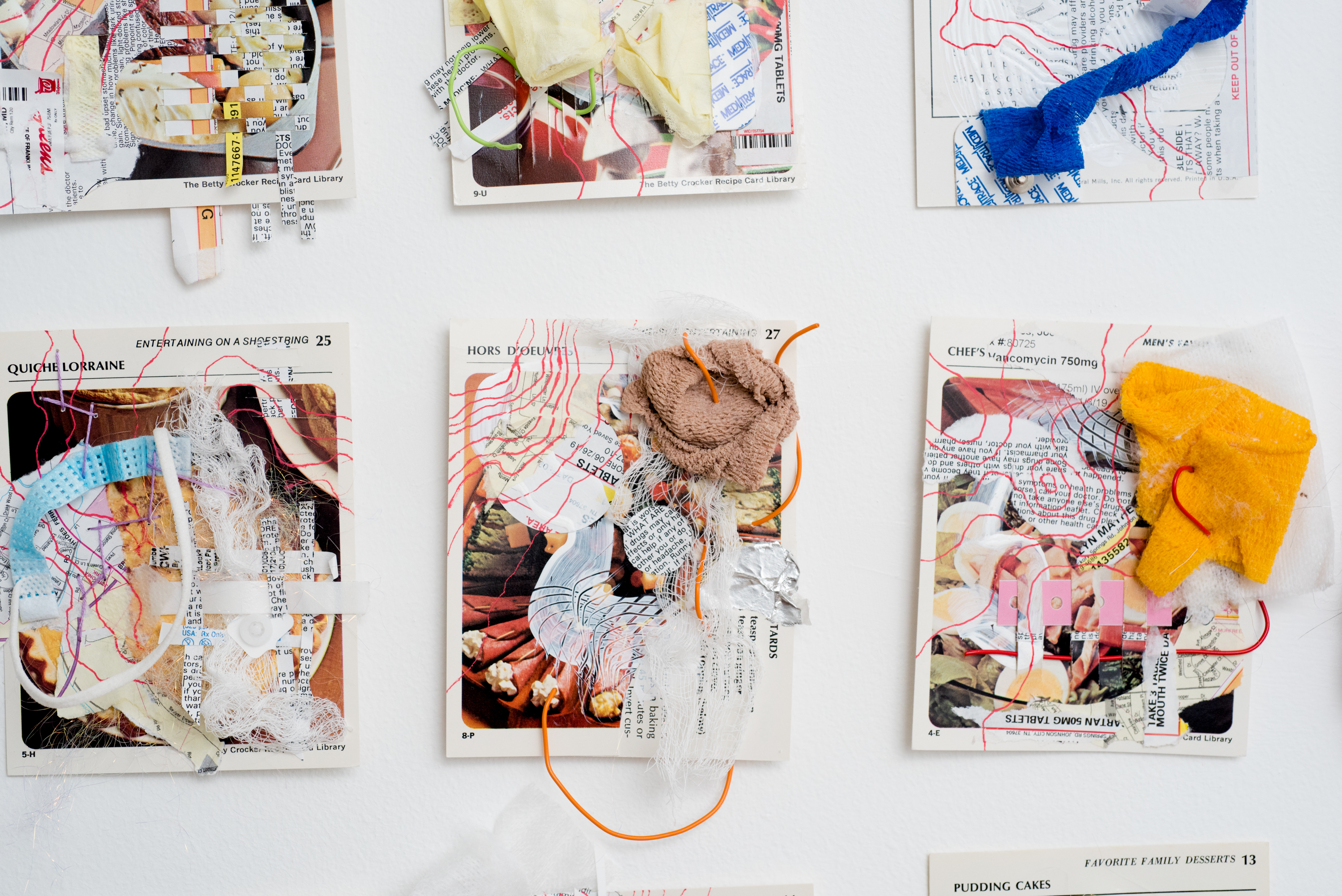
Jocelyn Mathewes, 30 Days (detail), 2021, set of mixed-media collages constructed using vintage Betty Crocker recipe cards, road maps, vellum, embroidery, ink, paint, cyanotype, prescription information sheets, medical detritus gauze, hospital bracelets and wire, 36” x 36”
FH: In your work Para(site)dise, you describe the removal of weeds as a continuing process similar to the ongoing processes of repenting from sins or healing from illness. How do these two separate ideas coincide for you in this work?
JM: First, it’s very critical to state that my faith’s understanding of sin is more like sickness than is is breaking the law. Sin/sickness are unified theologically. This does not result in a binary legalism; the reason for someone’s sickness is not that someone has sinned or is “in sin”. Nor does health - a blessing to have - mean that someone is favored by God in some way. Orthodox Christian theology draws from more than just scripture, but an easy way to cite this would be to quote Matthew 5:45: “He makes his sun rise on the evil and on the good, and sends rain on the righteous and on the unrighteous.” (NRSVA)
This piece is primarily about the maintenance of a body - and a form of record-keeping about that maintenance. To weed a garden is to discern what to remove and what to make space for. But the removal is relentless and ongoing to maintain the garden in a particular state. The accumulation of what is removed is usually invisible - instead, I document its expansion.
So my first thought about this piece is more like tracing the outline of something to understand its shape and mass. I think about graphing parabolas (rational functions) in mathematics, where lines can stretch into infinity. I’m discovering that “function” that remains underneath.
That “function” is a physical execution that is a kind of origin or analog for the maintenance of a physical body, while also spiritually it translates into removing practices, habits, and thoughts that do not draw one closer to God. The weeding is removal-as-cultivation of the good. It takes effort. It is always changing shape. All these processes are similar motions, repetition, labor, accumulation, removal. Para(site)dise is a way to make that effort visible and beautiful - a part of the garden.
I want to thank curators Anna Buchanan and Russell Facemire for inviting me to show Para(site)dise in its current form at the William King Museum in August, and for my friend and musician Travis Goyette for creating a custom ambient piece to coincide with it.
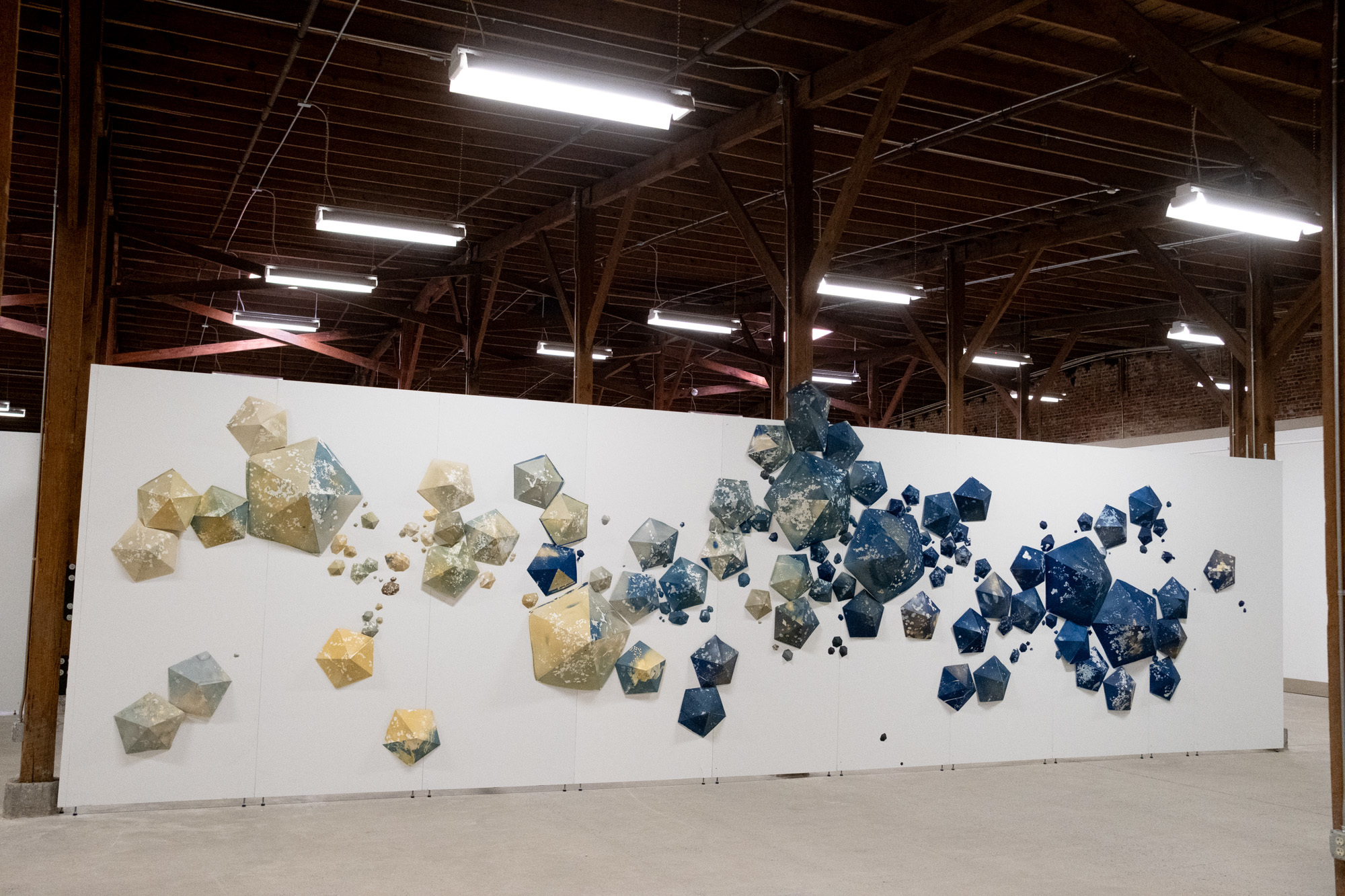
Jocelyn Mathewes, Para(site)dise, 2023 - ongoing, paper constructions formed from cyanotype prints of weeds pulled out of my garden - includes polyhedral shapes, dimensions variable, from 16' w x 8' h to 30' w x 8' h
FH: Does your faith play a role in how you understand your illness, or how you approach your art? In what ways do you see it doing so?
JM: My faith is foundational to my understanding of the cosmos, humanity, and embodiment - these are the underpinnings of how I approach all of my concepts and materials. There’s no way that it couldn’t. The strongest notion that I draw from my Orthodox Christian faith is the unity of mind/body/soul - there is no separation.
So when I make creative work it is a part of my living life, which is fundamentally a spiritual practice that uses the whole self. I see art as a vehicle for communicating, for pointing towards something. I want to point to what is important, transcendent, and true - complicated, painful, joyful, all the things that what is true can mean.
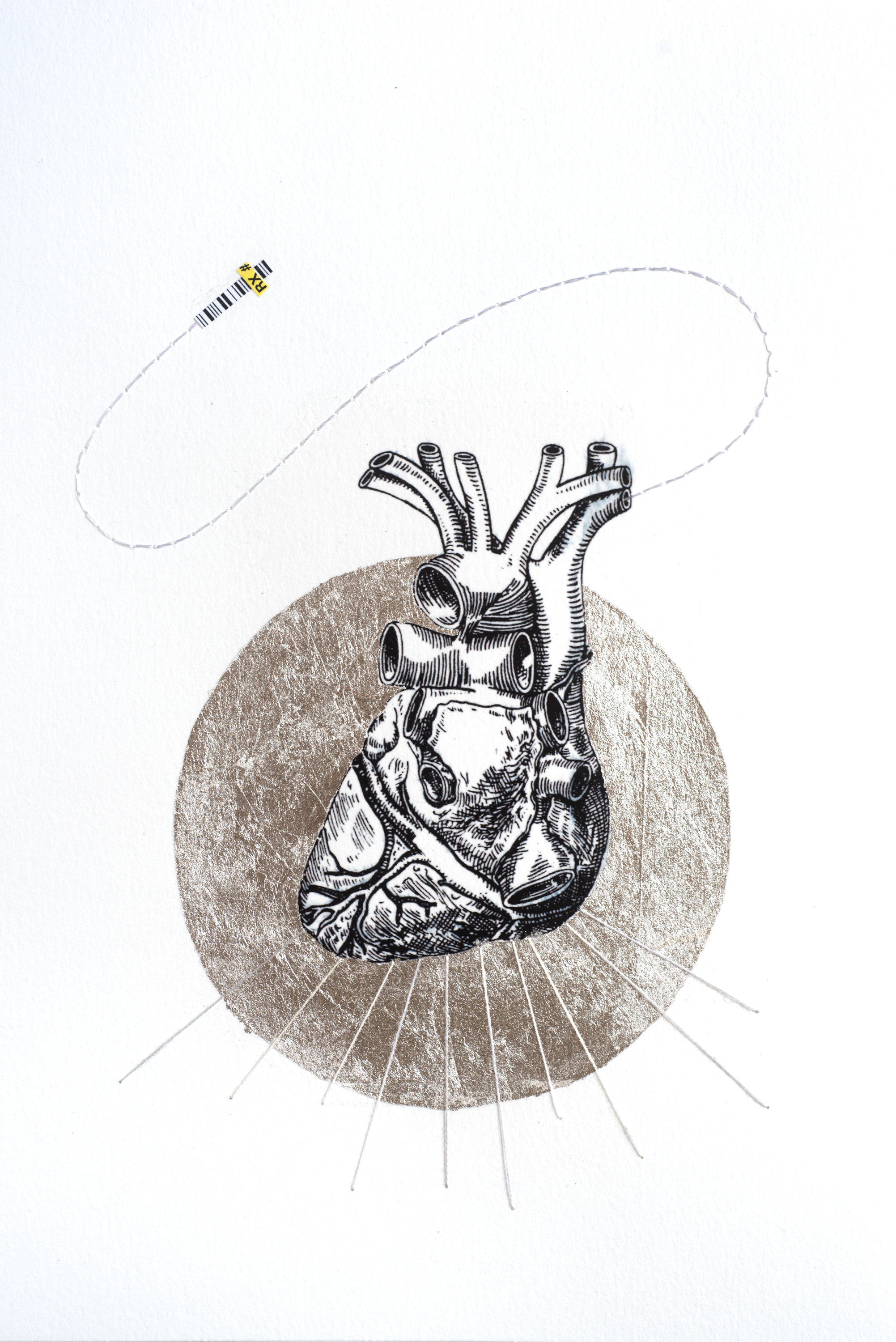
Jocelyn Mathewes, The Heart Size is Unremarkable 2, 2019, image transfer on watercolor paper, metal leaf, collage, embroidery, 9” x 12”
FH: What are you currently working on? And how is your work evolving for you? Do you see yourself continuing to explore the dynamic of medicine, chronic illness, and the human experience? Or are there other subject matters you are contemplating?
JM: Currently, I’m preparing for my exhibition Para(site)dise at the William King Museum of Art, which opens August 20th and is on view through January 17th. It’s a chance to pause and look back on a particular body of work I’ve created. I’m most excited about the community engagement piece happening at the opening, which is a collaboration with award-winning storyteller Hannah Harvey.
So, I’m in a bit of a reflective mode, going back through my old work, reviewing previous work I made on other themes to feel out what’s next (as I mentioned before – “Sankofa” is a useful term for this). I do this by “living with” my own artwork in my home as a means to rekindle and revisit. For example, one of my favorite older pieces from a series I did on space exploration (“Pluto’s Inversion,” which was published in Christina Z. Anderson’s book Cyanotype: The Blueprint in Contemporary Practice) hangs in my dining room.
In addition to space exploration I have a particular fondness for fairy tales, complexity theory, metacognition, and technology even though I engage in heavily analog mediums. Connecting what is advanced to what is ancient is what is interesting me right now, and I’m not sure where it will lead me. It’s important to engage in these themes while look back at those old pieces to see what fascinated me, what continues to, and what is new. It’s a chance to pick up the thread, choose a fresh color to weave into things, repurpose or refine my ideas.
So I’m in the nascent stages of experimentation with other themes. However, I am also applying for residencies where I can execute plans for longer-form, large-scale textile works in cyanotype that continue my body of work on chronic illness.
Jocelyn Mathewes is a mixed-media interdisciplinary artist, whose work documents the invisible labor of the body. Working primarily in cyanotype, collage, and alternative photographic processes, she transforms the materials of illness — prescription sheets, medical detritus, hospital bracelets, weeds pulled from the garden — into objects of beauty, grief, and dark wit. Her practice is rooted in the conviction that chronic illness generates a kind of knowledge that culture is reluctant to see: that constraint can be a grammar, and that what the body loses, an art practice can make visible and transmissible.
Mathewes is based in East Tennessee and has exhibited widely across the United States. Her work is held in the permanent collection of the Reece Museum, and has been featured in The HAND Magazine, Image Journal, and Cyanotype: The Blueprint in Contemporary Practice by Christina Z. Anderson, the definitive English-language volume on the medium. She is a 2025 ArtFields competition artist and a 2026 solo exhibitor at the William King Museum of Art.
In 2020, she founded EAT/ART space, an alternative gallery in her home dining room in Johnson City, Tennessee — a community institution built to create opportunities for Appalachian artists within the constraints of rural living and pandemic isolation. She has curated exhibitions at the Reece Museum, Arts Depot Abingdon, and Create Appalachia, and has lectured on illness, creativity, and artistic practice at Milligan University and the Artist/Mother Podcast Network.
Mathewes holds a B.A. in Studio Art and English Literature from Messiah College and has participated in residencies with the Artist Residency in Motherhood (ARiM), Makers Circle, and Stay Home Gallery.
Faira Herod is an Intern for Tri-Star Arts, currently based in the Chattanooga area.
* images courtesy of the artist