INTERVIEW: JENNIFER PEPPER
OCT. 12, 2026
INTERVIEW: JENNIFER PEPPER
OCT. 12, 2026
Elise Cochran: You studied painting and drawing at the University of Tennessee, then went to North Texas for your MFA in painting/drawing and sculpture. What initially drew you to studio art, and how did the three disciplines of painting, drawing, sculpture build on each other?
Jennifer Pepper: I’ve been drawing since I was very little and was encouraged by my family and teachers. Even though access to Fine art education and museums was limited, I was able take advantage of the TN Governor’s School of the Arts and a HS summer art program at Murray State. My Dad was a self-taught artist but didn’t have the luxury of pursuing it because of the pressure to support and raise our family. I tend to construct and formulate in both 2D and 3D... and also have a love and respect for materials and what they do - whether paint, wood, wax, metal, etc.
EC: Your statement describes your work as an "expression of awareness of nature both within myself and what I observed." What does that phrase, "within myself," mean to you?
JP: My childhood memories are mostly of being outside on acres of meadow, forest and creeks. When I went away to college and later got married, I found myself in cities, but the pace and cadence of nature was embedded in my psyche - it’s a deep connection. I longed for it - all of it, changing seasons, mud, bugs, smells, flora and fauna. Twenty years ago, we had a chance to move back to a rural setting and did it.
EC: Your body of work spans painting, drawing, sculpture, installation, sound, and video. Do you feel as though your practice has deepened, or continued to grow in range, since you moved to Tennessee?
JP: Although I have a deep love for painting, I came out of my MFA program working conceptually. The ideas were dictating the materials use. Each piece evolves from either an initial impression or idea into its own physical reality - whatever feels right for the expression - whether it’s sculptural, painting, installation, etc.
EC: For nearly ten years you kept honeybees. What was the original draw to beekeeping - was it always connected to art, or did that connection come later?
JP: The original draw to beekeeping was total infatuation with honeybees - the inspiration for art they gave me came later. At that time, I was making paintings and collages about invasive plants in our yard. My children were young when I started beekeeping and I shared the experience of the seasonal bee maintenance with them. Harvesting the honey was the gift of the bees - but the rest of the year was trying to keep the colonies healthy from mites, wax moths, hive beetles, pesticides, climate change, etc.
EC: You use recycled beeswax and wooden hive equipment as primary materials. What does that process look like? How do you prepare the beeswax for use in a piece? Have you found any constraints or qualities specific to used beeswax?
JP: I bring the wooden hive pieces and wax comb into my studio. There they sit, sometimes for years. I eventually figure out a way to use the parts as art making material. I harvest the wax by putting it in a double boiler or using my heat gun (carefully! - beeswax has a low flash point). I sometimes add dammar varnish. I do a lot of tests and experiments to see what I can get away with, what is stable enough for artwork that will become part of someone’s personal collection. Sometimes I wait over years to see how wax is going to behave in certain presentations. Sometimes the pure wax that I’ve used to cast will develop a slight film but goes away with careful rubbing with a soft cloth. Overall, I’ve found it to be a very stable and beautiful medium.
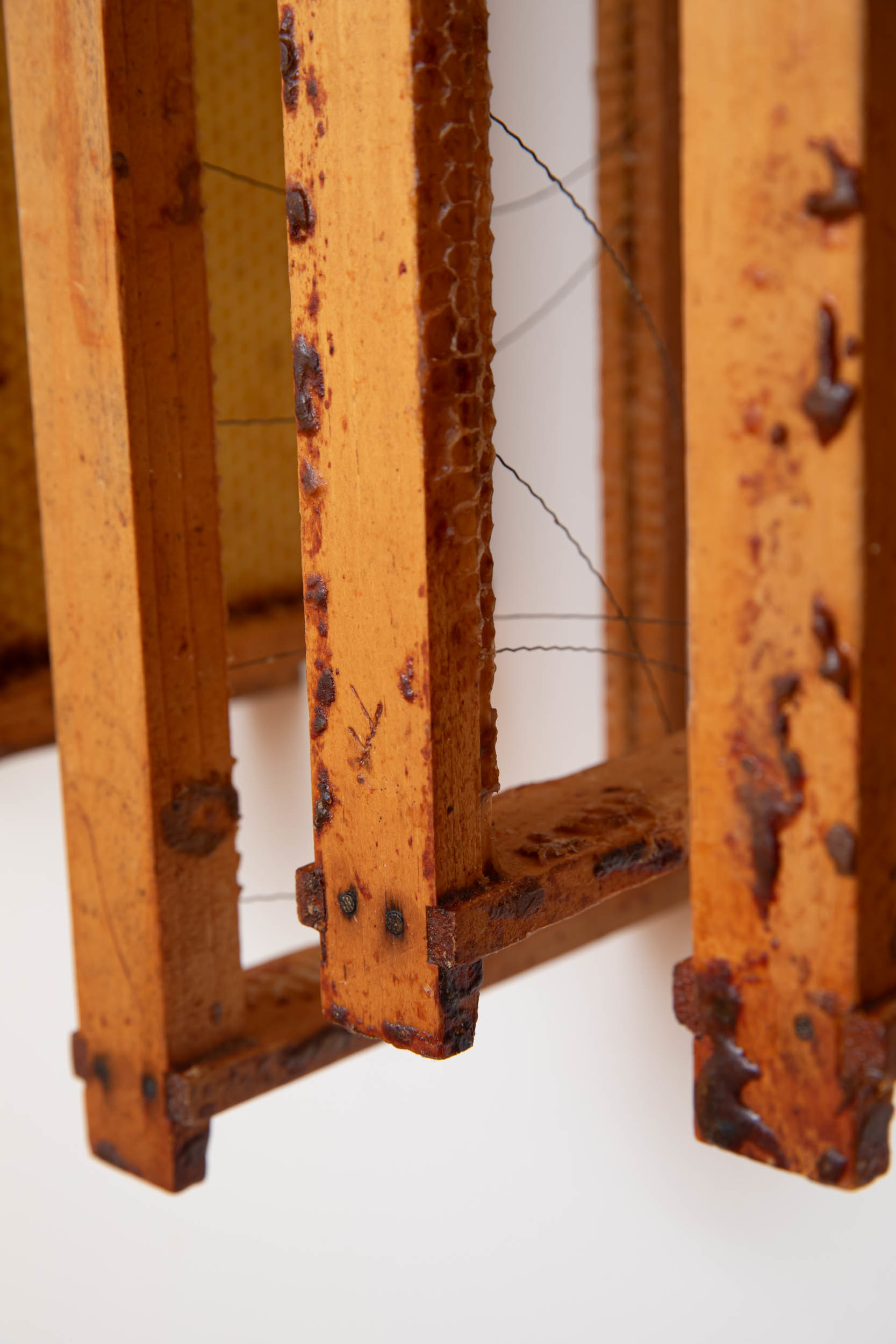
Jennifer Pepper, Orchard (detail), 2023, used wood bee hive frames, wax, propolis, pigment, 15" x 47" x 7"
EC: In "Orchard", you combine wooden hive frames, wax, and propolis. Why did you choose to include propolis specifically in that piece, and what does it represent or evoke for you?
JP: The propolis was on the frames since they had come directly out of a working hive. Propolis is a magical material that bees produce which is both an antibiotic and sticky material that the bees use like caulk to plug holes in the hive and keep drafts out. It’s very durable and hard to remove. I wanted to keep it as part of the very tactile, physical history of the colony that once used the frames - but also, I love the warm color of it.
EC: The beehive frames in "Orchard" appear uniform in scale but vary in vertical placement on the wall - juxtaposed with a painting that runs straight through it. Is there significance to this choice in presentation?
JP: Yes, I was thinking of music and sound waves. The orchard running through as a steady beat, as the frames shift a bit up and down. Almost like a written measure of music - the orchard as the bars, the moving frames as notes.
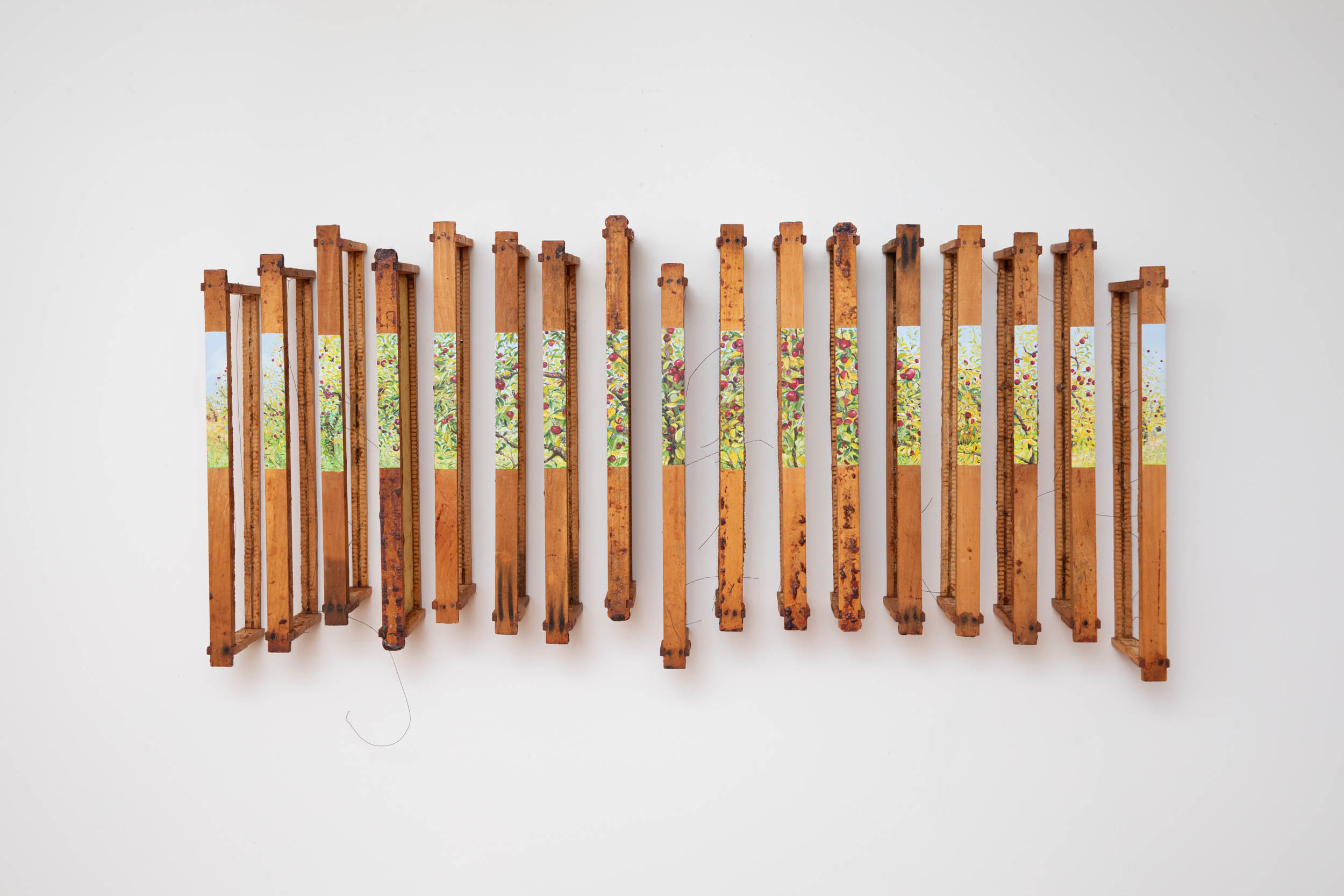
Jennifer Pepper, Orchard, 2023, used wood bee hive frames, wax, propolis, pigment, 15" x 47" x 7"
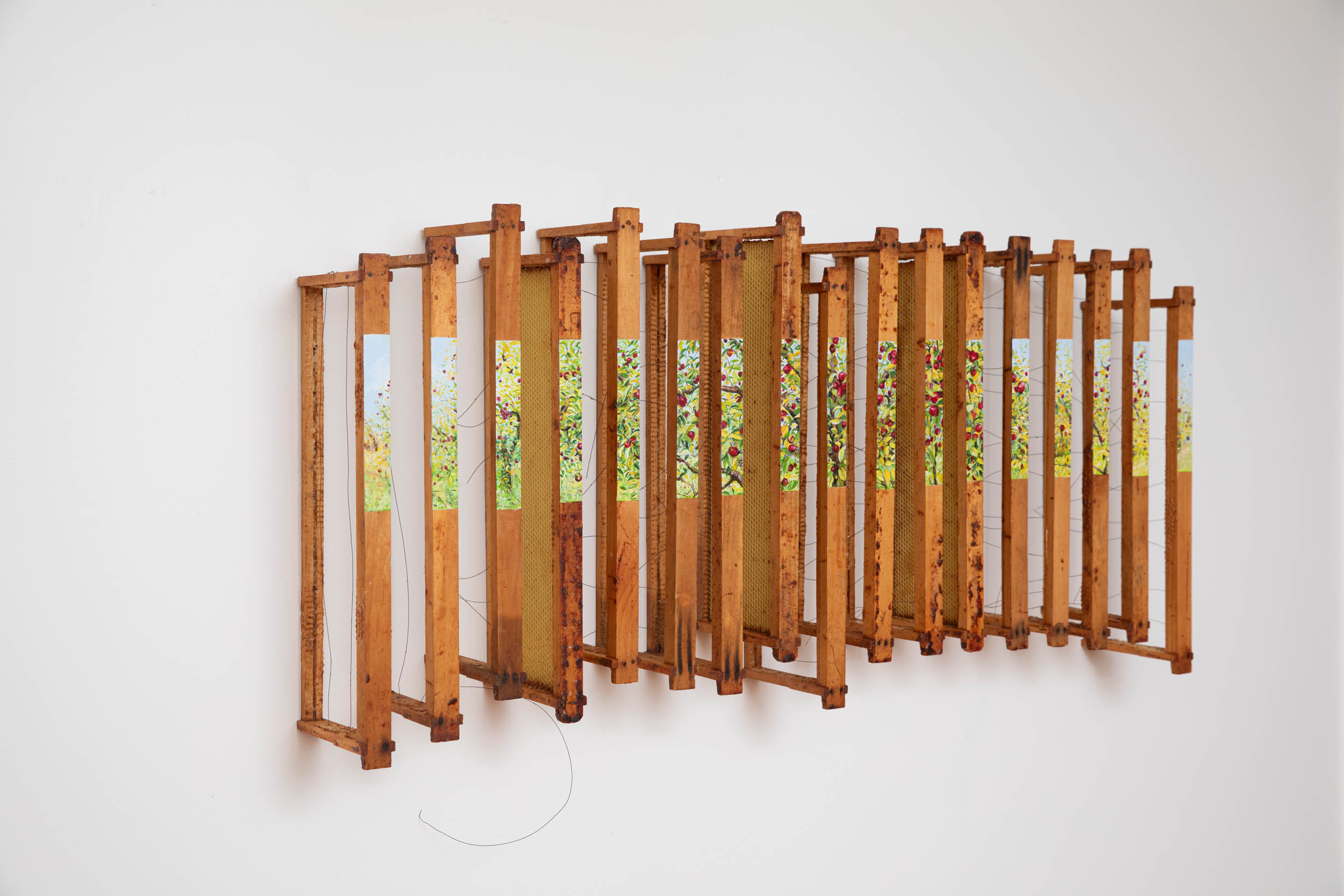
Jennifer Pepper, Orchard, 2023, used wood bee hive frames, wax, propolis, pigment, 15" x 47" x 7"
EC: When people encounter a work like "Wild Empties" or "Surplus", what do you hope happens in that moment? What experience would you like the viewer to have?
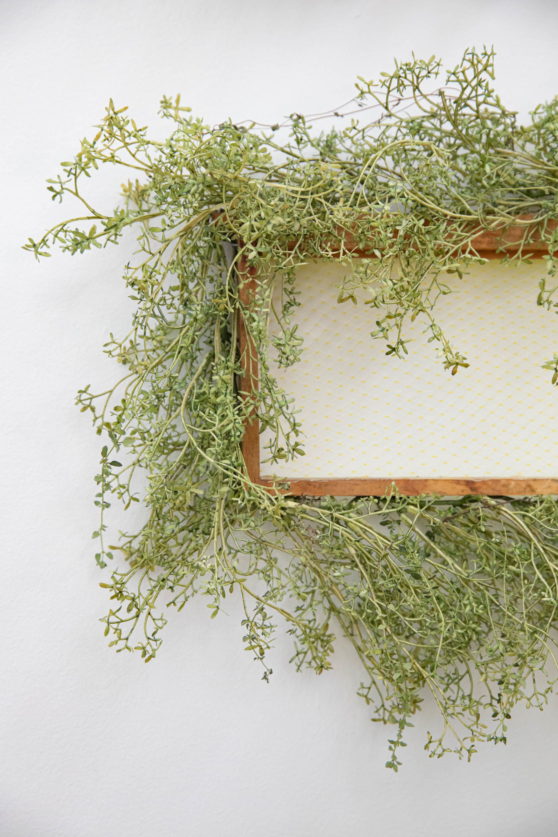
JP: Both works are expressions of love and esteem for bees. By their scale and use of elements like gold and movement, I’d hope that comes across. "Wild Empties” contains 5 empty beehive frames - the frames (as in 2D art) a space for potential. The hexagonal honeycomb that could be built in those frames are multipurpose storage for the bees - for brood, nectar (which becomes honey), and pollen (their main source of protein). The thyme (play on the word “time”) encircling each is a favorite plant of the bees. “Surplus” is a beekeeper’s dream - the boxes that are added to the initial 3 white boxes at the bottom (which contain the queen, food stores, and brood) are all meant to be filled with honey over the summer - the surplus. The boxes themselves are called “supers”.
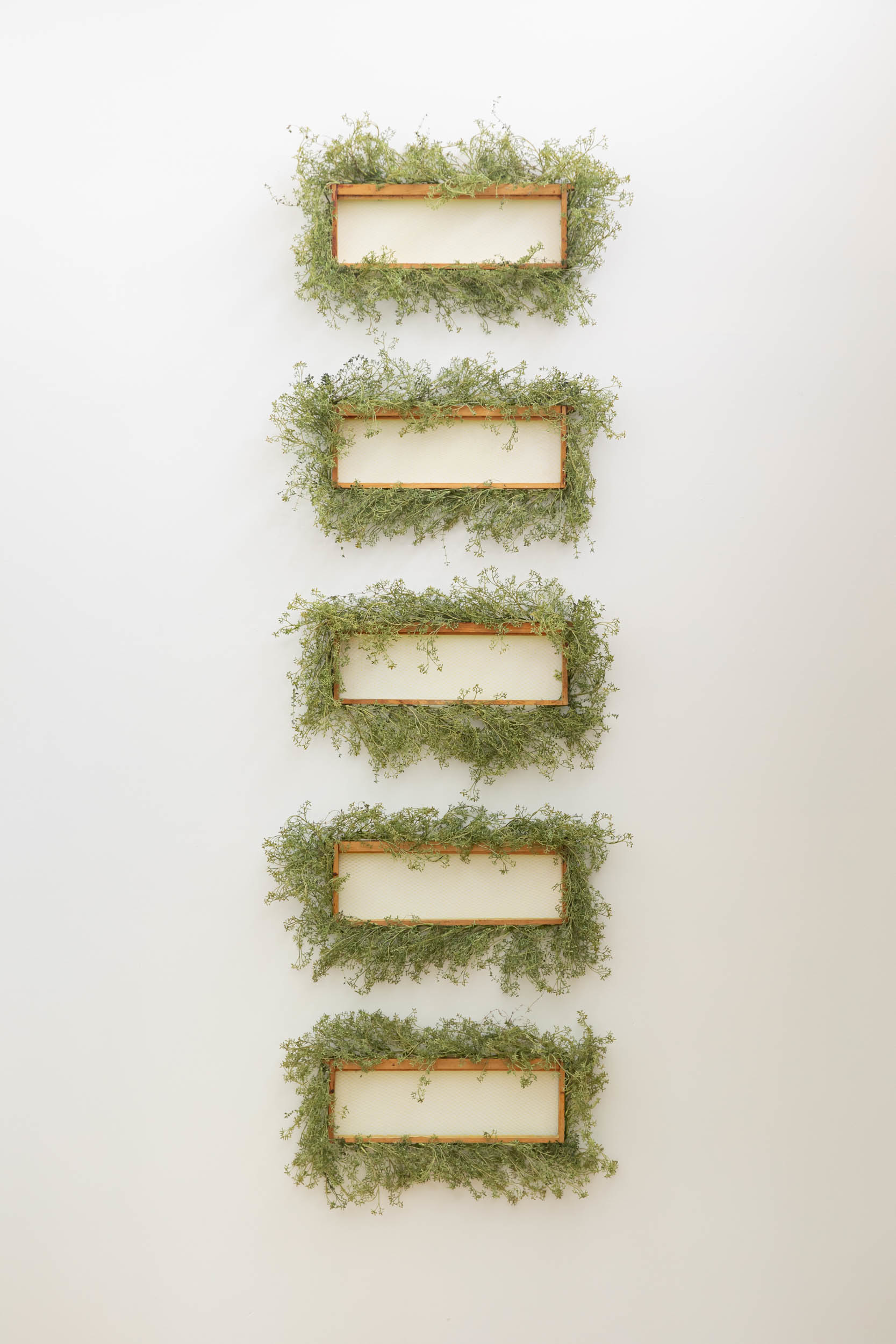
Jennifer Pepper, Wild Empties, 2017, thyme, plastic, beeswax, pigment, wood, 81" x 28" x 7"
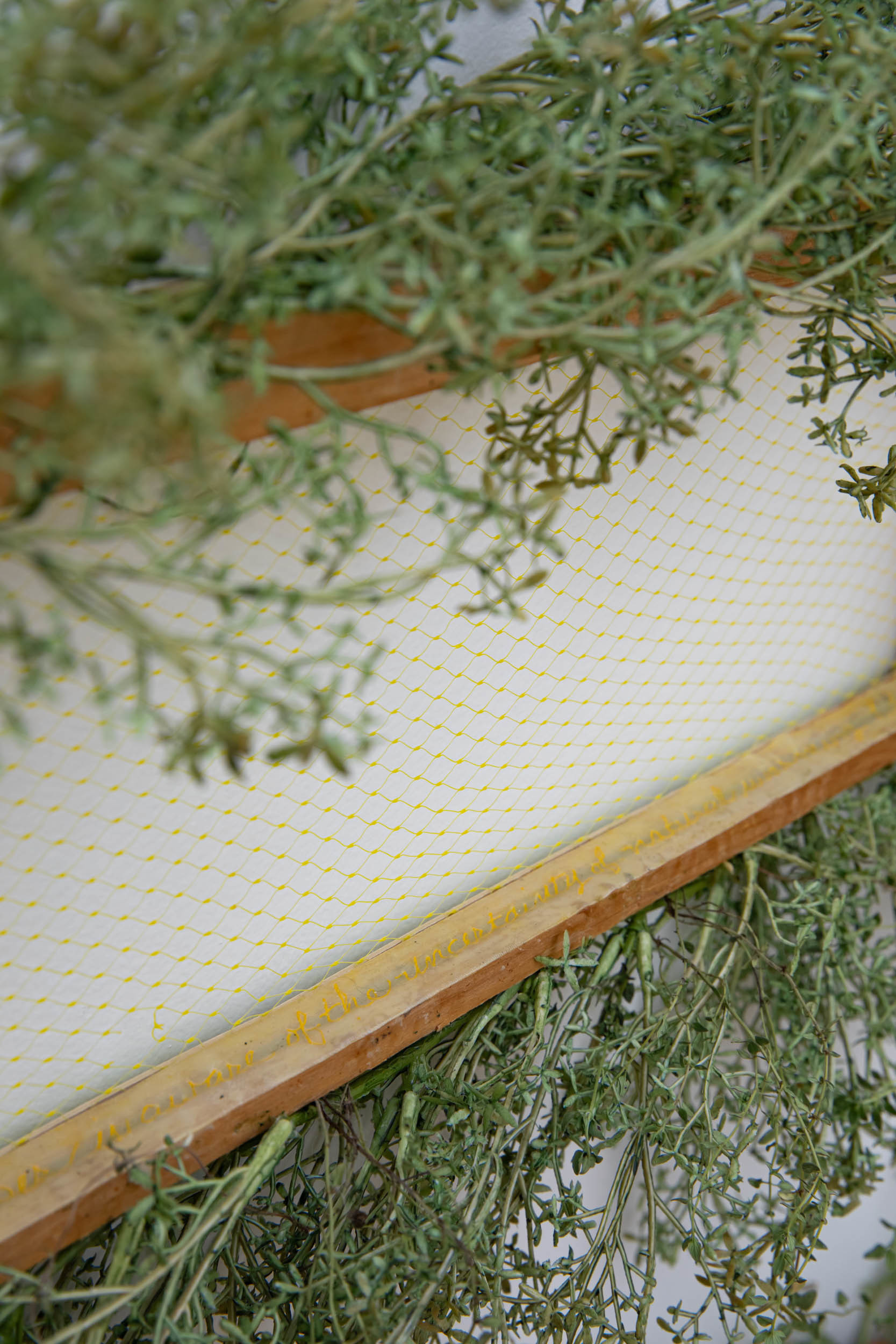
Jennifer Pepper, Wild Empties (detail), 2017, thyme, plastic, beeswax, pigment, wood, 81" x 28" x 7"
EC: Your statement mentions 19th-century Romantic landscape painters as an influence. Which specific painters from that period do you find yourself returning to, and what is it about their work that speaks to your practice now?
JP: Mainly women of the Hudson River School. Initially, I was interested in these women’s dedication to painting from direct observation. The core of my connection to the landscape comes from daily observations. These artists were hiking in their burdensome 19th century dresses often to remote and deep wood places with their oil painting materials. I’m impressed with their grit and determination to try to support themselves with their sales of work.
EC: In "A Sunnier Realm of Light," you combine wood, pigment, wax, plastic, and oil pigment—materials that sit physically on the surface—alongside an illusionistic landscape painting. Can you tell me about your use of the tension between material presence and illusionistic landscape imagery, as seen in this work?
JP: The entire work is from reclaimed wood and recycled items - except for the painted landscape which I based on a 19th century painting “Untitled (Clarendon, Vermont?)” 1874 by Laura Woodward (1834-1926). It felt right to compare the serenity of that landscape with the green recycled vegetable netting from produce and the found wood. The 19th century landscape artists were already concerned with the impact of industrialization on the landscape. And here we are, more than a century later.
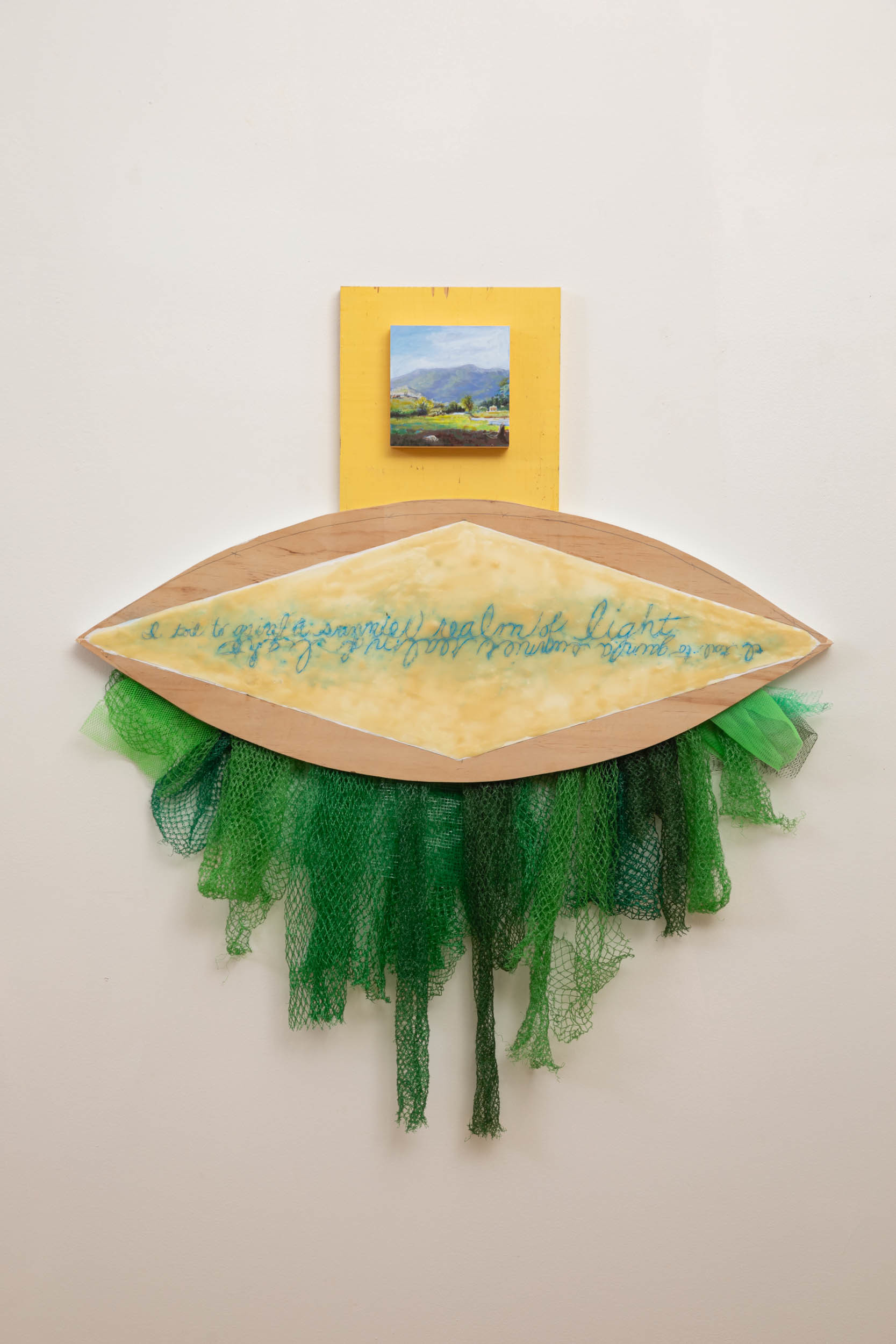
Jennifer Pepper, A Sunnier Realm of Light, 2023, wood, pigment, wax, plastic, oil pigment, 27" x 31"
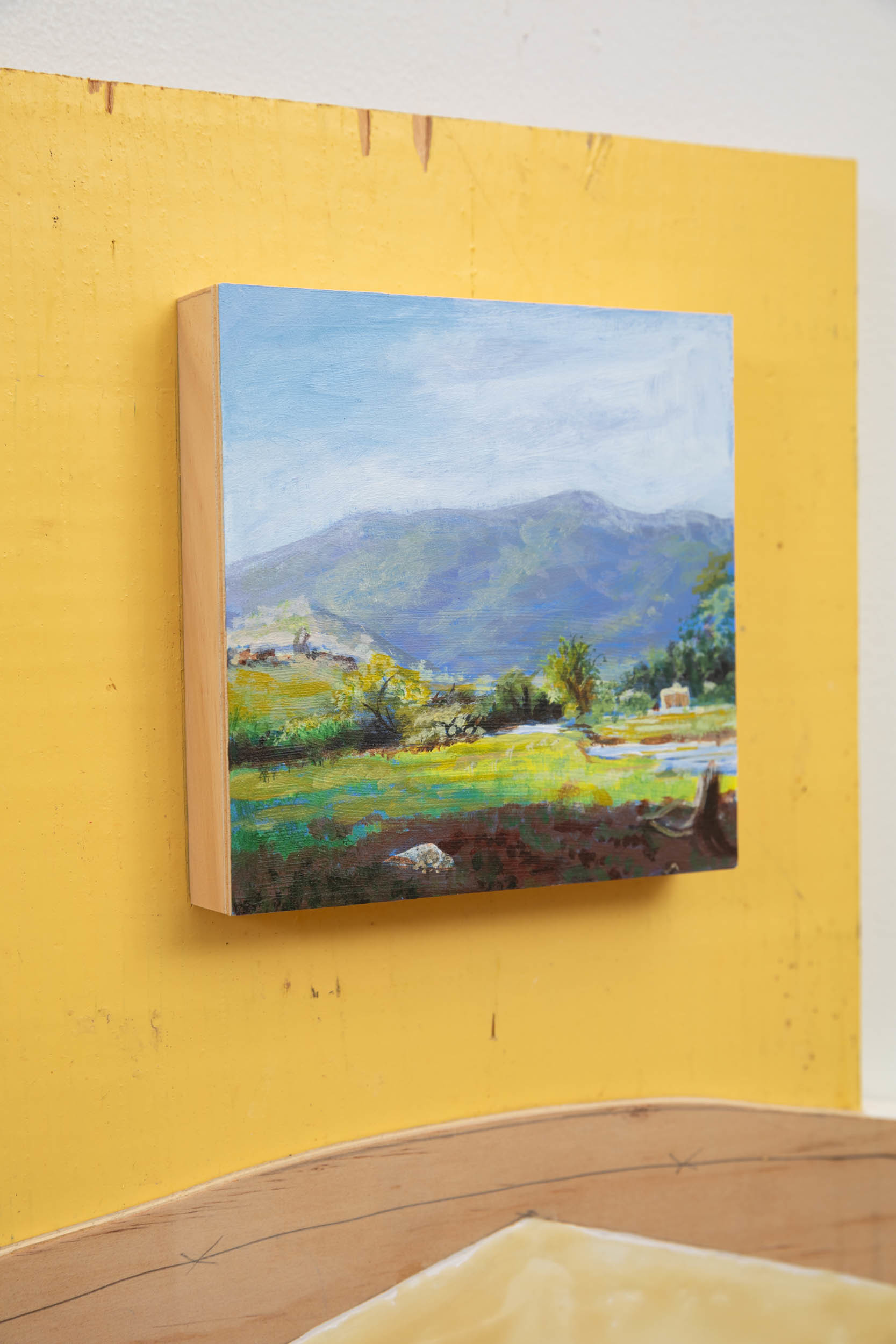
Jennifer Pepper, A Sunnier Realm of Light (details), 2023, wood, pigment, wax, plastic, oil pigment, 27" x 31"
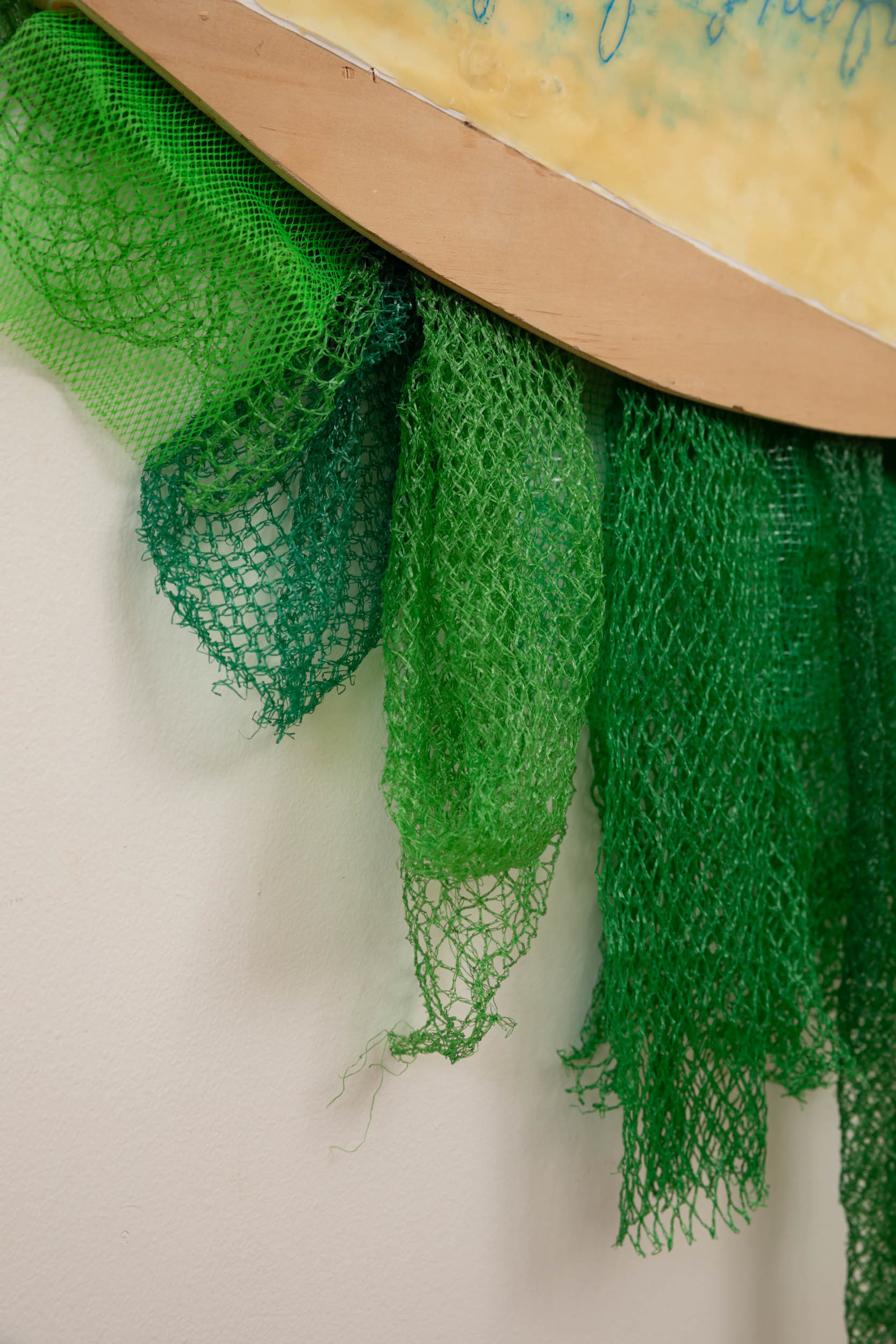
Jennifer Pepper, A Sunnier Realm of Light (details), 2023, wood, pigment, wax, plastic, oil pigment, 27" x 31"
EC: In Sir Boothby, you reference Joseph Wright of Derby's 1781 portrait of Sir Brooke Boothby, in which he reclines in a landscape holding a book by Rousseau. In what ways, if any, has Rousseau's philosophy shaped this piece or this series as a whole?
JP: I became obsessed with this painting by Derby a few years ago - during what I’d call the rise of selfies (not that they are bad - my husband loves marking special occasions with the group selfie). I was also loving the way Boothby insisted that his portrait show him in a wilderness with his handy copy of Rousseau. I spend months trying to sculpt his relief in clay to use to make the mold for the wax (implication-can melt under extreme heat). Certainly, some of Rousseau’s ideas such as idea of self-love (amour de soi) which in itself is not bad but when it turns into toxic vanity (amour-propre) which causes people to compare themselves and fight for status. The framed inset of the painted landscape is intentionally minimized and the uneven hexagonal pattern with the wax drips, for me alluded to the noncontrollable aspects of nature.
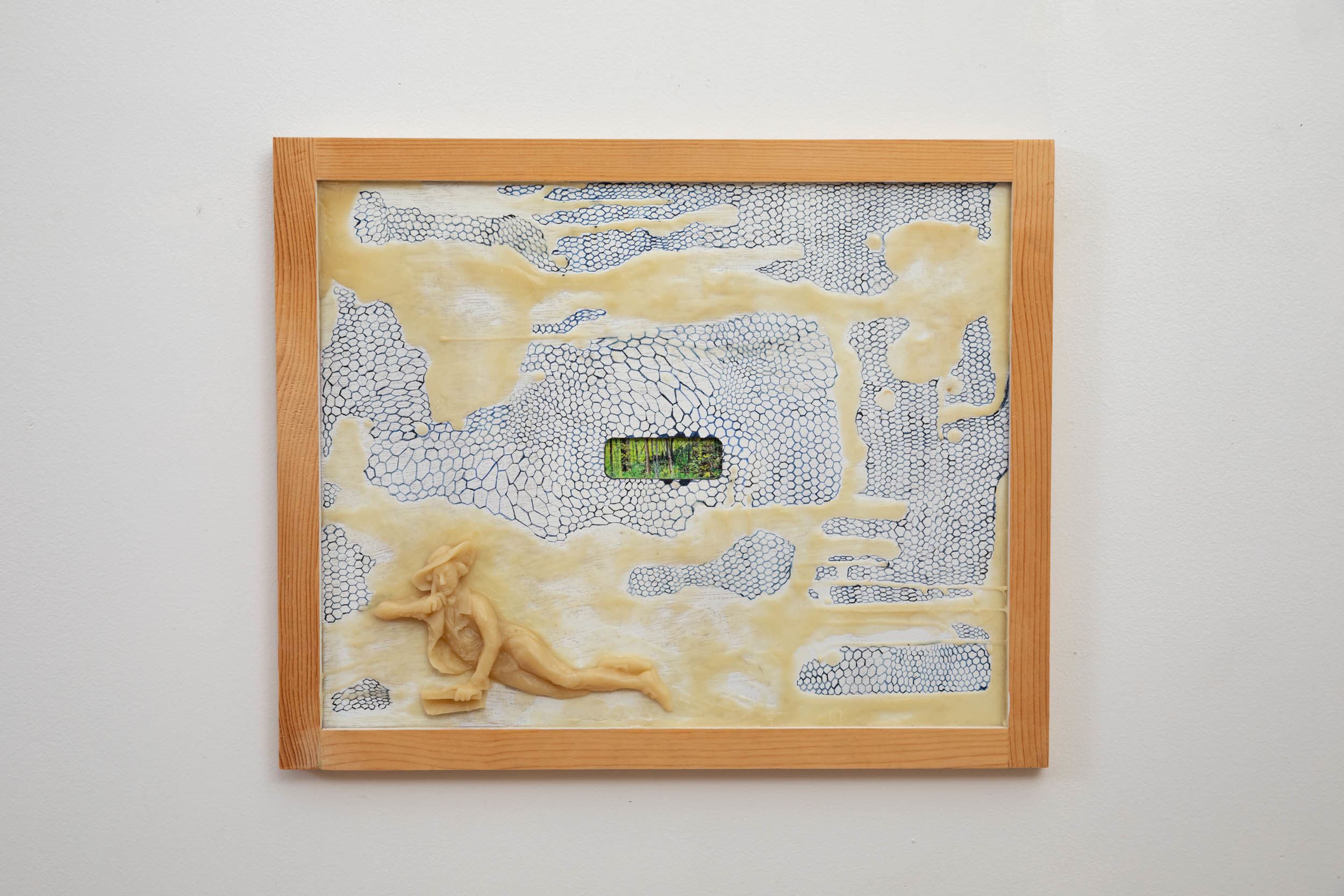
Jennifer Pepper, Sir Boothby, 2021, beeswax, pigment, wood, 16.25" x 20"
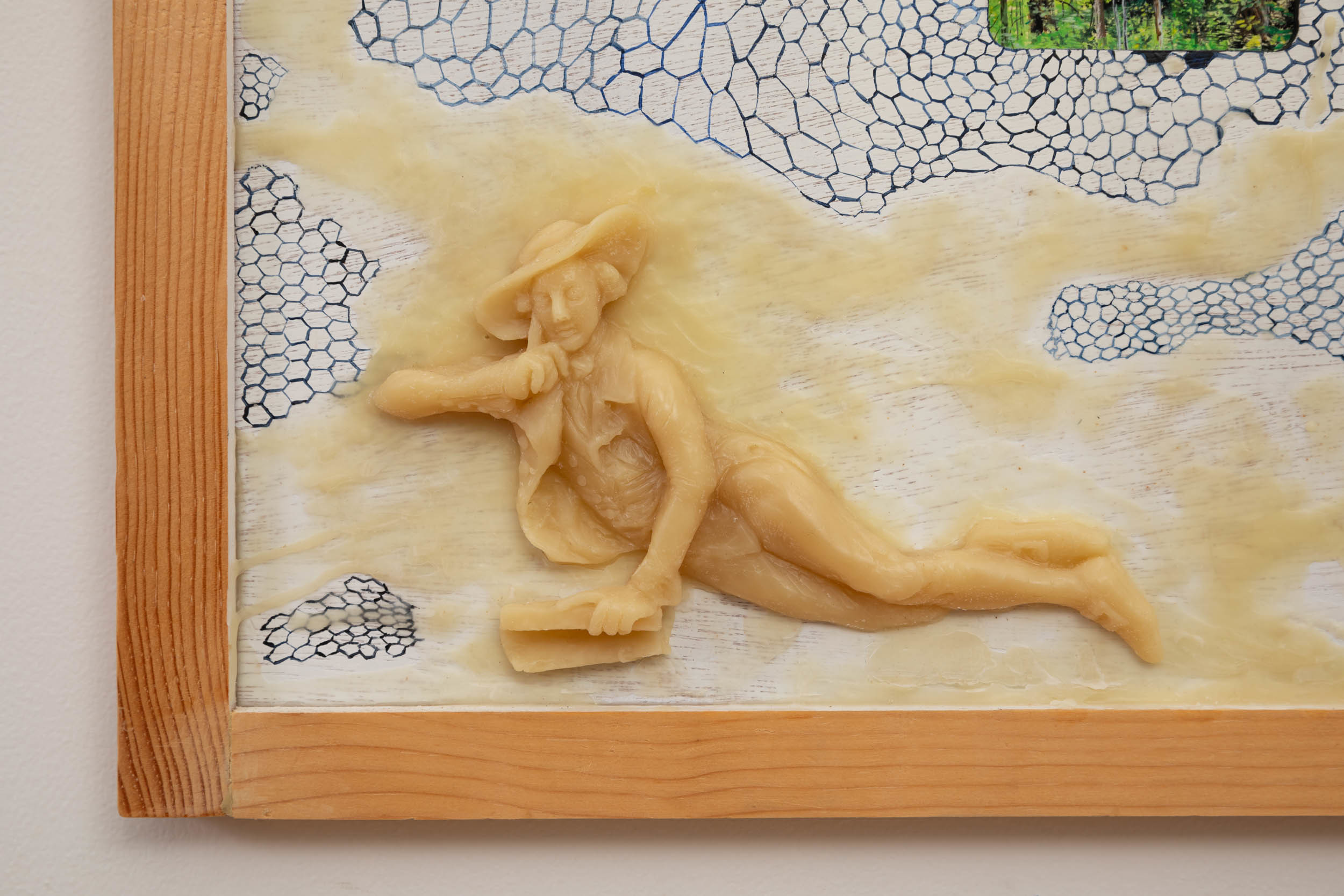
Jennifer Pepper, Sir Boothby (detail), 2021, beeswax, pigment, wood, 16.25" x 20"
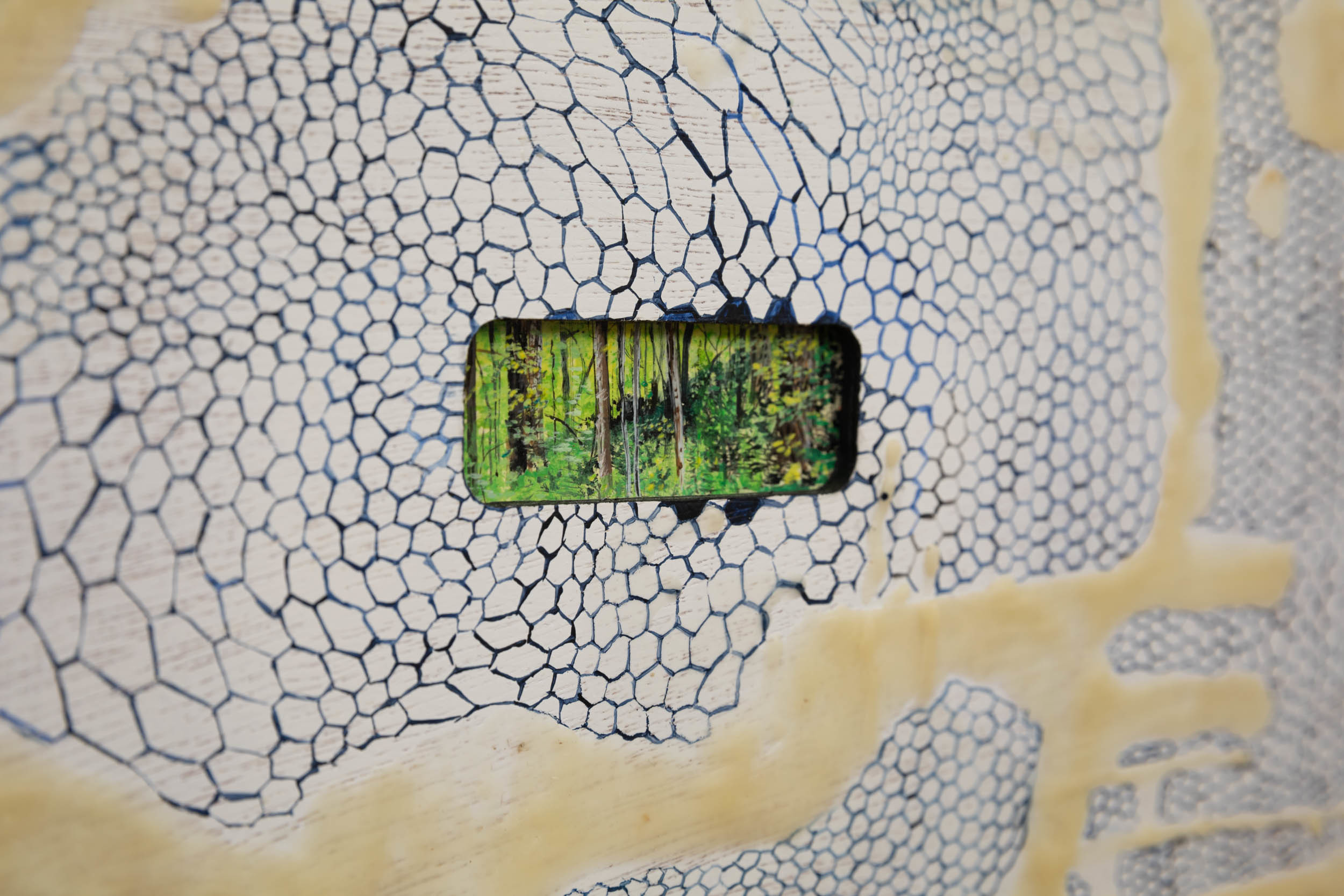
Jennifer Pepper, Sir Boothby (detail), 2021, beeswax, pigment, wood, 16.25" x 20"
EC: Have you received any surprising responses to this series - perhaps from someone in the beekeeping community?
JP: Beekeepers have been so positive and usually love seeing the parts and materials they know so well as a homage to the bees. But what has been more interesting to me are the conversations with folks that really know very little about bees and the process. Many people tell stories of family members keeping bees, hopefully it ignites something in them too.
EC: What's your studio rhythm when you're working? Do you have a regular time or season you make work, or does it depend on when you have used hive equipment available?
JP: Usually, because of teaching, summers and weekends were when I could disappear from my family and squeeze in some studio time. But it was hard to keep up the amount of time I’d prefer. Now that my 2 sons are grown and off on their own, I have more time.
EC: You teach studio art and art history at two universities. Does teaching students about historical landscape painting or contemporary art directly influence what you make in your own studio, or do you keep those worlds separate?
JP: I’m a geek about art history - and I’m often reading art history books alongside a good fiction. It gives one lots to consider and pull from... and compare. Teaching about an artist or material process gives me an excuse to do a deep dive and add to my knowledge base. And I do believe in the importance of having a knowledge base to work from - not having to look stuff up, but know it, spend time with it.
EC: What are you working on now? Does it still center on the beekeeping materials and themes, or are you moving in a different direction?
Currently, I have a diverse group of works in process. I am close to finishing a large painting work based on a fig tree in my yard. Also have been working on sculptures using plant materials based on childhood. Having watched my parents’ generation age and downsize, I’ve come across ephemera that is quite beautiful. I have some very charged inherited personal items that are in my studio. They are not directly being integrated into art - but they are inspiring a large-scale installation that I am planning to exhibit in TX next year.
Jennifer Pepper (b. 1970) is an exhibiting artist living outside Nashville, Tennessee and makes mixed media artworks and installations that consider the fragility of nature as well as our place in it. Over the past 25 years, Jennifer has dedicated herself to the spectrum of art related endeavors while continuing to work as a studio artist and raising a family. After earning her BFA in Painting and Drawing from the University of Tennessee, she worked as an art restorer in Dallas, Texas. She received her MFA with honors in studio art with a concentration in painting/drawing and sculpture from the University of North Texas. During her time in Dallas, Texas, she exhibited her work regionally and was a key member in 500X Gallery (one of Texas’ oldest, artist run, cooperative galleries). She had the unique opportunity to work as assistant curator of education at the Modern Art Museum of Fort Worth during the museums’ historic move from the original building to the world class Tadao Ando designed building in 2002. She has been a member of Nashville’s Coop Gallery, a board member of Tri-Star Arts and has taught studio courses at Belmont and Lipscomb universities.
Elise Cochran is a Senior Intern for Tri-Star Arts.