INTERVIEW: ISAIAH KENNEDY
MAR. 28, 2026
INTERVIEW: ISAIAH KENNEDY
MAR. 28, 2026
Rachel Bubis: Your work returns again and again to Southern identity, asking what it means to be Southern. Has the process of making your work changed or clarified that question for you in any way? And looking forward, where do you feel Southern identity is evolving or revealing itself in unexpected ways?
Isaiah Kennedy: The South, as an ideological construct, is polylithic in nature, not a monolith. What being Southern means to one person is completely different than what it means to another. The more I dig into the idea of being Southern, whether it be my own sense or some kind of larger socio-economic idea of the South, the wider and more expensive it becomes. The further I delve into the work, the more I realize that my idea of Southerness is comprised of numerous multicultural and digital influences, with the Internet and video games being two of the most significant. Video games, in particular, bring in multiple layers of Japanese influence into the mix. I think that everything really exists in the wake of the Internet, specifically in the wake of the hyper-accessible information exchange. One way in which the internet plays into or alters Southerness is how coded cultural information is made accessible without the context it is derived from. The internet offers a heightened ability to access information from different cultures without the inherent cultural markers that act as a code to understand such information. Southerness, as a concept for so long, was based on a specific sense of regionality. That regionality had to do with access to resources, but now, wider cultural influences are a larger part of that. We’re becoming more aware of the differing cultural stories that are involved in being Southern.
RB: Your work explores Southern experience through masculinity, class struggle, lost faith, and cognitive dissonance. Which of these feels most important to you right now, and why?
Cognitive dissonance is a really pertinent feeling these days. Being able to articulate that notion that what you’re experiencing and what you know are clashing, and how that causes different kinds of fatigue or strange feelings inside of you. I find this feeling to be common and really important in how people all over the South feel. There’s a really great piece of writing by a Southern author named Willie Morris that describes this feeling as being in love and then being with misery with something at the same time. To me, this is really what it is to be Southern. To understand our history, the faults, and all the gnarly weight that it carries, but continuing to move on and continuing to go forward with perseverance and pride. Being kind of trapped in between those two feelings is very much a cornerstone in my Southern experience.
RB: How do you think regionalism functions in contemporary art today? Does identifying as a “Southern artist” feel like a constraint, a grounding force, or something else entirely?
IK: Identifying as a Southern artist can certainly constrain someone, but it can also act as a grounding force. I think the differences lie between whether you’re performing the act of being a Southern artist or that you are an artist that is of the South. How, by proxy, one’s Southernness is an inherent quality that is attached to your work, whether you make things that are directly in conversation with that or not. Honestly, I feel like people in the larger art world fetishize being Southern, being poor, and coming from a lower class. It’s a dance if you’re going to speak directly to it, for fear of pigeonholing yourself into only being known for those conversations. Agency and authenticity are timely topics within the contemporary art world, and I believe a poor Southern voice is quite difficult to imitate, so being able to speak from those places with honesty, curiosity, and humor brings me great joy.
RB: Your visual language draws from pop culture, art historical references, and autobiography. How do you decide when an image or reference earns its way into the work?
IK: If an image or motif has a collective sense of relevance or if you can act as a metaphorical placeholder on multiple levels, then it becomes considered as a reference point. Now there’s some different things that I think about when considering these metaphors. I like to think of them as Actors. I consider how the motifs exist in conversation in the fine art world, or does it fall on the edge of fanart. Really and truly, the images need to act as conduits for content that strengthen compositional connections and allow for multiple ways into the work. A recent example that I’ve been using is the figure of a wasp Sprite named Bee-drill from the 2000 Pokémon game Crystal version. It’s important to note that the developers for the first 5 Pokémon games created unique sprites for each game only up to Crystal. The First layer is said to be a recognizable visual language that has an associated cultural context. It’s from a Pokémon game. The second layer is that it’s a response to another Tennessee painter, David Onri Anderson, and The Sacred Bee, his painting of a queen bee. The third layer is the colors, both David and I are using are allusions to the minimalist painter, John Wesley. The last layer is that the wasp exists in the context of a trailer park. If you’ve had any firsthand experiences with living, existing, or visiting a trailer park, you know that during the summer wasps are everywhere. They are like malicious sentinels guarding their hives. Washed home in a very specific way. The summer is very, very hot. Often trailers are not properly cooled, so the heat has a strong tendency to slip in, so the summer heat is flashbulb thought associated with mobile homes. These wasps offer a way into the kinesthetic language tied to what trailer parks feel like. This example of a wasp illustrates the intention behind choosing these actors, how they can potentially be repeated and connected to multiple layers of information throughout a singular piece, and the larger idea explored through the body of work.
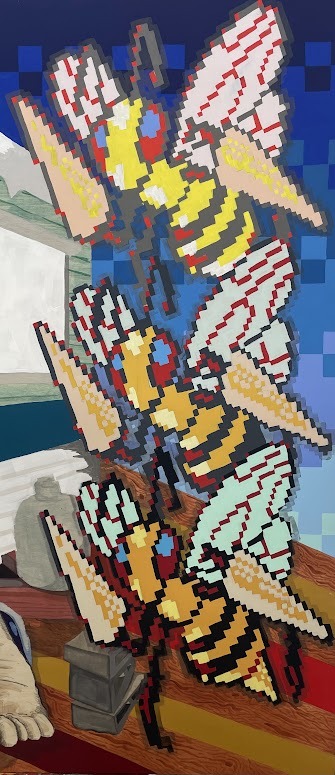
Isaiah Kennedy, 2026
RB: Japanese influence appears as an important thread in your practice. Can you talk about where that influence comes from and how it manifests formally or conceptually?
IK: To begin, I want to say I’m really excited about multiple layers of information or multiple layers of influence that live together and are connected in ways that you may not perceive at first glance. My connection to Japanese influence started when I was a kid. Being poor and in the country, video games offered fantasy and an escape. These games were also connected in the relationship I share with my brother. The majority of the video games we play here in the States are Japanese games that are translated and ported for the American market. Pokémon and Yu-Gi-Oh, for example. Those games were heavy sources of fantasy in which I could recede when things were not good. Growing up the way I did, there were a few times when the safe space these games provided was needed. Fast forward to high school, in 2017, I had the opportunity as an 18-year-old to participate in a youth exchange with a student from Japan, so I had the opportunity to live in the city of Kanazawa. This is the capital of the Ishikawa prefecture. A city about the size of Seattle. I lived there for a year and basically redid my senior year of high school. While there, I experienced so many amazing things and really got to feel and see what it was like to live somewhere that was the philosophical opposite of the South. The philosophical opposite of what I was used to. Through this experience, I became aware of Japanese cultural coding and nuances that we get within translated western or Japanese media. There’s a lot of contextual information that is lost when it’s brought over to the States or nodded to in ways you may be unaware of. In Japan, I began to understand the connections that I had experienced through media, history learned, and the actuality of Japanese life.
The other really important breakthrough I had while in Kanazawa was that I missed the South dearly. I missed so many things about home, not with some romantic zeal but rather being able to hold it at arm’s length and really consider what about being Southern feels right and wrong. To paraphrase Willie Morris again, I needed an Exodus in order to understand the importance of returning home. The coexisting nature of these two realizations it an important thread within the work and a catalyst experience for the desire to create as one of the main goals in my life.
Flash forward to recent times, in graduate school, one thinks a lot about one's visual language and artistic voice. In undergrad, collage was a rather important medium and way of thinking. To use different pieces of different things for the specific information and context surrounding them. When refining, exercising, and exploring my voice, it came naturally to think about the synthesis of multiple sources and layers of information that are pinned to those connections to Japanese history in Japanese dialogue, having experienced living in Japan, a more nuanced way of thinking about Southerness, and how these different dialogues are also reflective of common experiences held by many people. The video game motifs that had been so important in my childhood began to take on new meaning because of their hidden cultural information, giving meaning to images that can be used as allegories. This concept is especially true for the more on-the-nose Southern elements in the work.
RB: You have a background in carpentry, and there’s a clear attention to finish in the wooden components of your work. Is precision and cleanliness of execution important to you conceptually or just aesthetically?
IK: Attention to cleanliness and finish in all the works stems from Care or thinking about Care. In carpentry, Care looks like attention and being intentional to avoid making mistakes. You don’t want to come back and have to fix something. My experience working with my father on houses and roofs has taught me that 90% of the time you’re fixing someone else’s mistake, and that mistakes can be avoided if you just take the time and effort and Care into something. That sense of Care bleeds into my larger artistic life. Care shows that just about everything within your practice matters, and any moment of interaction with material could be a moment that you could infuse with content or a moment that could be used or could be pivotal. It’s about considering our history as folks, as artists. You should consider yourself a student long after your schooling. Attention to finish is about the consideration of materials. Nuanced curiosity and understanding of materials are important ways to show that you Care. There’s a heavy emphasis in the art world to be uber intentional with conceptual thinking, and that should follow right into the attention we give the material component of our works. I think one should consider the skillful creation of the work as an object first, then its conceptual meat second. I fall in line with Kerry James Marshall’s thought as described by Helen Molesworth in Mastry. “I wanted to know how to make painting: but once I came to know that, reconsidering the question of what Art is returned as a critical issue.” The work can live its full life when conceptual and material care are matched and attended to at the same level.
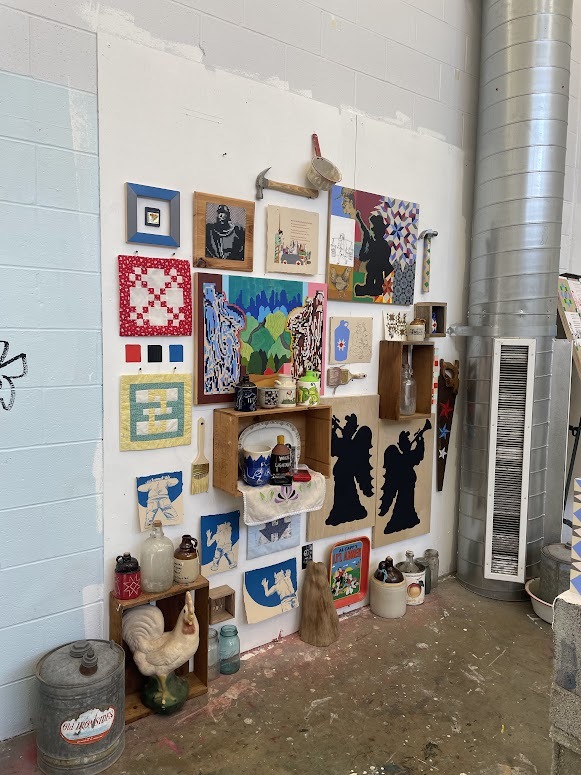
Isaiah Kennedy, studio view, 2026
RB: Do you see your carpentry practice as separate from your artmaking?
IK: I think carpentry is the extension of the skill, not the practice. It’s just used for different things at different times. We can make pieces of art that are intended to live as art, and then at the same time, we can make things that are craft objects that are intended to live and exist with a life based in purpose. I think it is important to attend to a material with understanding, curiosity, and care. In the same way, you might call a painter a painter because they use paint, you call a carpenter a carpenter because they use wood. It’s just the kind of way we talk about it or think about it. A lot of the same core rules are involved, whether you’re creating something for an art piece or if you’re building something to support or to live in. Both have some kind of greater purpose that requires specific attention. The ideas of building are congruent between both; even if something needs to look really pretty, it still has to exist in a specific way based out of like a need to function, so they’re not separate in my eyes.
RB: You’ve spoken about breaking away from the traditional square composition. What initially drew you to disrupt that format, and how does it change the way viewers physically engage with the work?
IK: As my practice has become more interdisciplinary, the way an idea lives in space versus on a 2-D picture plane has grown. I’ve begun engaging with found objects that hold cultural relevance. The information, coded within those objects, lives a different life then as if I were to portray that object on a two-dimensional space. It’s healthy to question what the purpose is in painting something if it already exists in space, and if it already exists in space, how does it act differently than something one creates? Bouncing back-and-forth between those two questions has provided a lot of fruit. This method of using both found objects and created objects feeds my soul in certain ways. It’s opened up new avenues in what I consider parts of my practice. An example is to go thrifting or to go look at antiques with the purpose of finding objects to engage with to respond to. It’s also a moment that can strengthen a connection with my family that can exist not only between us personally, but also in the studio space or in the art space in general. Incorporating these found objects gives a moment that family members can interact directly and be included in the work through objects, and exist as a part of the work. For example, I dig through my grandmother's barn quite frequently. Each time something comes back to the studio, there’s a story attached. I get really excited at the bits of cultural information that are hidden within those objects. That’s a new word or a new moment that appears in the vernacular. The interactions and synthesis that can happen between the 2-d work and the 3-d gets me really jazzed. These objects also offer me new ways into making or approaching the making. Response, remixing, and making in conversation have been making things feel very choral. Richard James and Radcliffe Bailey have been really informative in thinking this way.
RB: Your upcoming MFA exhibition Dixie Knights asks, “What does it mean to be Southern?” through a post-digital lens. What does “post-digital” mean to you in the context of this work?
IK: Post digital means existing in the wake of the Internet, and it also means existing in the wake of video games, video games being the catalyst for a large amount of the visual language held within the paintings, and also a catalyst for multiple layers of information that have been with me from childhood till now, into my artistic career.
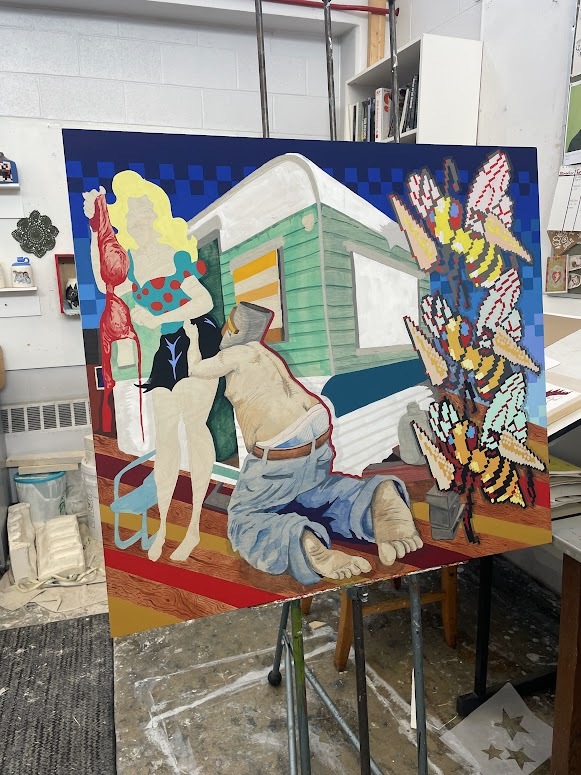
Isaiah Kennedy, progress photo of Betrayal, Bees, and New-Found Bras, 2025, acrylic, watercolor, gouache, graphite, and ink on wood panel, 34.5" x 38"
RB: Family of Green’Acres went through multiple physical iterations, moving between wall and floor. How did that instability shape your relationship to the piece?
At first, it honestly scared me. I spoke earlier about care, and along with care comes responsibility and I think about responsibility with painting pretty intensely. As my painting vernacular grows and changes, I feel the responsibility to carry a similar level of finish and consideration, no matter the size. This responsibility also grows as my skills and painting repertoire grow. For this reason, scaling up can be a tad daunting. This painting is a bit bigger than the paintings I’ve made in the past year or so. It was imposing because there is so much space there, that space containing so many moments that I had to be responsible for. I wanted to build the pictorial space in a way that felt honest to the ideas I was trying to portray. I ended up just taking bites over about 6 months to a year rather than long painting sessions within a couple of months. I would paint a moment at a time, then I would switch and work on something else. This back and forth over an extended time ended up being to the work’s benefit because of all the other breakthroughs that happened along the course of the painting added to the overall language. The breakthroughs that were happening with other paintings, drawings, and other parts of my practice were incorporated throughout the duration. That frustration and moving it up and down just added to its life. A normal part of any painting for me also includes leaving holes or gaps within the composition when it comes to my reference material. Normally, I will build a collage or an illustration for the reference, then purposely leave moments out so that when I transfer it up, those moments are kind of left for me to solve. Things can get boring if you just recreate a drawing directly. Having to be in conversation with the paintings has been a super important lesson that’s spread throughout my studio practice. The longer amount of time that I worked on it allowed a lot of room to think about what I could supplement in there. This time and space were really helpful in creating a more cohesive narrative. It was a consistent conversation that changed tones regularly.
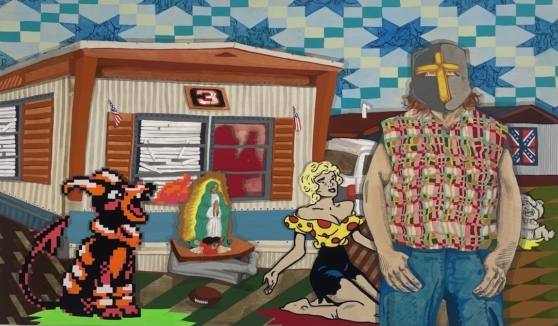
RB: The work references Picasso’s Family of the Saltimbanques and stages its figures like actors frozen before confrontation. What drew you to that moment of tension? You’ve described the piece as a “trailer park tragedy.” How do empathy, critique, and autobiography intersect in that framing?
IK: What I really love about Family of Saltimbanques is the drama of the figures and the sexual tension. The implication of a cucking scenario being at play really changes the way the viewer perceives the figures. I really wanted to engage with the kind of dialogue that the narrative is moved around by the gazes, and the figures tell you what’s going on by their placement. I’d be having this idea of an adaptation of Hamlet, but it was set in a trailer park. I was also thinking a lot about how, no matter what trailer park you go to there’s someone who has a valure rebel flag blocking sunlight in their window. This weird common occurrence feels like super close to how narrow-minded thoughts just won’t die and definitely find root in low-income spaces. If you’ve ever spent any time in the trailer parks in around folks that live in trailer parks not as a generalization, but just like a based in my own experience, it often feels really surreal and plays out almost like a soap opera the way that people live in the way that they kind of engage in these cycles, and I knew that you know if I was to preface my experience or if I was to reference my life in a way that connects to the art historical canon it would be through something that humor, but also an area for great depth . Because of all these thoughts is started playing with the theatrical trailer park scene. Walt Whitman once said humor is judgment cast, the night figures went into paintings represent southern white Christian men, the Templar helmets being connected to the historical Knight figures that participated in the Crusades that Templar idea that they are part of a larger system that they can only participate in to attempt to enjoy its benefits yet while their power or their agency is related to their body and how they use them via labor or violence. For these reasons, the knight feels the most pertinent allegory for me to talk about Southern white Christian men. When I’m showing these Knight figures, I can’t help but empathize with the greater machine they’re a part of that removes or forces their choices in how to think and live. However, as someone who comes from the same place, I also recognize the ability of one’s choice to acknowledge the system and how you can exist outside of that system. The figures within the painting act as critiques on the way that people tend to characterize themselves based on their cultural teachings or understandings of what it means to be Southern. This can come from so many different places, so many different signifiers, but in my experience, it feels like folks attach to an idealized notion of being Southern and the way folks latch on to stereotypes. They run with them these notions their whole lives, and that’s reinforced by so many different social factors, so the figures emphasize the larger ideas in their scenarios. These ideas are extremely close, particularly to the zealous Christian nature of my family, and how our economic standing and place affect our viewpoints.
With all of those things in mind, when I think of the most dramatic, hilarious, and dark scenario in a trailer park, I think of a shotgun wedding/the announcement of a pregnancy. The thought of an unplanned pregnancy for poor Christian folks holds all the drama one could want. Was the baby conceived out of wedlock? Will the man stay? Will the lady’s family force a marriage? How will they provide for the baby? What future will the baby be born into? That’s some damn trailer park drama on the same level as Hamlet.
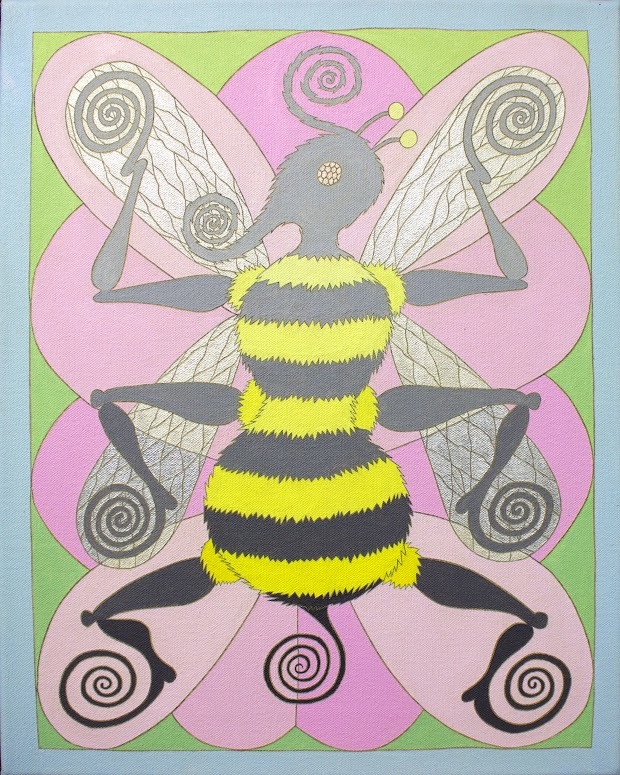
David Onri Anderson, Sacred Bee, 2022, acrylic on canvas
RB: As you finish your MFA and prepare for this exhibition, what feels unresolved or still open-ended in your practice?
IK: I don’t really think the question of what it means to be Southern can ever be answered, but can only continue to be dug and explored. That gives me hope and a desire to continue to make things based around this idea. At the time making the show, so many things have opened up in the work and exploring those ideas in conversation, whether that be installation, sculpture, painting, ceramics, interactive video games, sound design or the written components. I guess my time in grad school has been successful because here at the end, it’s become completely wide-open. I’ve always thinking of my practice as a soundboard. Each knob or dial is related to a material or idea. All these parts are all in conversation, so mixing the mediums and motifs feels like mixing on the soundboard. I’m excited to pursue some concrete questions, such as making paintings on an even larger scale, finding some real funky balance between sculpture and paintings, and making a video game with all these different pieces.
RB: What are you working on now and what’s next?
IK: Recently, I’ve been excited about cabinet paintings or paintings that have shelves built into them. I make or find objects to sit on the shelves. The elements that are on the shelves are interactive with the paintings. Right now, these objects exist as ceramic whiskey jugs and beer cans that have text, images, or create patterns. The dialogue between sculptures, objects, and paintings has been on my mind lately. Henry Smith and I created an exhibition last year. It happened in Chicago at the Kiosk gallery, and the name of the exhibition was Appalachian Shibboleth and other Trail Tales. We’ve been working on showing that body of work with some new artist including Ron Marion, Sierra Evans, and Eleanor Davidson, at another gallery within the mid-south. Within the next year, that exhibition should be up somewhere. Then, in August, I have curated a group exhibition with a lot of Memphis folks called The Third Hand, referencing Philip Guston‘s discussions about the spirit of creativity when one is inside the studio space. The artists included in that show are Andres Arauz, Lucille Shelton, April Pierce, Gabriel Skinner, Beatrix Heidenreich, Blake Connor, April Pierce, Liz Huock, Olivia Malone, Rahn Marion, Abigail Wynn, and me. Recently, I stepped into the role of creative Director for a skateboard company called Politic skateboards, and we have our first drop under new direction, new energy. I’m very excited for some of those graphics to come out, and honestly getting back into the practice of drawing more. I’m an advisor for the summer program at Contemporary Arts Memphis. We’re an arts non-profit started by the artist Derek Fordjour. We have a summer program where gifted high school students go to study and live together for a month. They get extensive courses in painting, printmaking, art history, sculpture, drawing, and what it looks like to exist in the art world. The month culminates in a 5-day trip to New York, where we visit museums and artists’ studios. I’m super excited to be around the young folks. A lot of opportunities open up after grad school, so I’m really excited to get out into the art world by and large. All that to be said, I’m looking forward to warm weather, fishing, skating, and spending time with my partner. Thank you!
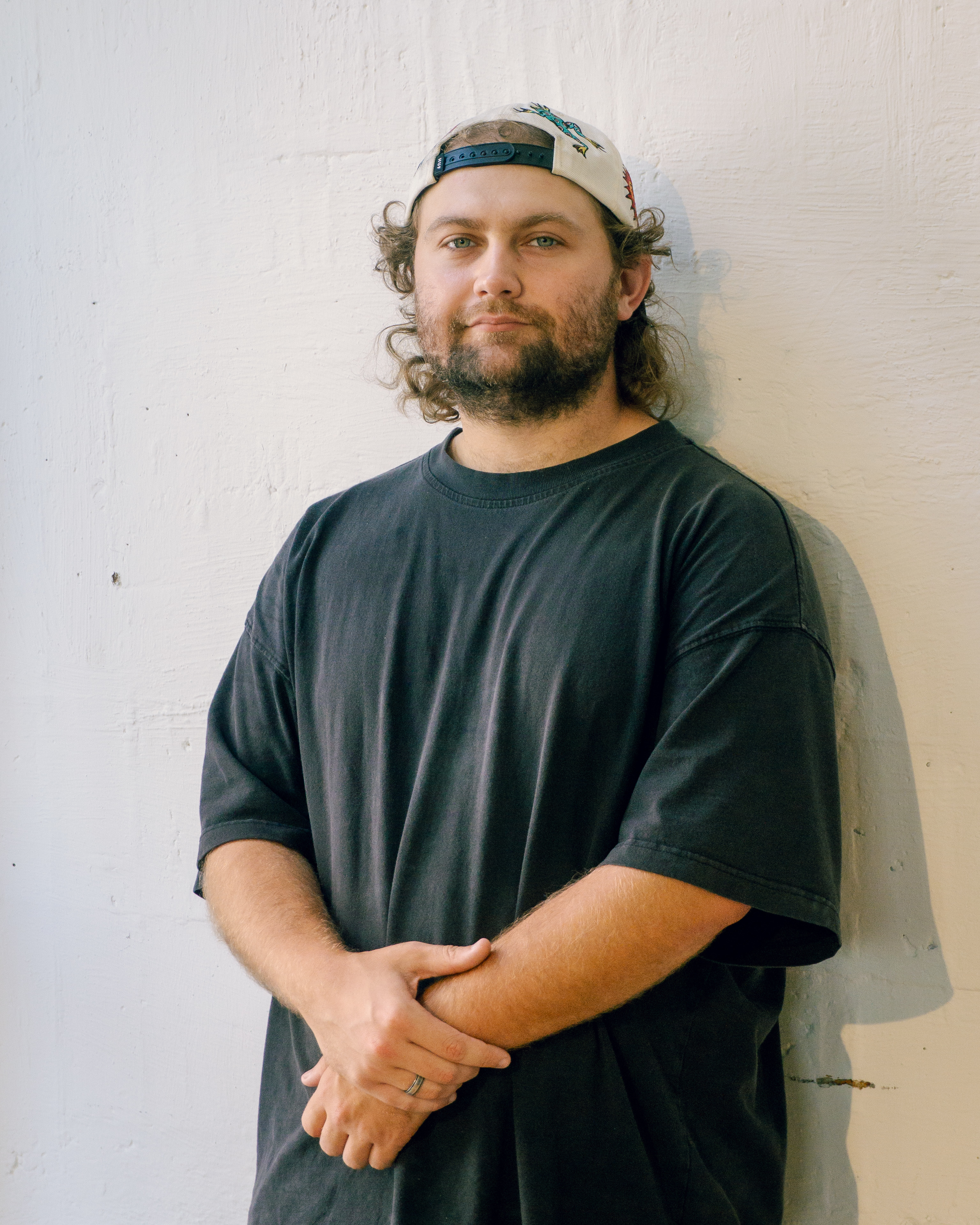
Isaiah Kennedy was born in rural west Tennessee. He earned his BFA in studio art from the University of Tennessee at Martin. He is currently degree seeking at the University of Memphis for an MFA in painting. His creative practice includes paintings, woodcuts, sculptural forms, installations, printmaking, collage compositions, traditional illustrations, film photography, and videography. Outside of his making-practice, Isaiah enjoys skateboarding, all kinds of cinema, sunshine, bad coffee, and good music.
Rachel Bubis is a Nashville-based independent arts writer, regular contributor to The Focus blog, and LocateArts.org Web Manager for Tri-Star Arts.