INTERVIEW: DENISE STEWART-SANABRIA
FEB. 27, 2026
INTERVIEW: DENISE STEWART-SANABRIA
FEB. 27, 2026
Wesley Roden: Whether by arranging drama scenes with ceramic figures and tequila umbrellas or depicting portraits of people in motion, your work conveys narrative. How do you arrange items or choose subject matter that creates parameters for imagination or a bigger story? Do you ever hint beyond the canvas or silhouette of the figure?
Denise Stewart-Sanabria: The objects in paintings have to have a level of fabulousness to them. They want to pose. They want to star in something. Whoever created them gets that credit. This goes from Donut and cake design to crazy Tchochkes. Who gets cast in a painting depends on scale, color, and how they can interact. I have ceramic birds that beg for food. I have another extremely judgmental one. My Godzilla’s like to interact with my T-rexes. As for my life size drawings of people on cut plywood, they are displayed in installations of virtual reality. How do people circumnavigate a room? How much space does one group of people cluster to hang out away from another group? How do you mix angles to create an interesting walk through flow for people attending the exhibit? Also, from the back they are all painted black. It becomes minimalist groupings of silhouettes.
WR: There’s a lot of humor in your paintings. It exists in obvious ways, through disco balls or fish-horse hybrids, or more subtle ways, such as an unexpected drizzle across neatly ordered limes. How much of your painting is either conjuring absurdity or finding humor in unexpected places?
DSS: Humor is more interesting than pure drama. Dramatic humor beats all. I need that when I incorporate violence. It needs to become absurd so it will be palatable, whether I’m impaling fruit on nails or using my magnetic decapitation Marie Antoinette salt and pepper shakers.
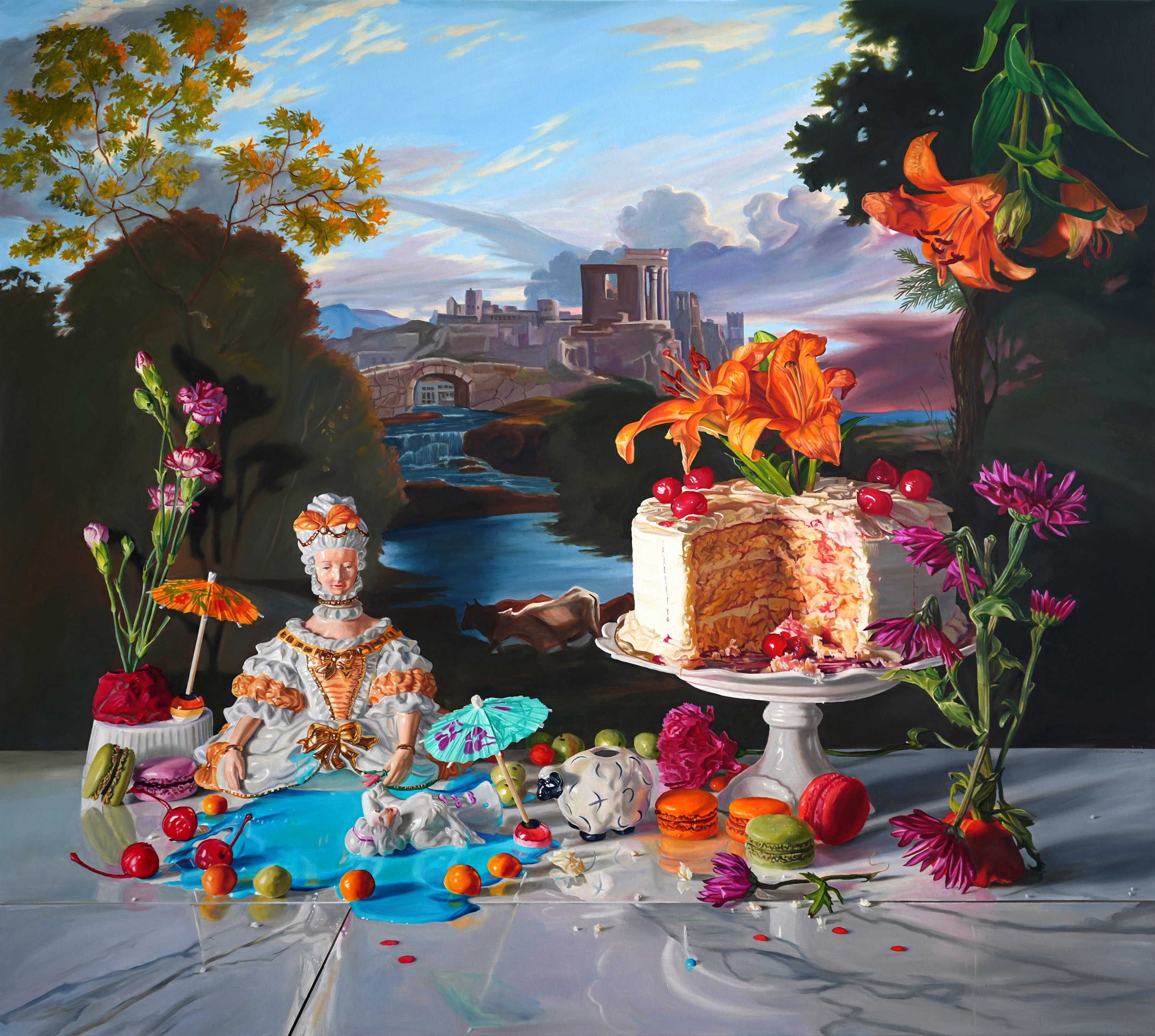
Denise Stewart-Sanabria, Marie Contemplates Herself as Ophelia, 2025, oil on linen, 48" x 53"
WR: I’m inspired by the amount you create for a singular series. As a practical question, how do you remain consistent in investigating an idea? How much of your work ethic is guided by interest, genuine curiosity, or tenacity?
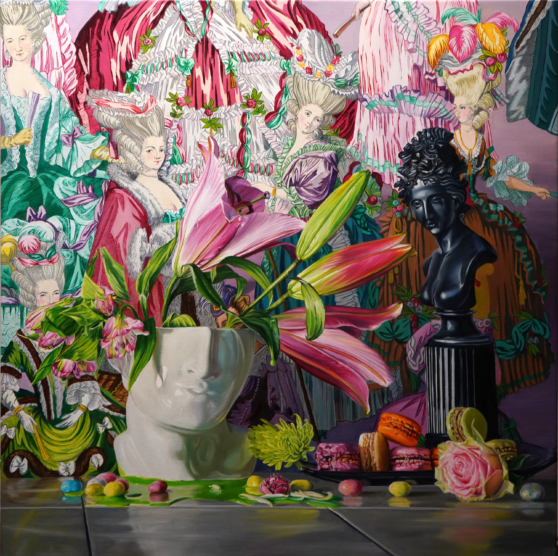
DSS: One idea triggers the next. Theme and variation. It evolves until I go on to the next thing. Various backdrops can change the concept, also. My backdrops vary from patterns to 18th century toile wallpaper to Western Civilization paintings, mostly from the Rococo. I do photo reference shoots after buying bags of produce, flowers and baked goods. These objects reappear in different paintings because I’m doing a lot of different layouts at the same time. I usually get at least four or more various references for paintings from one shoot. Clean up time is not amusing.
WR: I notice bright colors and sweetness as themes. How do the two concepts echo one another and maybe echo our current climate as a whole? Like Rococo, do you believe contemporary art is consumed in a confectionary way and do you celebrate or subvert modern views of consumption?
DSS: Color theory used in creation really revs up appetites, whether it is food or art. Nobody wants to eat grey cupcakes. Monochromatic drawings are harder to sell, darn it! Artificiality seems to be the goal for the most complicated food out there. Cake designers, at this point, are artists. Sculptors of creations that are perishable…unless it’s a Twinkie. Using what they make in my paintings is a double whammy. The thing is that I rarely eat anything I bring home from bakeries. I don’t really like sweets. I just like looking at them. I keep my husband out of the studio while doing reference shoots. The whole place will smell like cake and make him nuts.
WR: You’ve mentioned Versailles while speaking about your work. How does borrowing visually from a specific place and time reframe your language of contemporary realism?
DSS: Versailles was the height of indulgence. The Monarchy and class system was purely toxic, but the creative class really took advantage of working for those privileged incompetents. Whether they were architects. landscape designers, artists, bakers, interior designers or clothing designers, they were allowed to go absolutely wild with what they created. In fact, everything that remains of this time is because the craftsmen and artists they hired created the whole thing. The Monarchs thought they were only immortalizing them. Creators used the funding to do what they couldn’t afford on their own. These places are monuments to the hands that built them. I like to take French Macarons and have them interact with Chattanooga Moon Pies or Whoopy Pies. Different century, different culture. Dainty VS big and bold, and sometimes sloppy.
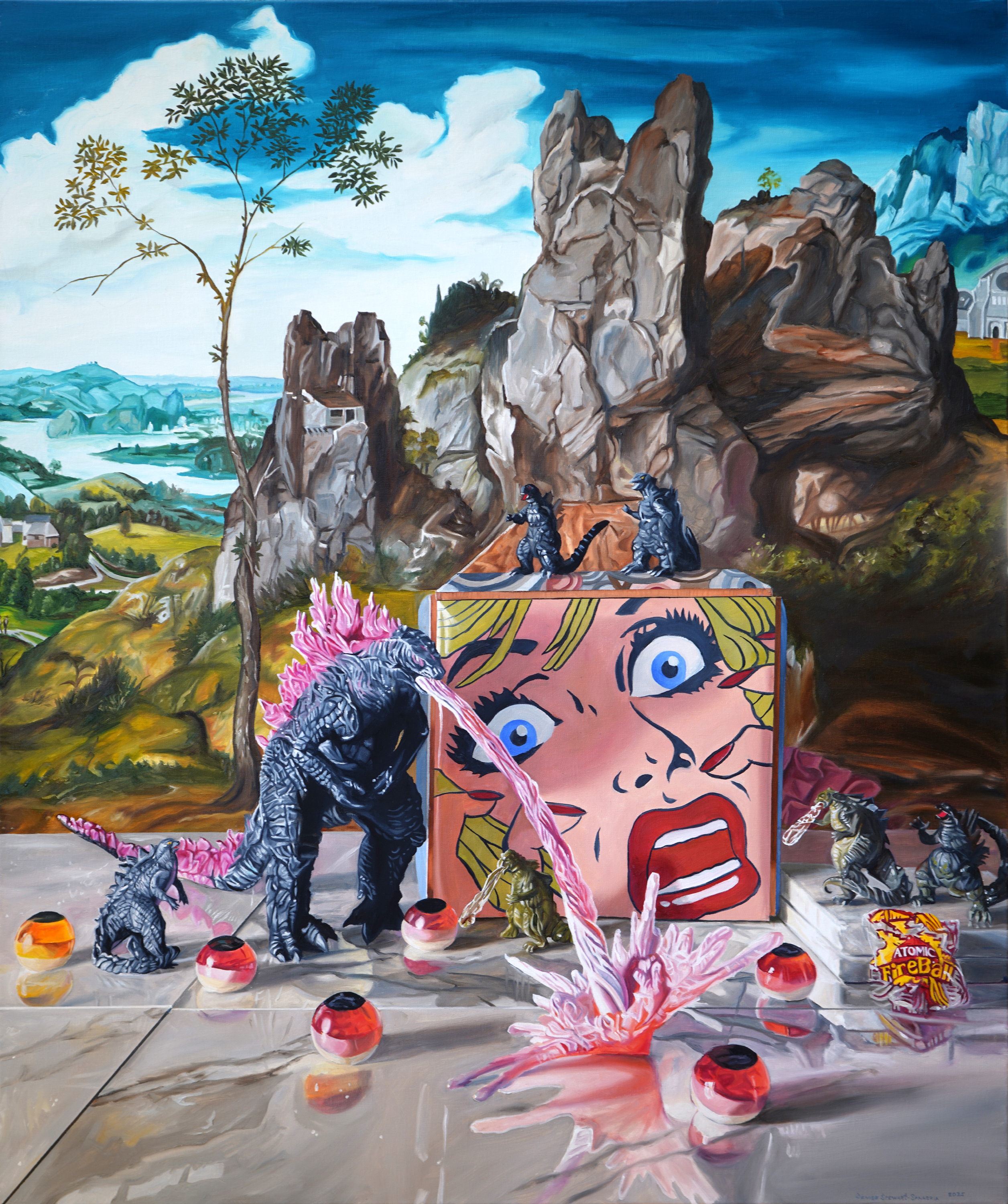
Denise Stewart-Sanabria, Teaching to Laser Blast, 2025, oil on linen, 34” x 30”
WR: I love that Godzilla is as prominent in your work as Marie Antoinette. How important is modern as well as older iconography to the work and do you give preference to personal or universal symbols?
DSS: If they weren’t universal symbols, people wouldn’t get it. Godzilla is 20th century mythology. We saw Tomoyuki Tanaka create it in real time in reaction to the horrors of war. That is how all mythology comes about, I think. People create characters and stories to explain the unexplainable or the traumatic. Certain historic characters become larger than life and are symbols of all kinds of negative or positive attributes. They are all good, and I like to combine them together to see how they interact. How does the past look on the same playing field as the present?
WR: Your work captures a single moment. Whether blurred charcoal or half eaten cakes, how do visual cues play with notions of duration, timelessness, or impermanence within a static image?
DSS: I have no clue, really. If it happens, it happens. If it works, it works.
WR: Whether inside or outside the studio, your process begins with a camera. Does this ever redefine your role to that of a documentarian? Do you ever research people or objects in a visual medium?
DSS: I do document my plywood drawing models when I stalk them and surreptitiously photograph them for reference. They are in galleries, socializing or looking at work. Or their phones, in the last fifteen years. The finished work goes back to galleries to recreate what I document. As for my paintings, I use perishables. It can take a month to finish a huge painting. I have to use photo reference. Then I think of Rachel Ruysch. How the heck did she keep those flowers alive back in the 17th century Netherlands for the time it took to create those elaborate paintings? And the bugs!
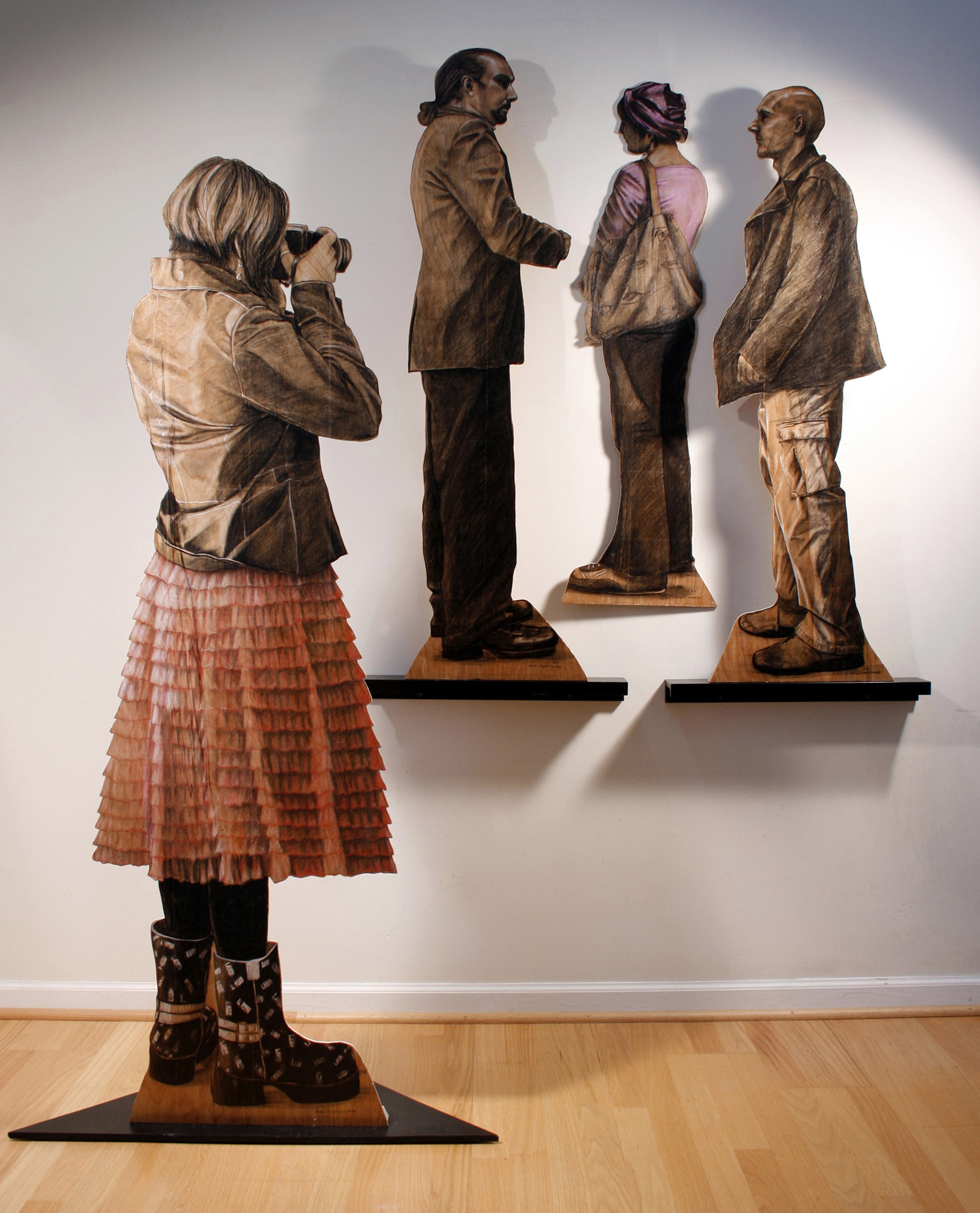
Denise Stewart-Sanabria, Domination Extinction - front view, 201, charcoal and pastel pencil on plywood, 74” x 48” x 24”
WR: I was pleasantly surprised when seeing your drawings on plywood in person. What appeared photographic contained wild lines. In what ways does scale or our reading as an object as human give leeway to very abstract expression? How does playfully erratic line lend towards your understanding of the subject and does this ever emerge into refined oil paintings?
DSS: I’m basically just going along and thinking one area looks good with smudging, but then I figure I want to build it more with hatching. At one point I wanted selective color areas and also used pastels and pastel pencils. I’m fanatical about using line weight. When I cut the plywood out and mount it, it becomes what I call 2.5 D. The line weight feels like I’m already laying into it with the jigsaw. I always want my work to be readable, so I don’t go full core hyper-realist. I grew up where there were tons of John Singer Sargent paintings, and you just can’t stop reading his slashing way of smearing that paint. The viewer becomes involved in the process. It’s open communication.
WR: Does drawing ever feel more like sculpting, especially given the tactility of wood and fluidity of charcoal?
DSS: I wish, but no. I use its rigidity to do multi-layer pieces and to attach objects and mechanical things to some work simply because you can use it to build. Paper has limitations. Stuff can sag or rip.
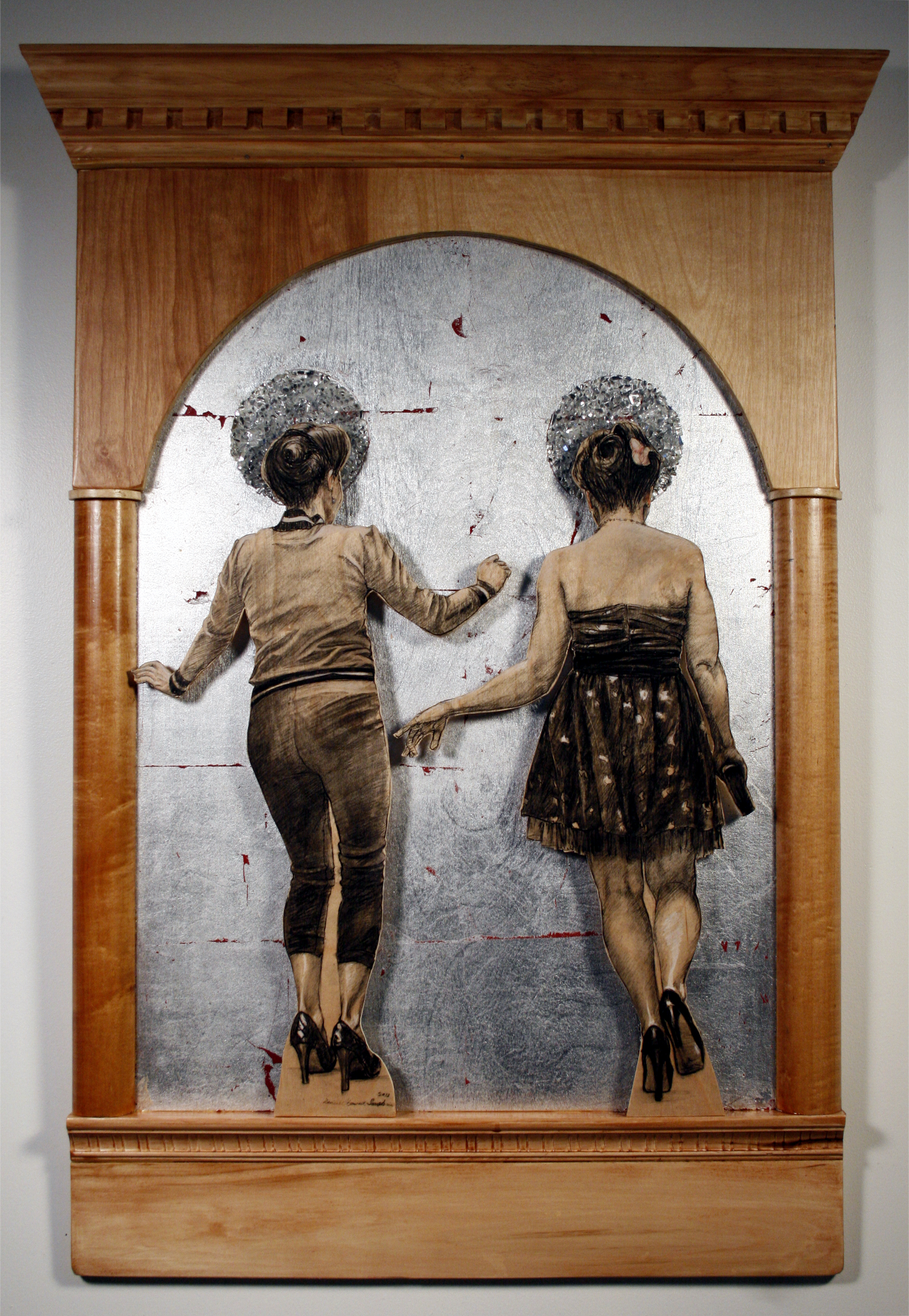
Denise Stewart-Sanabria, Saint Vitus Retro, 2013, charcoal on plywood, silver leaf, mirror shards, hand built wooden altar frame, 40” x 24”
WR: I appreciate how some works read as religious icons. How does a visual language of personal reverence in these works and others redefine familiar subjects?
DSS: I love religious art. I’m not the only artist out there that is a sucker for using halos and stigmata! Five major religions use halos. Where does that originate? I’ll use them for irony, or secular reverence. Using gold leaf makes it even better.
WR: I noticed a work featuring money growing on trees. How do sayings or wordplay influence the driving concept behind a work and what are some inside jokes or personal aphorisms at play?
DSS: That was a commission for a bank. They loan money for people to create businesses with, which will hopefully grow even more money! I’ve done so many bank commissions that I really researched the history of the objects of exchange. I’ve had actual titles come along that force me to come up with a painting. It’s always amusing stuff. Today, after a TN state representative filed legal complaints about Bad Bunny’s performance at the Super Bowl, I’m trying to think how I can conceptualize a piece I can call “Widespread Twerking”.
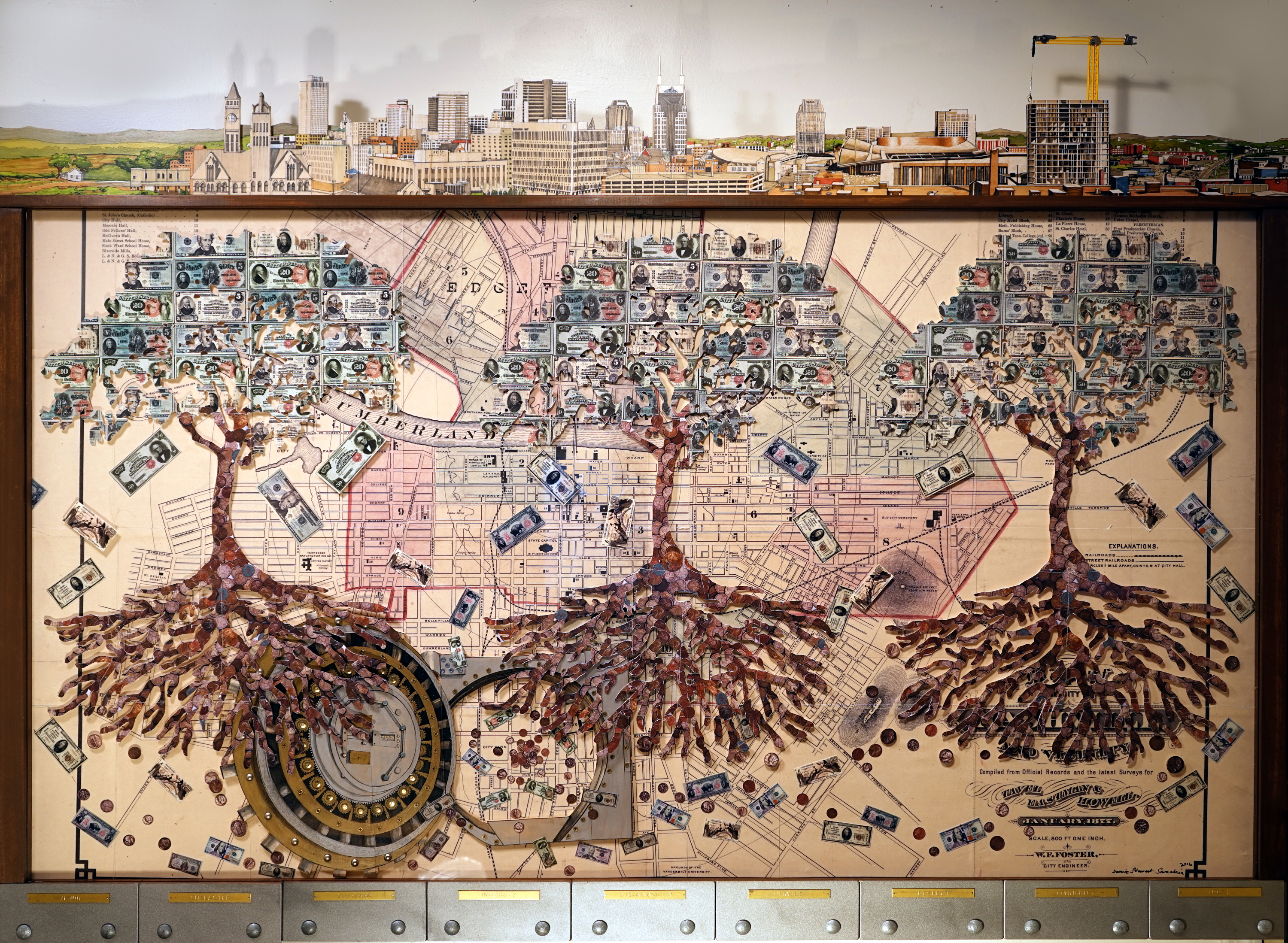
Denise Stewart-Sanabria, Progress of Banking, 2016, cut basswood and ink, archival pigment prints and foamcore, engraved metal, found objects in handbuilt frame, 48” x 72”
WR: How do wallpaper or paintings within paintings subvert traditional notions of depth? How do you leverage flatness or perspective to either sell or dispel the illusion?
DSS: I approach each one using different perspectives. Sometimes the background integrates into the foreground in totally collaborative ways. Sometimes it is just thematic. Sometimes it is pure color theory in one way or the other. I’ve got grayscale backgrounds that I use to contrast with foreground colors in very deliberate ways. I use historic painting backdrops- mostly Rococco, sometimes Bosch, as cultural bridges, and because I can pretend I’m an art forger.
WR: During our studio visit, you mentioned virtual reality. By presenting drawn figures as existing in real space, how do you redefine the galley space as a stage? How does a 3-dimensional setting incorporate viewers into the work or conjure reality?
DSS: My full scale plywood people can stand in the middle of the room on floor mounts or be hung on the wall. With an installation, the horizon line becomes very custom. I have a lot of “shelf people.” They average 40” high, and are mounted in interacting groups on black shelves. The floor mounted, full scale people are often observing them…or ignoring them. Gallery spaces are all different. Some are completely open, some broken up with free-standing island walls. The latter means I need more shelf people. When I install, I try to replicate how people move in a space, but I also like feedback from whoever is in the gallery with me at this time. I’ve gotten great suggestions!
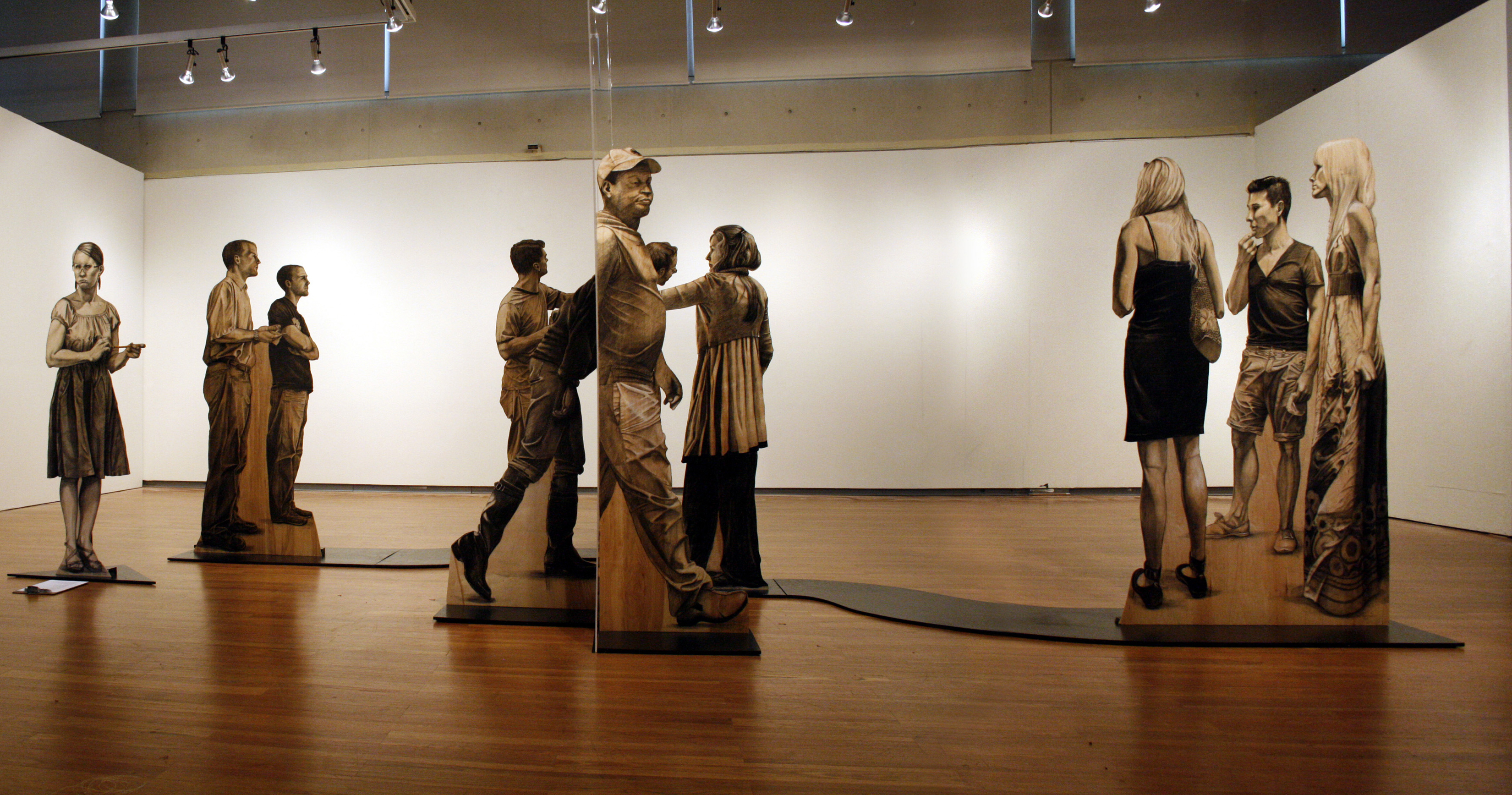
Denise Stewart-Sanabria, Quantum Web - installation view, 2010, charcoal on plywood, plexiglass, 8’ x 8’ x 18’ installation
WR: I appreciate how much you’ve mentioned play, especially considering the detail and rigor of your work. When having fun is typically relegated to expressive, gestural marks, what are ways that you instead experiment through the detailed reality you create. How does your brand of realism embrace your role as “an adult who never puts away toys”?
DSS: I clearly remember how I used space playing with toys when I was a kid. I had a desk with shelves in the back. I’d lay out scenes with troll figures, Ratfinks, dinosaurs, rubber bugs I made with a Creepy Crawler set, and plastic cave men. They would be the backdrop while doing homework. I’m still laying out these scenes, but with mostly adult toys, such as ceramic figurines of humans and animals, art reproductions of characters out of Bosch, Dali and Magritte paintings, and scale models of Greek and Roman mythology figures. I also still have actual toys. Godzilla with pink laser blast, and a T-rex with dragonfly wings are my favorites. There is a toy maker that makes animal hybrids. I need to do something with my Zebra-roo. I make landscapes with produce that I plant into Zingers and cupcakes. I make ponds with pastry glaze with a lot of food coloring. There are companies that make chocolate boulders and pebbles. I try not to eat them. I like to mutilate the cakes that I use to suggest drama and violence. I change things quite a bit on Photoshop afterwards. I add or retract, or re-size objects, and bucket dump different colors. I crop constantly. They all started off as simple culinary dramas, but have become increasingly complex.
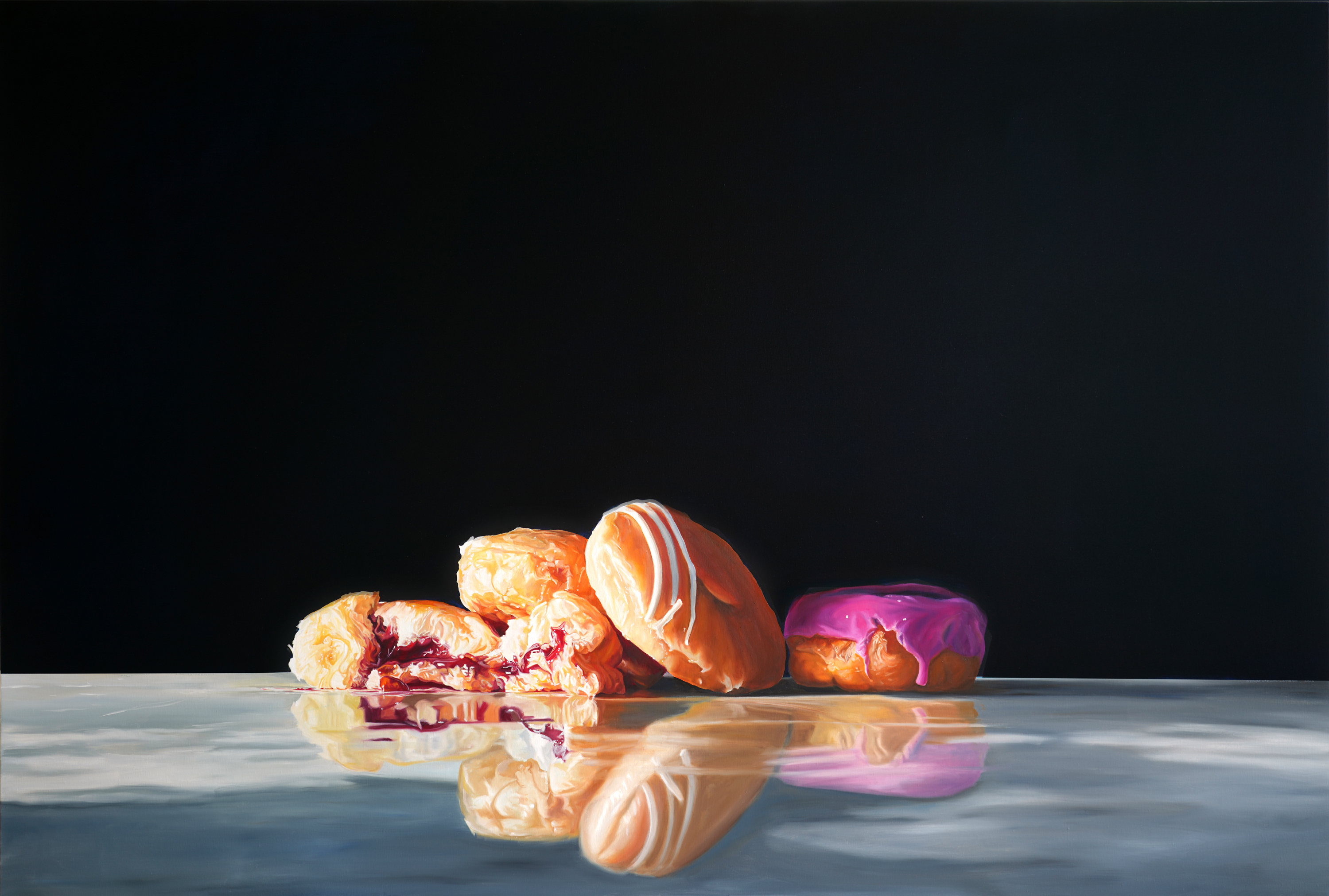
Denise Stewart-Sanabria, Donuts Behaving Badly, 2023, early morning oil on linen, 48” x 72”
Denise Stewart-Sanabria was born in Massachusetts and received her BFA in Painting from the University of Massachusetts, Amherst. She has lived in Knoxville, TN since 1986.
Stewart-Sanabria paints both hyper-realist epicurean dramas of everything from produce to subversive jelly donuts. The anthropomorphic narratives often are reflections on human behavior and history. She is also known for her life size charcoal portrait drawings on plywood, which are cut out, mounted on wood bases, and staged in conceptual installations. She is a recipient of the 2019 Tennessee Arts Commission Individual Artist Grant for her work on wood.
Her work is included in various museums, private, and corporate collections including: The Tennessee State Museum, The Evansville Museum of Art in Indiana, The Knoxville Museum of Art, The Huntsville Museum of Art, Fort Wayne Museum of Art, Notre Dame of Maryland University, Firstbank TN, Pinnacle Banks, Omni and Opryland Hotels, Knoxville Botanical Gardens, Jewelry Television, TriStar Energy, the Atlanta Branch of the Federal Reserve Bank/Nashville office, the Aslan Foundation, The Ayers Foundation, Meta, and the corporate offices of McGhee Tyson Airport.
Wesley Roden is the Program Associate at Tri-Star Arts and received a BFA in Painting from the University of Tennessee, Knoxville in 2023. Based in Knoxville, he currently works in digital and mixed media in a continually evolving practice.
* images courtesy of the artist