Exhibitions
CAITLIN BLOMSTROM, MORGAN OGILVIE & RIPLEY WHITESIDE: SUSPECT TERRAIN
Tinney Contemporary / 237 Rep. John Lewis Way N. April 11 - May 30th
Caitlin Blomstrom, Morgan Ogilvie, Ripley Whiteside
TINNEY is pleased to present Suspect Terrain, a three-person exhibition featuring works by Nashville-based painters Caitlin Blomstrom, Morgan Ogilvie, and Ripley Whiteside.
Suspect Terrain bears reference to a book of creative non-fiction by John McPhee, which reexamines narratives surrounding plate tectonics and the formation of our landscape. Here, the phrase underlines the environmental bent of the three painters included in the exhibition: in some sense, all three make left-field “landscapes” that complicate the ways we represent and relate to our surroundings.
Whiteside takes up the most definitive era of the landscape genre of painting, highlighting the latent arguments inherent to the dramatized vistas of artists such as Claude Lorrain. In depicting a “virginal,” unsettled wilderness, these paintings proffered an idealized vision of prospective colonial projects, lands ready for the taking. Whiteside’s process incorporates styrofoam, a substance as ubiquitous and enduring as it is artificial, which he presses to the surface of each painting, resulting in a gently abstracted, faux-antiquated surface.
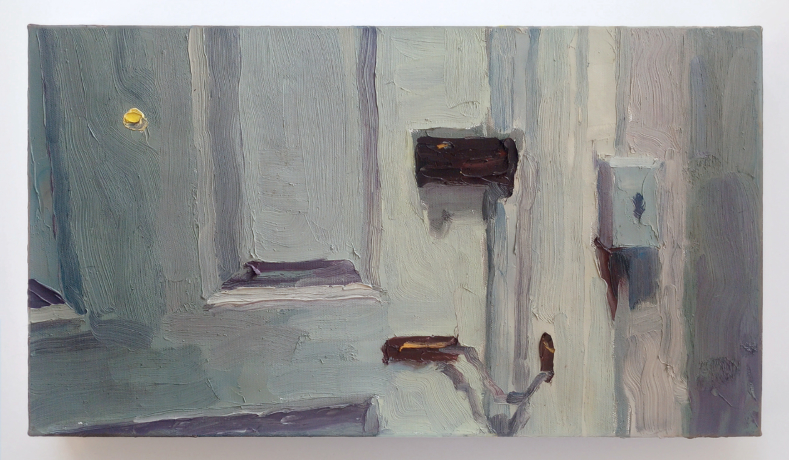
Ogilvie’s brilliant impasto paintings take up two subject matters which differ drastically in size: 7 foot reproductions of the famed Paramount Pictures title card dwarf 6 inch paintings of closed (or slightly-ajar) doors appropriated from horror film stills. Ogilvie’s miniscule thresholds convey a classic anxiety, which, in the context of the artificial, near-mythological, language of the Hollywood set, is hard to separate from natural disaster and precarity, as taken up by Mike Davis’ seminal book Ecology of Fear.
Blomstrom’s plein air practice revolves around the virtue of sustained attention to the minutiae of one’s immediate surroundings, and reads as antidote to a hyperproductive attention economy. Depicting commonplace views, such as the cast shadow of one house onto the vinyl siding of another or the infamous Home Depot 12-Foot-Skeletons that proliferate on suburban lawns every October, Blomstrom balances tongue-in-cheek levity with a realist diagnosis of the mass produced American landscape.
Our environment is relayed to us through various media—through the baroque landscape paintings that preoccupy Whiteside’s technical, painterly riffs, or the carefully manufactured film sets deftly conjured by Ogilvie, or the proliferation of snapshot photography that lends Blomstrom’s hyper-focused plein air paintings their immediacy. By in some way “performing” a labor-intensive reproduction of these genres of images—each constitutive of a vernacular understanding of our environment—each artist challenges how we conceive the world we occupy, and how that world is mediated back to us.