Exhibitions
STEVE KEENE
Tops Gallery at Madison Avenue Park / 151 Madison Ave. October 16, 2026 - April 16, 2027
Steve Keene
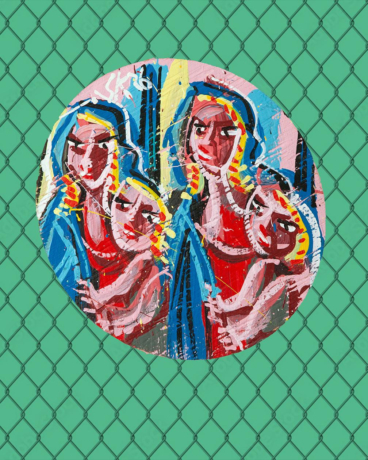
Steve Keene's paintings enter people's lives the way songs do. You didn't necessarily seek them out, they simply appeared, hung in a corner of your friend's apartment, leaned against a bookshelf at a record store, or carried home after a concert. Before you realized you knew Steve Keene's work, you had already seen it dozens of times.
When I first moved to Greenpoint in the final year of the 1990’s, we had a Steve Keene painting hanging in our illegal live/work loft. As I found myself at more and more loft parties, I began noticing them everywhere. Everyone had one. Owning a Steve Keene painting didn’t feel like collecting art, it felt like joining a community. It was something indelibly Brooklyn, a secret handshake, an IYKYK kind of thing.
The apartment you were trying to build a life in was modest, even scary to your parents, perhaps down the street from a sewage treatment plant and sandwiched between a scrap yard and a taxi repair shop. There wasn't much to impress anyone. But everything inside was yours, every record, every book, every chair rescued from the curb, every friend’s print or painting tacked to the wall. The things weren’t expensive, but they were chosen. Together they became a portrait of your values. In that way, Steve Keene was for you. You didn't have to borrow money to buy one of his paintings and they belonged to your taste. What he fixed his gaze upon, somehow you had too. They became part of how you learned to look.
Keene’s paintings are the exact opposite of prints. Each one is singular, handmade, and irreducibly itself. Their value has always exceeded the modest price he has continued to ask for them. They belong less to the capitalist marketplace than to a gift economy of culture, where meaning compounds through experience, friendship, and community.
For my generation, Keene will forever be linked to Pavement. His cover for Wowee Zowee became inseparable from the visual language of the 1990s, our High Renaissance, a moment when records, films, posters, flyers, paintings, zines, and books all seemed to belong to the same conversation.
Back then, we were labeled “slackers,” “lazy,” and “unambitious.” Our ambition wasn't absent, it was just directed elsewhere. Looking back, it feels like one of the most fertile moments for self-expression. There was even the idea of “selling out,” a phrase that only makes sense if there is first something worth protecting. It assumed that art possessed a kind of integrity before it became a commodity, and that integrity mattered.
America has always understood bigger, faster, louder, but it has never quite known what to do with the modest, the small, the intimate, or the handmade except to repackage it and sell it back to us. Maybe that's why the 90s are often misunderstood? All these years later, even those of us who lived through it can't fully explain what it was we were after. We seemed to measure ourselves against what we did not want to be. Like the impulse to make art itself, it resists simple explanation. Maybe that's the point. Steve Keene was at the tip of that spear.
Beneath the casual appearance of Keene’s work lies a radical investigation into painting. His paintings flirt with industrial production, but they can never escape the body that made them. There is enormous confidence in them. Confidence not as in perfection or the sinking-ship heroism of capital P painting, but in momentum. Paint lands exactly where it needs to. Decisions accumulate without fuss or hesitation. Meaning emerges through accumulation rather than refinement. Plywood panels move through his studio in an assembly-line rhythm, advancing from one station to the next, each receiving another color and another mark. Subjects repeat again and again. Here, repetition does not eliminate meaning, it reveals it.
Looking at a group of his paintings together, one begins to think of Rauschenberg's Factum I and Factum II. Two paintings that insist spontaneity itself can be repeated. That apparent sloppiness is not the opposite of intention but one of its most sophisticated forms. Keene extends this proposition across hundreds of thousands of paintings. The remarkable thing is not that the works differ, but how astonishingly similar they remain while never becoming identical. What initially appears mechanical slowly becomes deeply human. The system that promises the neutrality of the machine, delivers the irreducibility of the individual. His studio wasn't designed to eliminate the artist's hand, but to make it radically available.
If you stand in front of ten Steve Keene paintings of the same image something happens. At first, they seem interchangeable, then you begin to notice a brushstroke that carries slightly more paint, an edge that lands a fraction higher or lower, a blue that unexpectedly overtakes a neighboring yellow. The paintings slowly separate into distinct objects. One painting changes the next, then returns to the first. We don't understand the image all at once. We understand it over time. A single painting records a series of moments. Thousands of them record a lifetime. Like painting itself, Keene's work is simultaneously a mirror, a window, and a surface, reflecting the artist, the culture that produced it, and eventually, the person who chooses to live with it.
Keene does not accept the orthodoxy that original art belongs only to the art-collecting class and to ivory tower intermediary institutions. Instead, he proposes that for the price of a concert ticket, you could leave a show carrying home an actual painting, not a poster or a print, but a unique object that had passed through his hands. In a culture that has equated value with scarcity, Keene proposes the opposite, abundance can be generous and original paintings belong in everyone’s everyday life.
– Kevin Ford