Exhibitions
ANNA GREGOR, CHRIS PECKHAM AND BOBBY SMITH: FROM THAT WHICH IS BELOW
Tops Gallery / 400 S. Front St. January 30 - March 28th
Anna Gregor, Chris Peckham, Bobby Smith
“As for the cellar, we shall no doubt find uses for it ... It will be rationalized and its conveniences enumerated. But it is first and foremost the dark entity of the house, the one that partakes of subterranean forces. When we dream there, we are in harmony with the irrationality of the depths.”
― Gaston Bachelard, The Poetics of Space
Tops Gallery is made up of a particular combination of portals and altitudes. Descend into the labyrinthine basement of Memphis’ 400 South Front Street and one arrives at an irregular doorway, formed long ago by a sledgehammer’s route through the cement partition. Once used to store coal, today this corner of the building’s cellar contains decidedly other elements: artworks by Anna Gregor, Chris Peckham, and Bobby Smith find themselves in harmony. Weatherboarded textures, natural elements, and three-dimensional architectures compliment and contradict one another. Concrete foundations double as gallery walls. A window of sorts, a single manhole feeds a shaft of natural light into the space, a projection of weather and movement from above.
Drive ten minutes and one arrives at the gallery’s Madison Avenue Park space, a window vitrine overlooking the sidewalk and street, its inhabitants visible to all those passing by. In contrast to the severe privacy of the South Front Street gallery, this space announces its contents to the public, generous to insomniacs and late-night travelers with its 24-hour glow.
In collecting materials, Bobby Smith looks to the “blood and guts” of buildings. There is the foundation, the structural anatomy, the essential roof and window glass, but oft-overlooked are the likes of insulation, drywall, wood paneling, linoleum. These are things torn out and replaced, whether due to ill-wear or perhaps questionable aesthetics. Smith’s sculptures are constructed from similarly used objects––store-bought is too sterile (“It has no soul,” he says). Teeming with the past lives of their materials, his works evoke pile dwellings. Some feel more occult, resembling coffins or burial scaffolding. Clapboarded, stilted, and forming unlikely chambers, we are invited to peer through windows and around corners. The works act as thresholds, between land and sea, earth and sky, life and decay.
Similarly concerned with thresholds, Chris Peckham’s work examines public and private space, repurposing practical and industrial materials for poetic exploration. The ordinary grows uncanny through its simplicity. The seemingly surreal and perhaps supernatural scene in Snowflakes and Skeleton is secretly mundane. An observation from Peckham’s commute, what is at first glance haunting is ultimately explicable, perhaps even comforting. Similarly, rhythmically lined abstractions strive for order while provoking a sixth sense. Metal abstractions recontextualize industrial elements, while door jamb panels reference Peckham’s past work as a door manufacturer. The spatial ritual of commuting to and from places of production––whether studio, office, or factory––is threaded throughout these works, uniting Peckham’s disparate imagery.
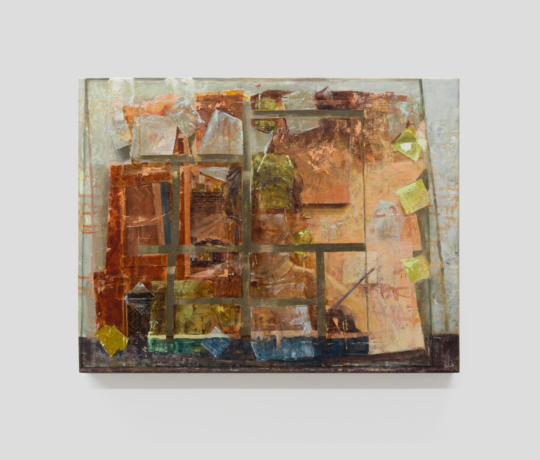
Anna Gregor has long considered painting “a construction site,” an opportunity for the artist and viewer to recycle scraps of––in this case––Western culture. Etching familiar compositions onto gold-leafed mirrors, each painting is born from the reflection of the studio space in the mirror’s surface. Gregor acts as translator, preserving the essential details while communicating new context. The resulting images deconstruct past ideals, projecting their mediated imagery onto present spaces. Proposing new methods for historical analysis, they preserve truth while embracing the inexplicable. Abstraction, emotion, and experimentation exist in conversation with reason.
From that which is below places the physical realities of Tops at its core, considering how private, submerged, or catacombed spaces may be embraced, reimagined, and inhabited by the public. Whether through Gregor’s excavation of history, Peckham’s closed-off rooms and traces of industry, or Smith’s revitalization of discarded elements, the artists share an experimental attitude towards process and a pension for revival. Positioned in conversation with the material idiosyncrasies of the gallery space, the resulting composition proposes alternative pathways and architectures. Darkness offers a clean slate; seclusion clarifies. Like Tops itself, these works ask curiosity of their viewers. Yet at times, not unlike the Park gallery, they compel our attention.
-Maria Owen